
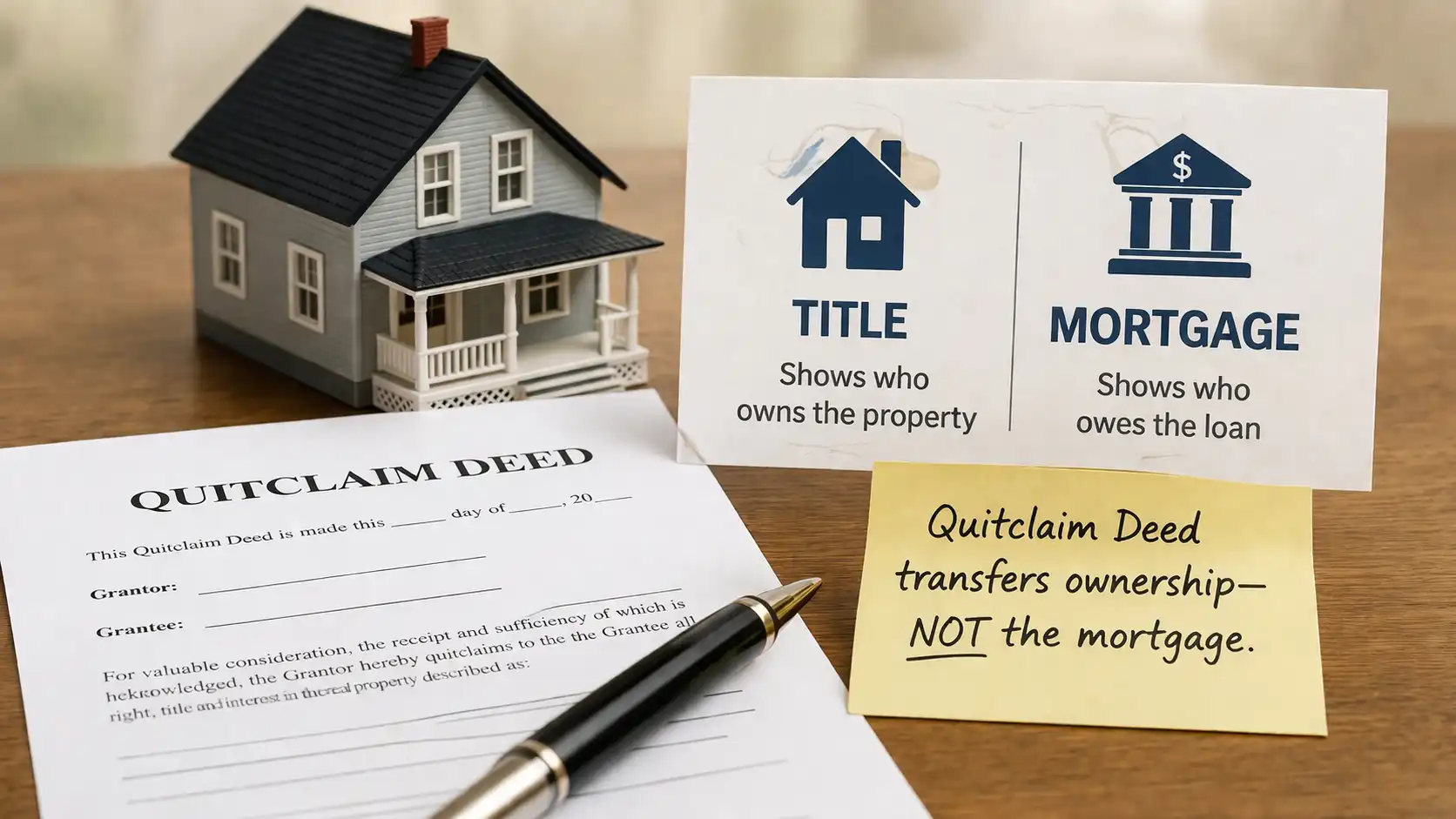
No. A quitclaim deed transfers your interest in the property’s title. It does not change who is responsible for paying the loan. Those are two separate legal instruments, and signing one has no automatic effect on the other.
This distinction trips up a lot of people — especially during divorce, family transfers, or buyouts between co-owners — and getting it wrong can leave someone with no ownership stake but full liability for the debt.
Title and debt are two different things
When you bought the property, you almost certainly signed two different documents at closing:
- A deed, which conveyed ownership of the real estate to you.
- A promissory note (the loan itself), secured by a mortgage or deed of trust (the lender’s security interest in the property).
The deed answers the question who owns this land? The note answers who owes this money? They were created together, but they live in different worlds afterward. The deed is recorded in the county land records. The note is held by your lender. Changing one does not change the other.
A quitclaim deed only operates on the title side of that equation.
What a quitclaim deed actually does
A quitclaim deed transfers whatever interest the grantor currently has in the property — no more, no less — without making any warranties about what that interest is or whether the title is clean. It’s the simplest, fastest way to move a name on or off the title in situations where the parties trust each other and aren’t worried about title warranties: spouses, family members, co-owners restructuring ownership, transfers into a trust, and similar.
What a quitclaim deed does not do:
- It does not pay off the mortgage.
- It does not release the grantor from the note they signed.
- It does not require the lender’s involvement or consent to be valid as a transfer of title.
- It does not give the lender any reason to stop sending statements — or pursuing — the original borrower if payments stop.
If your name is on the note and you sign a quitclaim deed transferring the property to someone else, you have given up your ownership but kept your debt. That’s almost never what people intend.
The due-on-sale clause
Most mortgages contain a due-on-sale clause, which gives the lender the right to demand full payoff of the loan if the property is transferred. This is another reason to think before quitclaiming a financed property: in theory, the transfer can trigger the entire balance becoming due.
In practice, federal law carves out important exceptions. The Garn–St. Germain Depository Institutions Act of 1982 (codified at 12 U.S.C. § 1701j-3; implementing regulations at 12 C.F.R. § 191.5) prohibits lenders from enforcing due-on-sale clauses against several categories of transfers on residential property of fewer than five units, including:
- Transfers on the death of a joint tenant or tenant by the entirety (§ 1701j-3(d)(3)).
- Transfers to a relative resulting from the death of the borrower (§ 1701j-3(d)(5)).
- Transfers where the spouse or children of the borrower become an owner of the property (§ 1701j-3(d)(6)).
- Transfers resulting from a divorce decree, legal separation agreement, or incidental property settlement, where a spouse becomes the owner (§ 1701j-3(d)(7)).
- Transfers into an inter vivos trust in which the borrower is and remains a beneficiary, where there is no transfer of rights of occupancy (§ 1701j-3(d)(8)).
These protections cover many of the most common reasons people use quitclaim deeds. They do not, however, address the underlying loan obligation. The transfer is allowed; the debt stays put.
It’s also worth noting what isn’t on this list. Transfers into an LLC or other business entity are not exempt under Garn–St. Germain and can trigger the due-on-sale clause, even when the underlying ownership is unchanged. Owners restructuring rental property into an LLC should get lender consent in writing rather than rely on a quitclaim and hope.
How you actually get off the mortgage
Only the lender can release you from the loan. There are four typical paths:
Refinance. The new owner takes out a new mortgage in their name, the old loan is paid off, and you’re done. This is by far the most common solution in divorce buyouts and family transfers — and it’s clean, because once the old loan is satisfied, the original note is no longer in play. The catch is that the new owner has to qualify on their own, at current rates.
Loan assumption. Some loans are assumable, meaning the lender will allow another qualified borrower to take over the existing note. VA and FHA loans, in particular, are generally assumable subject to the lender’s creditworthiness review and the program’s specific requirements. Conventional loans usually aren’t, but it’s worth asking. An assumption typically requires the new borrower to qualify financially and pay an assumption fee, and crucially, it should include a release of liability for the original borrower — without that, the loan has been assumed but you are still on the hook.
Release of liability without refinance. Less common, but some lenders will release a co-borrower from a loan if the remaining borrower can demonstrate they can handle payments alone. This is more often available with government-backed loans than conventional ones. Ask the servicer in writing.
Sale of the property. Selling and using the proceeds to pay off the mortgage ends the obligation for everyone on the note.
If none of those happen, your name is on the loan until the loan is paid off — even if your name is no longer on the title.
The divorce scenario, specifically
This is where people get hurt most often. A divorce decree might award the house to one spouse and require the other to sign a quitclaim deed. The deed gets signed, the title transfers, and the moving spouse believes they’re done.
They aren’t. The divorce court can order one spouse to take responsibility for the mortgage between the parties, but a state court order does not bind the lender. The lender wasn’t a party to the divorce and isn’t required to release anyone. If the remaining spouse misses payments, the credit damage hits both names. Foreclosure hits both names.
A divorce settlement that addresses the house should require the responsible party to refinance within a set window, and should specify what happens if they can’t.
Before signing
If someone is asking you to sign a quitclaim deed on a financed property, three questions are worth answering first:
- Who is on the note? A copy of the closing documents will tell you.
- What’s the plan for removing you from the loan? Refinance? Assumption? On what timeline?
- What’s the backup if that plan fails? A reversion clause, a forced sale provision, something enforceable.
A quitclaim deed is a useful, efficient instrument for transferring title between trusted parties. It is not a tool for getting out of a mortgage, and it was never designed to be one.
Deeds.com provides state- and county-specific quitclaim deed forms for all 50 states, prepared to meet local recording requirements. We do not provide legal advice; for questions about your specific situation, consult a licensed attorney in the state where the property is located.