
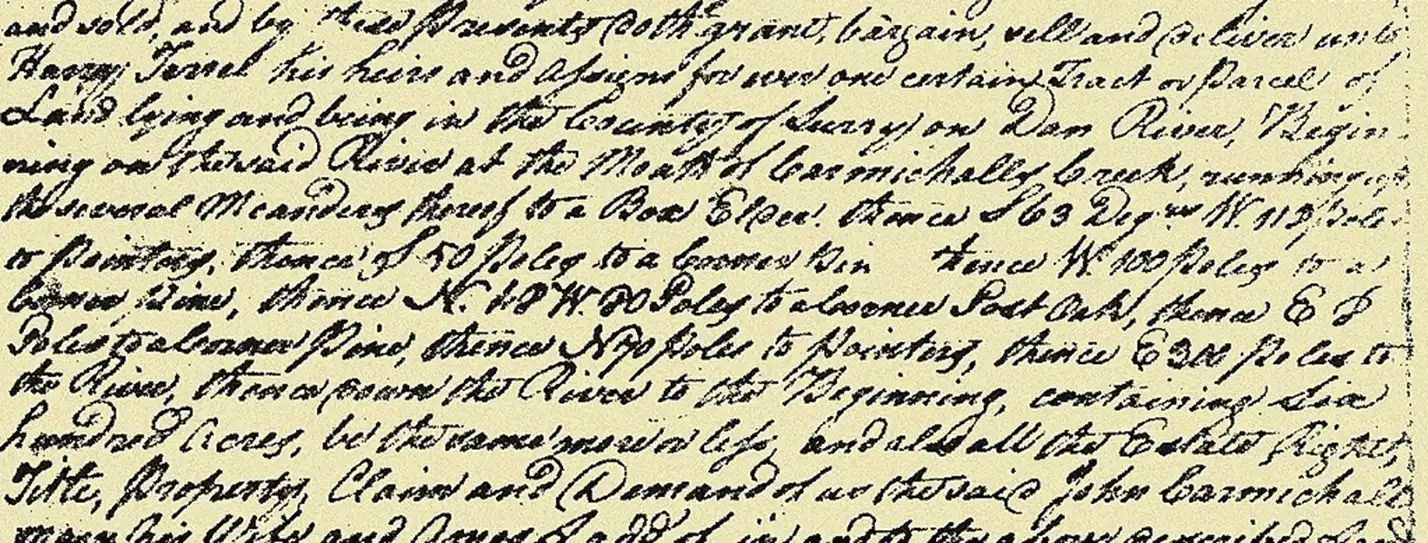
U.S. history can be traced through generations of property deeds. Embracing that knowledge, many deed recorders’ offices are working behind the scenes to preserve deed books.
The books contain old plat maps, mineral rights records, and the deeds to homes — thousands upon thousands of beautiful, handwritten documents.
Handling East Texas Deeds With Care
Upshur County has a fully digitized office of deed records. Deeds and maps, recorded rights and claims from the early days in East Texas — they’re all indexed, and fully searchable online.
But what about the stuff that’s old and papery, dating all the way back to the early 1840s? It’s about time these old books receive the respect they deserve. Some of them have done time in the old county courthouse jail!
But now, they lead a cushier life. This is because the county recently paid more than $100K to create a record storage building. And now, with the restoration of the Upshur County Courthouse due for completion in early 2026, books will have dignified space to spend the years ahead.
The environment will be safely maintained. To keep books in good shape over generations, the relative humidity must not go above 55%, or drop below 30%. Temperatures should be kept below 75F. “Even slight changes in temperature can double the natural aging rate of paper,” according to restoration experts at Dallas-based Kofile, Inc. “Red inks smear first, then blue inks, and lastly, black inks.”
Upshur County Clerk Terri Ross told KLTV news viewers about the preservation task. A reporter gently turned the pages of an older book filled with beautiful cursive writing. The books created in later years are typewritten.
It will cost $3,000 to $5,000 per book (some have around 200 pages). The complete preservation project would cost about $51K, as quoted in July 2025 by Kofile.
The work started off with a shipment to Kofile’s restoration lab, where each restoration is a months-long job. Each volume is then kept in an acid-free sleeve, and bound in materials that resist fire, water, moisture, and the effects of time.
Meanwhile, in Grant County, Oregon…
In Canyon City, Clerk Laurie Cates has begun the work of restoring old books full of deeds. The goal is to have a collection of restored history that all may explore. The earliest deeds were created in 1864.
Grant County Court held a meeting in November, where Cates said the spiral-bound, original deed index was coming apart on account of age. Cates did some looking into archive and book restoration options in the area, and zeroed in on an Oklahoma company named Sutterfield Technologies.
A restoration expert from Sutterfield Technologies visited Canyon City and examined the courthouse documents. The quote to preserve the full collection came in just below $8,000. Work on an early group of documents was scheduled.
The county packed the documents into containers, locked them, and shipped them off to Oklahoma.
The restoration experts did their magic. Two volumes were created out of the original book. (The process of covering restored paper in clear sleeves makes the books bigger.) Cates told the Blue Mountain Eagle these newly preserved deed books will last another 500 years. And during the restoration process, book pages were scanned, so Grant County would get digitized copies as well.
The county has five more books of deeds in need of preservation. Books bound with string will be the costliest to restore. In the interest of finances, the county has selected books with clean pages for rebinding first.
Rockingham County, Virginia Spruces Up Its Law Library
The Rockingham County Circuit Court has put a $21,446 grant from the Circuit Court Records Preservation Program to good use. The money has enabled the restoration of four books full of deeds dating back hundreds of years. This is part of $1 million in grants from Virginia that the Rockingham County Circuit Court has tapped for the maintenance of its historical library.
The county chose Kofile, the Dallas book preservation company, to carry out the latest batch of work. Most recently, the county clerk’s office has overseen the repair and fortification of:
- An 1815 burnt deed book.
- An 1878 land records volume.
- Property tax records going back to 1812.
Researchers, historians, and the public will now be able to explore the historical volumes kept at the law library at Rockingham County Circuit Court.
Here again, the pages were scanned and digitized as they underwent repair and preservation. All pages now have high-resolution copies available for public searches. Meanwhile, the preserved original books provide a window to the past, so that the public can explore the history of households and the way Harrisonburg, Virginia and surrounding towns developed over the generations.
The Art of Preservation: What It Takes to Save Our Deeds
In the past, paper makers bleached pages white. Bleached paper becomes acidic — resulting in brittle pages that turn yellowish. Inks fade over time, especially when exposed to sunlight.
When documents are handled during ordinary business, pages pick up natural skin oils and dirt. Tape, adhesives, and laminates will stain paper and cause the ink to blur. Leading to cover damage over time are any metal materials in book spines, as well as clips and staples.
The experts take the binding materials apart with extreme care. A sheet’s binding margin is delicate, and must be treated through a special process called encapsulation. Kofile does not use guillotine cutters to separate book pages. Any necessary trimming is done with handheld shears made for delicate paper, one sheet at a time to make sure no text is cut.
Kofile removes adhesives and fasteners that cause punctures, distortion, or rust. Heat is applied to remove old adhesives that cannot be peeled off. Solvents are a last resort. Surfaces are cleaned using purpose-built tools.
Deacidification happens in spray exhaust booths using a magnesium oxide solution. Bent pages are flattened in the company’s Ultrasonic Humidification Chamber. Mending torn paper, explains the company, is an art form.
Title stamping follows the same format of the originals, with any modifications to be approved by the deed recorder’s office.
Binding can be sewn, or created with posts. The pages, encased in Mylar® sleeves by hand, will reinforce the binding edge of the finished book.
Believe it or not, all of the above work is reversible. But we doubt the county deed recorders will want to reverse anything. Kudos to these diligent officials for treating the people’s historical deed documents with care.
Supporting References
Andrew Culver for ABC Channel 7 (KLTV in Gilmer, Texas): Upshur County Working to Preserve Historical Deed Books Going Back to the Early 1840s (Sep. 15, 2025).
Justin Davis for the Grant County Blue Mountain Eagle (Grant County, Oregon): Preservation Breathes New Life into Grant County Deed Books (published Nov. 8, 2025 by the EO Media Group).
Mair Famet for WHSV-TV (Gray Local Media Station in Harrisonburg, Virginia): Rockingham County Circuit Court Preserves History (Jan. 23, 2025). See also Rockingham County, Virginia: Online Records Information.
Proposal for work for the Upshur County Clerk, from Chris Finch of Kofile Technologies, Inc. (Jul. 24, 2025).
And as linked.
More on topics: Ohio’s county deed recorders to start digitization, Deed records go digital in Delaware County, Pennsylvania
Banner image from Wikimedia Commons: Legal property deed from year 1784, copied on microfiche from the original at Surry County, North Carolina; Book C, p. 110; licensed under CC BY-SA 4.0 International.