
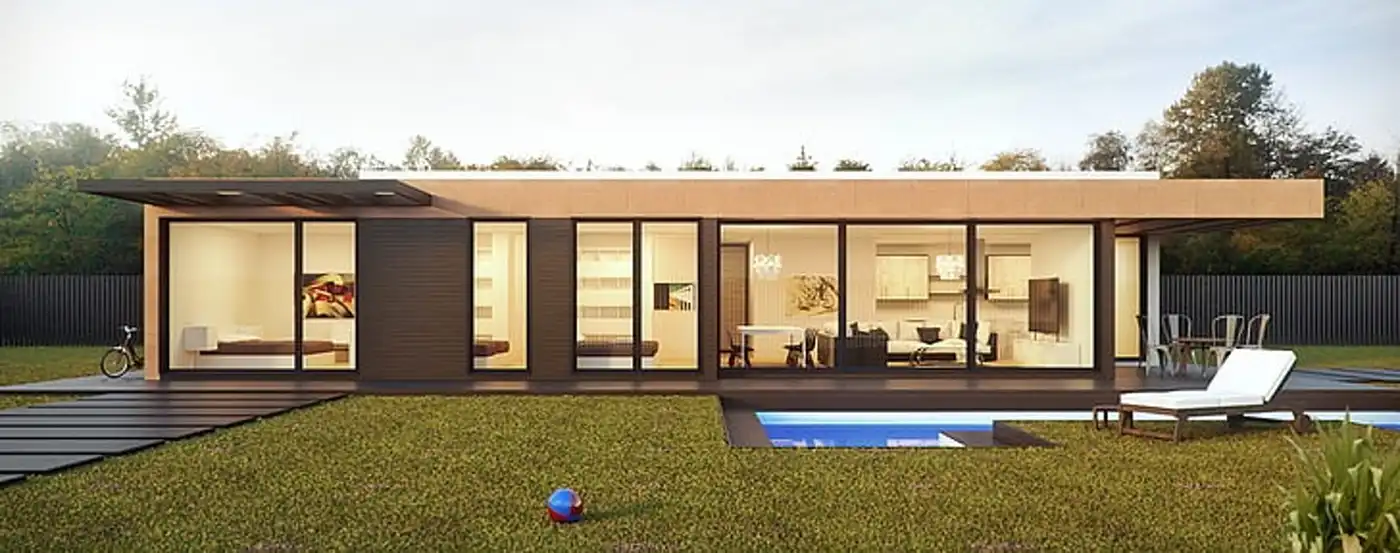
It’s a question on many minds, especially now, with the federal Road to Housing Act opening new opportunities for manufactured homes. Some current deed holders are thinking of switching to a low-maintenance prefab home well before they need to, just to make life easier. The whole idea was even covered in The New York Times recently. Here are the pros, cons, and deed considerations.
Prefabricated homes offer efficient timelines. Manufacturing improvements have made these homes as strong and enduring as homes built on-site. Knowing all this, our readers might want a general idea of what’s to like (and what to look out for) when downsizing to a prefab home.
Your first question might well concern whether you’ll own the land under your prefab home.
Benefit of Having a Deed to Your Land
Land value tends to appreciate. So do well-built prefab homes. Having a deed helps the buyer build wealth rather than shift it to a landlord.
And there’s less stability when renting the land. Rents can go up and almost never go down. A landowner could sell at any moment.
Buyers who rent land face these risks even when they own the homes on it. Manufactured housing communities are owned by some of the largest U.S. private equity firms, including Apollo Global Management (Inspire Communities), Blackstone (Treehouse Communities), and The Carlyle Group, according to the Private Equity Stakeholder Project’s tracker.
So, choosing to buy a prefab home where you can own the land matters. It also means buying a prefab home won’t be a whole lot cheaper than buying a home that’s built on-site. That’s because land tends to be expensive.
Buying a home with land can help you qualify for the favorable terms of a regular real estate mortgage. For a manufactured home loan to meet Fannie Mae’s requirements, the home must be titled as real estate rather than as a vehicle. Refer to Fannie Mae’s new titling requirements for manufactured homes by state so you know the standards, wherever you might be buying.
Converting a manufactured home from personal property to real property generally follows one of two approaches:
- For a manufactured home, many states require a document similar to a deed of conveyance, often a certificate of title. Where this is required, says Fannie Mae, “it generally must be applied for and then cancelled in order to title a manufactured home as real property” for a mortgage. Speak with your mortgage consultant for further guidance.
- Some states don’t require a certificate of title for a new prefab home that’s permanently fixed to the land. These states generally require an affidavit of affixture.
Next, lenders should record the mortgage lien with a description of the manufactured home. The legal description should state the home’s make, model, and vehicle identification number (VIN). It should also state that the home “is permanently affixed and attached to the land and is part of the real property.”
The Various Types of Prefab
Prefabricated homes are made partly or fully in a factory. They’re precision-made and have excellent insulating properties.
They’re trucked to the site. To handle that, they are extremely strong. Factory-made homes benefit from quality control in the factory and protection from the weather during construction.
Off-site construction produces several types of homes.
Mobile Homes
The preferred term these days is manufactured homes. These are simply portable homes, manufactured to meet the federal code. Local zoning has to be written to allow them.
The new federal law is ending the rule that says a manufactured home must be built on a permanent chassis. Watch for increasing acceptance of affordable manufactured homes.
Modular Housing
This type of home is manufactured off-site in sections and then trucked to the site and assembled. These can be elegant custom homes, affordable homes, homes with accessibility features, or accessory dwelling units. (In New York City, ADUs are receiving support and pre-approval now!)
Full modular homes can be bought for significantly less than the price of regular homes, even with utility installation costs included.
The sections are brought to the site, connected, and fixed to a concrete foundation. They’re generally very energy-efficient. They’re also made to meet state codes and local building and zoning requirements. On that note, the new federal law calls for getting rid of extra hurdles for factory-built homes. What’s coming next? A uniform standard for all state and local modular building codes.
Panelized Housing
With this type, walls are made in a factory, then moved to the construction site.
Like modular homes, these strong, watertight homes can have one or two stories. They can be assembled in just days, and construction can be complete in six months.
Structural insulated panels (SIPs) are highly cost-effective and weathertight, with impressive insulation power.
The above categories can overlap. For instance, modular or panelized homes can be located in mobile home parks.
For any prefab home, unless it’s in a mobile home park or co-op, groundwork must be done on the site in advance. The company will need to plan out the transportation logistics. The home needs a foundation completed a few weeks in advance. It needs an accessway and entrances. It needs utility systems and hookups. The home itself can be assembled in a day. Then a local contractor can create the interior, porch, and garage. When the work is finished, expect a home that looks like a regular new house. Single-story construction with a patio or garage built on-site can have advantages in cost, time to build, time needed for upkeep, and weather resistance.
Where to Find These Homes
They’re in mobile home parks. You can have them installed on a site you have vetted for the purpose.
As an example, Fast Company tips its hat to LifeArk’s eco-friendly, prefabricated housing, which can be shaped to suit the buyer and placed on lots of any size. Recyclable components are prefabricated into modules.
Dvele is one of the better-known names in the business. One to compare is Bensonwood, which offers a guide to energy-efficient construction.
Huntington Homes of Vermont (also serving Maine, New Hampshire, Massachusetts, and Connecticut) has been producing modular homes since 1978. And Champion/Skyline®’s history is clearly a point of pride.
Please note that we have no affiliation with these companies. These are simply examples, and we urge you to research what’s available as part of your own due diligence.
Be sure to work with a well-seasoned business. It’s good to choose a firm that knows and works in the area you want to live in. A good contractor will know how to navigate both state and local rules.
For new construction, it’s a good idea to have an architect work with the plans. Consider the types of plumbing, electrical, exhaust, insulation, and HVAC systems and amenities you’ll want to have. Include radon testing in your preparation.
Some Considerations for Picking a Location
If you’re buying land for your home, know what you’ll be getting well before the installation begins. Know what you’re looking for. Affordability? Or a simpler and better life as you get on in years?
Learn about the area and its zoning. Talk with people there. Meet the local leaders. And check out some homes installed by the firm you’re considering. Find out if the place is subject to a homeowners association of any kind.
If you’re looking to reduce car dependence, consider what’s walkable and accessible by public or shared transit. On a related subject, your home may need accessibility features. The ability to customize a prefab home’s floor plan and interior design can be most helpful.
In some cases, older adults are perfectly happy not owning their land, so we need to give this a mention. There are age-restricted properties in which the homes are owned as personal property, but the senior residents hold shares in the mobile home park. These are co-ops or nonprofits. Individual households may pay monthly dues to their community, a share of the property tax, and a minor tax on personal property. The homes are designed with seniors in mind, with truly accessible interior features, plus shared amenities and activities on offer.
Whichever style of arrangement suits their lives best is the “right” way for deed holders to downsize.
Supporting References
Jill Terreri Ramos for The New York Times: Ask Real Estate – I’m Looking to Downsize. Is Prefab Housing the Way to Go? (Oct. 17, 2026).
Fannie Mae: Titling Manufactured Homes as Real Property.
Image credit: Royalty-free, licensed by PickPik.