
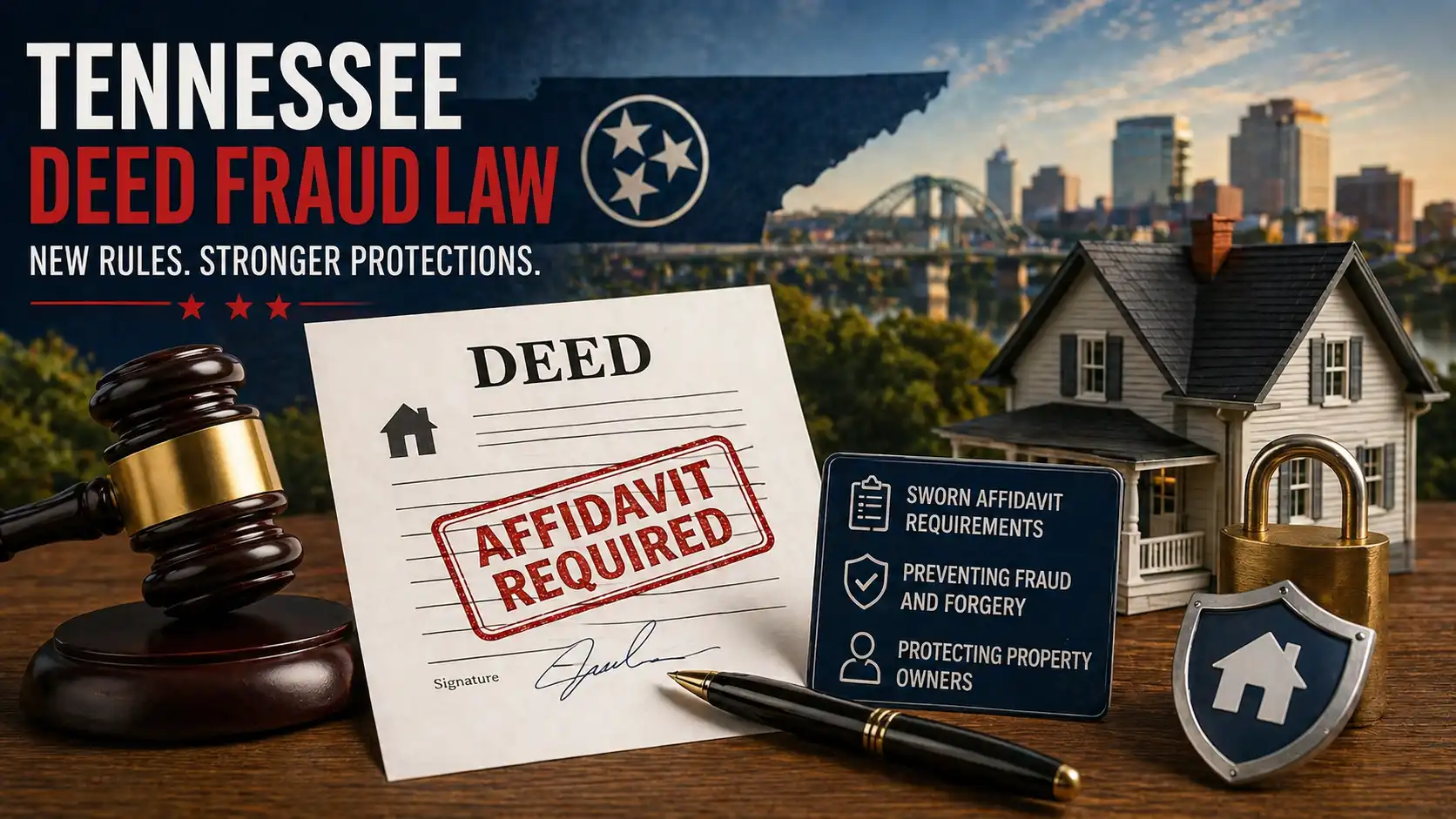
If you hang your hat in Tennessee, watch out for a potential law that changes the way deeds are submitted and verified. Somebody nearly stole Elvis Presley’s Graceland home in Memphis through deed fraud. Brent Taylor, a Republican State Senator in Memphis, says such activity is what lawmakers want to “put a stop to.”
When House Bill 1762 becomes Tennessee law:
- The property owners will still be able to create and submit deeds, but must submit a sworn affidavit confirming they prepared it.
- If it’s not the owner who is filing the deed, Tennessee will require the deed to have been prepared by a lawyer or title insurance agent licensed in the state, or a person authorized to represent the owner, using a sworn declaration.
So, deed preparers will be signing sworn affidavits confirming their legitimacy.
Government agencies are exempt from the new rule. So are financial institutions that have a secured interest (such as a mortgage) against the property’s value.
What the Affidavit Will Contain: The Law Lays It Out
A “sworn declaration or notarized affidavit” must say (not necessarily verbatim, but substantially):
I hereby swear or affirm that I prepared the attached deed of conveyance and that I am an attorney currently licensed in Tennessee [supply Bar number], a title agent currently licensed in Tennessee [supply license number], or an actual owner of an interest in the property that is the subject of this deed.
The new requirement takes effect for deeds prepared on or after July 1, 2026.
Lawmakers called the bill a safeguard and hope it acts as a powerful tool to help screen out fraudulent and unauthorized filings. Recording officials will turn away deeds that don’t comport with the new rule.
You might wonder: Don’t deed recorders turn people away already if they can’t verify their identity or a filing looks somehow suspicious?
Well, up until quite recently, that would have been unusual. Traditionally, the role of a deed recorder was to check that the document met formatting and procedural standards—nothing more.
The more high-tech society becomes, the more bad actors exploit traditional systems. Once they pass off a deed transfer, criminals can sell, borrow against, or rent out properties. They can even evict legitimate occupants.
Now, states across the nation are beginning to let county officials check IDs. That could help stop forgeries. It could also spare innocent deed holders and heirs from having to fight in court for their stolen homes.
Some title companies offer an extended title policy that covers identity theft and falsified deed transfers. Ask when buying or refinancing. Title coverage (not the same as homeowner’s insurance) calls for the insurer to resolve title problems in court.
What Happened to Graceland?
In 2024, Lisa Jeanine Findley was arrested for an alleged scheme to defraud Elvis Presley’s family of assets—including the deed to Graceland in Memphis, Shelby County. Elvis Presley’s Graceland home became a museum celebrating the star’s life. People visit the place in the hundreds of thousands annually.
Findley faced charges in a federal court near her home in Missouri. The criminal counts included mail fraud and aggravated identity theft.
Findley was charged with manipulating legal documents in multiple ways:
- Posing as three different representatives of a fabricated company, Naussany Investments.
- Falsely asserting that Elvis Presley’s late daughter had pledged Graceland to obtain a loan from the Naussany company.
- Forging the signatures of Elvis Presley’s late daughter and a Florida notary on fabricated loan documents, then filing claims against the Presley estate in a California court.
- Filing a falsified deed of trust in the Memphis deed recorder’s office.
- Demanding a $2.85 million settlement from the Presley heirs.
- Having a fraudulent foreclosure notice printed in the newspaper, announcing that Naussany Investments would auction off Graceland when Presley’s family wouldn’t pay the $2.85 million.
A judge called off this bizarre foreclosure sale. Not surprisingly, international media picked up on the story. And at that point, it started taking another bizarre turn. The suspect said the entire scheme had really been orchestrated by an identity hacker based in Nigeria.
In 2024, postal inspectors and investigators from multiple FBI field offices finally brought the manipulations to a halt. And last year, Findley got nearly five years in federal prison for mail fraud.
You Don’t Need to Be a Rock Star’s Heir to Be a Target

Dozens of cases have been arising in Tennessee annually. They often involve falsified signatures and notary stamps.
Late last year, a caregiver at a Memphis elder care site managed to get named as power of attorney for a patient, then created a quitclaim deed for the patient’s home, had it notarized, and filed it in the county. Shocking? Senior citizens—and even homes belonging to dying and dead people—are often targets of quitclaim fraud. There’s a lot of equity in their homes. And some of those homes are left unwatched, so no one is checking the mail for unusual notices of claims.
Recently, a Tennessee deed filer and a notary were caught; their target was in hospice care. A probate court voided their bogus quitclaim deed and appointed a relative as the patient’s representative.
Does this mean quitclaim deeds are dangerous? Only in the wrong hands. Quitclaim deeds can be abused more easily than deeds that come with title searches, like warranty deeds. But they work well in honest transactions that pass homeownership between relatives or co-owners, when one wants to give or release ownership to the other.
Shelby County Register of Deeds Willie Brooks has made media appearances to talk about deed protection. Shelby County’s Fraud Alert system alerts people within 24 hours about new recordings on their deeds. Thousands of Memphis-area households have signed up. An alert prompts the recipient to take a look at the records, and call law enforcement if needed. Wherever you live, it’s a good idea to sign up for these alerts in counties that offer them.
Thanks for reading, friends. And as Elvis would say,
‘Til we meet again, may God bless you. Adios.
Supporting References
Amendment to Tennessee Code Annotated, § 8-13-108(a); adding a new section 66-5-111 to Title 66, Chapter 5, and a new amendment to § 66-24-101 enabling recorders’ offices to reject deeds that do not comply with the new rule.
U.S. Department of Justice Office of Public Affairs, via Justice.gov: Press Release – Woman Charged For Scheme To Defraud Elvis Presley’s Family (dated Aug. 16, 2024; complaint updated on Feb. 6, 2025 by the Financial Fraud Components Criminal Division, USAO – Tennessee).
Tori Gessner for WKRN Nashville, via Yahoo News: Tennessee Lawmakers Pass Bill to Crack Down on Real Estate Fraud Following Graceland Case (Apr. 10, 2026).
AP / CBS News: Woman Who Tried to Sell Elvis Presley’s Graceland Sentenced to Over Four Years in Federal Prison (updated Sep. 23, 2025).
Deeds.com: Register of Deeds Blasts Crooks Who Steal Homes Out From Under Owners’ Funerals (Apr. 17, 2024).
Deeds.com: Home Buyers, Cover Your Assets – Choosing Between Standard and Extended Title Insurance (Dec. 11, 2020).
And as linked.
More on topics: Seniors targeted for real estate fraud, Protect seniors from deed theft, New York makes deed theft a crime
Photo credit: RDNE Stock Project, via Pexels/Canva.