

Buying a home? Downsizing into a condo community? Maybe you’re acquiring a deed for the first time in many years. And you’re thinking of how your deed will eventually transfer your new home to loved ones.
The way you vest ownership with your deed supports your goals. Be ready when the title company poses this question.
The Main Ways Seniors Hold Title to a Home
The most common ways seniors hold title to real estate include:
- Sole ownership — one person owns the property alone.
- Joint tenancy with right of survivorship (JTWROS) — ownership automatically transfers to surviving co-owners.
- Tenancy in common — owners hold separate shares that can pass to heirs.
- Revocable living trust — the property is owned by a trust and transferred according to trust instructions.
- Transfer-on-death (TOD) deed — names a beneficiary who receives the property without probate.
Each option has different implications for probate, inheritance, and control of the property.
Sole Ownership: Holding Title to Property Alone
You alone are named as owner on the deed. This works for solo seniors.
Pros: Sole ownership is the simplest form of title holding. Your property isn’t subject to a co-owner’s debts. There are no other owners who must sign when you want to sell or refinance—the decisions are all yours.
Cons: Naming only yourself means no one has survivorship rights. The probate court will distribute the property, ideally in accordance with a will you’ve kept updated and easy to find.
Can a solo owner avoid probate? Yes! See our section on living trusts below.
Where available, the transfer on death deed is a relatively simple form for designating a beneficiary who will automatically receive the property—no probate. The owner must sign, notarize, and record the deed. (The insurer needs to know the TODD exists so your beneficiary will need to be a named insurance beneficiary when you pass.)
Joint Tenancy: Ensuring Survivorship
If you specify on your deed that you co-own the home as joint tenants with right of survivorship (JTWROS), then you share the property equally, and together.
Pros: JTWROS bypasses probate. When one co-owner dies, the share that belonged to the deceased now belongs to the survivor(s). This form of titling is a simple way to distribute property. It is popular among married and unmarried couples.
Cons: Co-owners with blended families must use caution that their heirs aren’t overlooked when a new spouse is the surviving owner. The survivor needs to remember to do estate planning, or the property will still be going into probate eventually.
Tenancy in Common: Can Be Unequal Shares
People named as tenants in common on the deed can co-own 50-50%, or different percentages. This form of vesting the title can work for friends who each want their own share of the property. This is different from owning the home together and automatically passing the value to one another upon death (see above).
Pros: Each person’s share can be transferred or willed to whomever that owner selects. This allows each senior to designate their own beneficiary. Each owner may sell their own share.
Cons: When one co-owner dies or sells to a third party, the surviving one may end up with new co-owners.
Moving to a community property state? Dig into what this means for property that spouses consider their own, separate assets. Learn more about community property at Deeds.com.
Leaving Nothing to Chance: Quitclaiming Into a Revocable Living Trust
Avoid the public probate process and maintain your privacy. Creating a revocable living trust can make it happen. You, together with any co-owner(s), can quitclaim the home into the name of your trust. Be sure to meet the standards for notarization, format and content.
You can name yourself as trustee, and keep full control over your home and its equity. Name your spouse or other trusted person as successor trustee. This person can act for you if (and for so long as) you become incapacitated.
Pros: When you pass, your home will be distributed without probate, per the instructions in your trust. Until then, you control the revocable trust.
Cons: You’ll need a lawyer to go over your trust, and a trustee to handle the trust after your passing. You’ll need additional estate planning documents to address your other assets. Don’t die intestate!
So Many Choices! Find the Perfect Fit
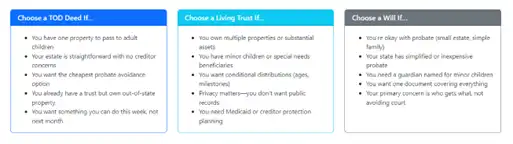
Check our comparison charts. These visual aids can help you size up your options.
Ready to explore more? See the “More on topics” section below. Call your real estate or financial professional when situation-specific questions arise.
How can an attorney help? Relationships, current or potential medical debts, homestead laws and tax implications all go into estate planning decisions. You should also explore the difference between a non-durable and durable power of attorney, to prepare for the time you’ll need one. Indeed, any life stage is a good time to pair your new homeownership with future planning.
We cannot offer financial, tax, or legal advice for use in case-specific questions. Yet we hope this overview of basic ways to vest a deed helps prepare you for those all-important consultations with your own professionals.
Supporting References
Christopher Hornbaker, Attorney at Davis Schilken, PC Law Offices, via the Steller Group (Centennial, Colorado): What Is the Best Way for Seniors to Hold Title to Property? (Nov. 6, 2024).
Sjoberg & Tebelius, PA, (law firm serving Minnesota and western Wisconsin): How Should You Hold Title To Real Estate?
Deeds.com: When a Homeowner Dies, What Happens to the Home? (Aug. 14, 2024).
And as linked.
More on topics: Real estate scams, theft, and fraud, Holding a deed in a trust or an LLC, Only one spouse on the deed, Choosing between a life estate and a living trust, Taking a late owner’s name off the deed
Photo credit: Cottonbro Studio, via Pexels/Canva.