
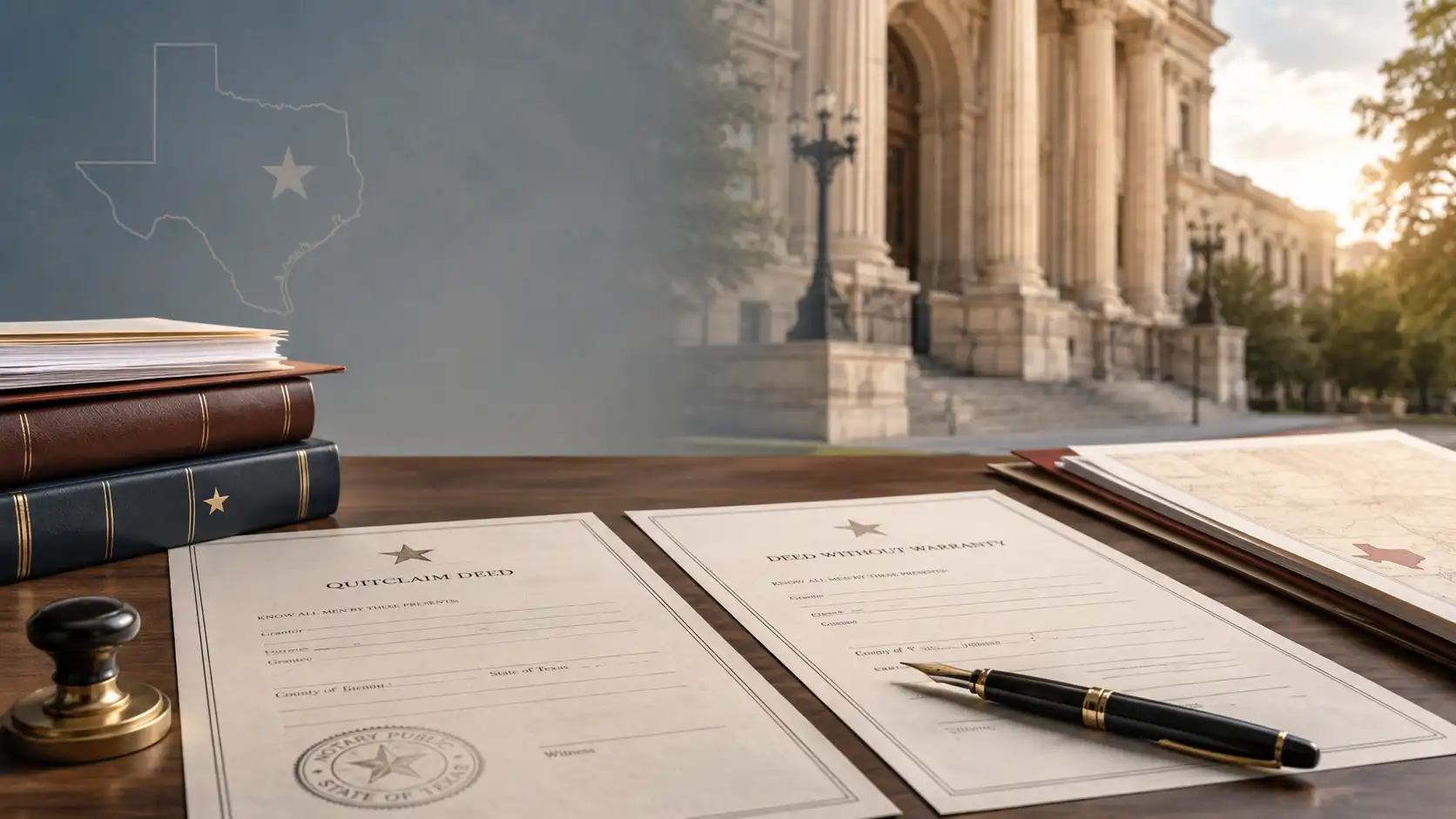
Few Texas real-estate phrases cause more confusion than quitclaim deed and deed without warranty. They sound similar because both are commonly associated with “no warranty.” But in Texas, they are not the same tool. A deed without warranty generally purports to convey the property itself while disclaiming warranties of title. A quitclaim deed generally releases whatever right, title, claim, or interest the grantor may have, if any, without representing that the grantor owns anything at all.
That distinction matters. Texas courts have long treated quitclaim wording as a warning sign in the chain of title. At the same time, Texas law recognizes that quitclaim deeds can be valid and useful in limited settings, especially where the interest is uncertain, disputed, or hard to describe. A deed without warranty can also be useful when the grantor is willing to convey property but is not willing to stand behind the title with a warranty.
Educational information only. This article is a general, fact-based overview of two Texas deed instruments. It is not legal advice, does not create an attorney-client relationship, and is not a substitute for advice from a Texas-licensed attorney, title company, tax professional, lender, or other appropriate professional. Deed language, title history, homestead rights, liens, probate facts, divorce decrees, entities, taxes, minerals, and recording practices can change the result in a specific transaction.
Why the distinction matters in Texas
In ordinary conversation, many people say “quick claim deed.” The legal term is quitclaim deed. The “quit” in quitclaim means to quit, release, or give up a claim. That history explains the instrument’s core idea: the signer is not necessarily saying, “I own this property and convey it to you.” The signer is more often saying, “Whatever claim I may have, I release or transfer to you.”
Texas title practice cares about that wording because it can affect how later purchasers, lenders, and title companies view the chain of title. A Texas deed that purports to convey the property is different from a document that only conveys the grantor’s uncertain claim. The Texas Supreme Court has explained that the question is not controlled by the title of the document alone; courts read the instrument as a whole to decide whether it conveys land itself or merely the grantor’s right, title, and interest.[5] [6]
A deed without warranty sits in a different category. It can convey the property itself, but the grantor does not promise that title is good. In other words, the problem is usually not whether the deed purports to convey the property; the problem is that the grantee receives no warranty from the grantor if title later fails.
Texas deed basics
Texas Property Code § 5.021 provides the baseline rule that certain conveyances of real property interests must be in writing, subscribed, and delivered by the conveyor or an authorized agent.[1] That does not mean every written deed is wise, complete, or insurable. It means the basic conveyance rule starts with writing, signature, and delivery.
Texas Property Code § 5.022 supplies a statutory form for a warranty deed, but the same section says a covenant of warranty is not required and that parties may insert lawful clauses or use other lawful forms.[2] This is one reason Texas has multiple deed types in practice: general warranty deeds, special warranty deeds, deeds without warranty, quitclaim deeds, trustee’s deeds, executor’s deeds, correction deeds, and other specialized instruments.
Texas Property Code § 5.023 creates another important drafting trap. Unless a deed expressly provides otherwise, the words “grant” or “convey” imply limited covenants that the grantor has not previously conveyed the same estate or interest and that the property is free from encumbrances.[3] For a deed without warranty, careful drafters often address these implied covenants directly because a document labeled “without warranty” can still create issues if its operative words imply covenants the parties did not intend.
Recording is a separate issue. Texas Property Code § 12.001 addresses when an instrument concerning real or personal property may be recorded, including acknowledgment or proof requirements.[10] County clerks also publish practical formatting requirements. Harris County, for example, identifies items such as an original document, notarized signatures, legal descriptions when applicable, a grantee address for conveyances, printed names under signatures, return-address information, and margin requirements.[11] County rules and fees can vary, so a recordable instrument in one context still needs to satisfy the local recording office’s requirements.
What a Texas quitclaim deed is
A Texas quitclaim deed is best understood as a release or transfer of the grantor’s claim, not a representation that the grantor owns the property. If the grantor owns a valid interest, a quitclaim can pass that interest. If the grantor owns nothing, the grantee receives nothing. The grantee generally receives no title warranty and no promise that the described property is free of liens, competing ownership claims, mineral severances, easements, restrictions, or other title problems.
The Texas Supreme Court’s modern shorthand is simple: a warranty deed conveys property, while a quitclaim deed conveys the grantor’s rights, if any. In Geodyne Energy Income Production Partnership I-E v. Newton Corp., the court recognized the validity and practical use of quitclaim deeds while also emphasizing their risk profile.[7] The Texas Real Estate Research Center likewise describes quitclaim deeds as instruments that pass whatever interest the grantor has, if any, while warning that they do not establish title in the way many nonlawyers assume.[8]
The caption is not everything. A document may be titled “Quitclaim Deed” but contain language that purports to convey land. Another document may be titled “Deed” but use only right-title-interest release language. Texas courts look at the whole instrument: granting clause, habendum clause, property description, warranty clause or disclaimer, exceptions, reservations, recitals, and the surrounding words used to identify what is being transferred.[5] [6]
Texas quitclaim history and case law
Quitclaim instruments have appeared in American land practice for centuries, especially where ownership was uncertain or claims needed to be released. Texas, however, developed a particularly important body of case law around quitclaim deeds and bona fide purchaser status.
In Cook v. Smith, the Texas Supreme Court explained the distinction between an instrument that purports to convey the property itself and one that merely passes the grantor’s right, title, and interest. The court made clear that use of the term “quitclaim” is not conclusive; the entire instrument matters.[5] Later, in Porter v. Wilson, the court again emphasized that “all right, title and interest” language is not automatically fatal if the instrument as a whole shows an intent to convey the land itself, but a document that only releases an uncertain claim remains a quitclaim in substance.[6]
The oil-and-gas context shows why quitclaims persist. Mineral ownership can involve old deeds, severed estates, ambiguous reservations, dormant interests, leases, assignments, probate gaps, and fractional claims. In Geodyne, the Texas Supreme Court recognized that sophisticated buyers may use quitclaim deeds when they are trying to collect whatever interest the seller may have in a complicated mineral or leasehold setting.[7]
Texas lawmakers also addressed a specific quitclaim issue in 2021. Texas Property Code § 13.006 now provides that, after the fourth anniversary of recording, a quitclaim deed does not affect the good faith of a later purchaser or creditor and is not notice to a later purchaser or creditor of an unrecorded conveyance, transfer, or encumbrance. The statute applies to quitclaim deeds recorded on or after September 1, 2021.[4] [8] This four-year rule reduced one historic quitclaim problem, but it should not be read as a universal cure for every defective deed, lien, forged instrument, missing owner, bad legal description, homestead issue, or title objection.
Common uses of quitclaim deeds
1. Releasing a doubtful or disputed claim. Quitclaim deeds are commonly associated with releasing a possible claim rather than selling marketable title. A person may sign one to relinquish whatever interest they might have, even if nobody is certain the interest exists. Texas cases and commentary often describe quitclaim use where interests are unknown, disputed, or of doubtful origin.[6] [7]
2. Mineral and leasehold transactions. Oil, gas, and mineral ownership can be fragmented and difficult to verify. Quitclaim deeds and quitclaim assignments may be used between sophisticated parties to transfer whatever interest the seller may own without making ownership promises.[7]
3. Curative work. In some chains of title, a quitclaim may be used to release a possible cloud, old claim, or competing interest. Whether that instrument solves the title issue depends on the exact defect and the person signing. A release from the wrong person, or a release using the wrong legal description, may not cure anything.
4. Family or divorce-related cleanup. Quitclaim deeds sometimes appear after divorce, inheritance disputes, or family agreements. In Texas, however, family transfers can involve homestead rights, community-property issues, probate authority, existing mortgage debt, tax consequences, and title-insurance concerns. A deed signed within the family does not automatically fix those issues.
5. Execution, constable, sheriff, or tax-sale settings. Some forced-sale instruments convey only the debtor’s right, title, and interest. These transfers may be governed by additional statutes, court orders, notices, redemption rights, and sale procedures. The label on the instrument is only part of the analysis.
Quitclaim deed warnings and traps
Trap 1: A quitclaim can damage marketability
The traditional Texas concern is that a quitclaim deed in the chain of title may signal that the grantee accepted uncertainty. Texas commentary warns that quitclaims can create marketability and insurability problems because later title companies and buyers may question whether the grantee received more than the grantor’s uncertain claim.[8] The 2021 four-year statute helps in a defined way for quitclaims recorded on or after September 1, 2021, but it does not transform every quitclaim into a warranty deed or erase unrelated defects.[4]
Trap 2: The title of the document may mislead people
Calling a document a “Quitclaim Deed” does not conclusively make it a quitclaim, and calling a document a “Deed Without Warranty” does not automatically make it safe. Texas courts review the whole instrument. The operative language matters more than casual labels, file names, online form titles, or what the parties informally called the document.[5] [6]
Trap 3: It may convey nothing
A quitclaim can pass whatever interest the grantor owns. But if the grantor owns no interest, the instrument may pass nothing. That is the central risk. The grantee often receives no promise that the grantor owns title, no warranty against prior conveyances, and no warranty against liens or encumbrances.
Trap 4: Recording is not title insurance
Recording a deed gives public notice of the recorded instrument, but recording does not prove that the signer owned the property, that the legal description is correct, that all necessary parties signed, or that the property is free of liens. The Texas Department of Insurance explains that title agents review public records such as deeds, mortgages, wills, divorce decrees, judgments, tax records, liens, encumbrances, and maps because ownership problems can arise before a buyer ever appears in the transaction.[13]
Trap 5: A deed does not remove mortgage debt
A deed changes record ownership only to the extent the deed is valid and effective. It does not, by itself, release a borrower from a note or deed of trust. Mortgage transfers can also trigger due-on-sale or due-on-transfer issues depending on the loan, the transfer, and applicable law. Fannie Mae’s servicing guidance, for example, describes acceleration requirements for nonexempt transfers under due-on-sale or due-on-transfer provisions.[14]
Trap 6: Homestead and spouse issues can be missed
Texas homestead rights are not casual paperwork issues. The Texas Constitution provides strong homestead protections and restricts sale or abandonment of a homestead without required consent by owners and spouses.[12] A deed that ignores homestead or spousal-consent requirements can create serious title problems.
Trap 7: “No warranty” does not mean “no consequences”
A grantor may think a quitclaim avoids all risk because no warranty is given. That is too broad. Fraud, forgery, lack of capacity, entity authority, bankruptcy restrictions, probate authority, divorce orders, tax issues, and false statements can create separate problems. “No warranty” is not a magic shield for every legal issue.
Trap 8: Online forms may not match Texas practice
Many forms online are generic national forms. Texas title practice is unusually sensitive to quitclaim wording. A form that is routine in another state may create problems in a Texas chain of title. The more the form says only “right, title, claim, and interest,” the more it resembles the traditional quitclaim problem.
What a deed without warranty is
A deed without warranty is a deed that purports to convey the property but disclaims warranties of title. The grantor is not making the usual warranty promises that appear in a general warranty deed or special warranty deed. The grantee receives the property interest being conveyed, if the grantor has it, but the grantee does not receive the grantor’s contractual promise to defend title if someone later asserts a superior claim.
The Texas District & County Attorneys Association describes a deed without warranty as an instrument used when a grantor is willing to convey property but is not willing to provide warranties, often because the grantor is unsure about the title history or gaps in title.[9] The important distinction is that a deed without warranty can still purport to convey the property itself. That makes it different from a quitclaim deed that merely conveys or releases whatever claim the grantor may have.
Because Texas Property Code § 5.022 says a warranty covenant is not required, Texas law permits deeds that convey property without warranties.[2] But Texas Property Code § 5.023 means the words “grant” or “convey” may imply limited covenants unless the instrument expressly says otherwise.[3] A carefully drafted deed without warranty usually addresses express warranties, implied warranties, and statutory implied covenants to avoid mixed signals.
History and legal footing of deeds without warranty
Texas deed practice has long recognized that different transactions call for different risk allocations. A seller in an ordinary residential sale may be expected to provide a general warranty deed. A fiduciary, government body, trustee, estate representative, lender, or other grantor with limited knowledge of title history may be unwilling to give broad warranties. The deed without warranty developed as a practical instrument for those situations.
The deed without warranty is grounded in the basic flexibility of Texas deed law. Texas Property Code § 5.022 supplies a form but does not require warranty language, and it allows other lawful forms and clauses.[2] That statutory flexibility allows parties to create an instrument that conveys property while disclaiming warranties.
In practice, deeds without warranty also serve a middle-ground function. They are often less problematic than quitclaims because they purport to convey the property rather than merely release a claim. But they are not buyer-protection documents. The buyer’s protection, if any, usually comes from title examination, title insurance, escrow requirements, closing instructions, affidavits, entity resolutions, probate documents, court orders, tax certificates, survey review, and other due-diligence tools—not from a warranty promise in the deed.
Common uses of deeds without warranty
1. Fiduciary transfers. Executors, administrators, guardians, bankruptcy trustees, receivers, and similar fiduciaries may be asked to convey property they did not personally own or occupy. A deed without warranty may be used where the fiduciary has authority to convey but will not personally guarantee the title.
2. Government or county transactions. Public bodies may use deed forms that limit warranties, especially where the governmental grantor does not want to assume historical title risk. County-focused Texas commentary identifies deeds without warranty as one of the deed types used in public-sector practice.[9]
3. Foreclosure, trustee, and lender-related transfers. After foreclosure or lender ownership, the grantor may have limited knowledge of conditions, occupancy, liens, or title history outside the foreclosure process. Instruments in this area may disclaim warranties or use special statutory language.
4. Curative or title-cleanup transactions. When the goal is to move a known interest while avoiding a warranty promise, a deed without warranty may be considered. Whether it works depends on the specific title defect and the required parties.
5. Transfers where the grantor will not warrant title. Some grantors are willing to convey but not to defend. The deed without warranty allocates that title risk to the grantee unless the parties have separate contractual protections outside the deed.
Deed without warranty warnings and traps
Trap 1: It is not title insurance
A deed without warranty can transfer title, but it does not insure title. Title insurance, if purchased and issued, is a separate contract. TDI explains that title insurance protects against financial loss from covered title defects and that a title company may defend against lawsuits attacking title or reimburse covered losses up to policy limits.[13]
Trap 2: Implied covenants may sneak in
Texas Property Code § 5.023 implies limited covenants from the words “grant” or “convey” unless the deed expressly provides otherwise.[3] A deed without warranty that uses those words but does not disclaim implied covenants may be internally inconsistent. The document’s wording needs to match the intended risk allocation.
Trap 3: “Without warranty” does not fix missing ownership
If the grantor does not own the interest, lacks authority, or cannot convey because a required person did not sign, a deed without warranty does not magically create ownership. It may convey whatever the grantor can convey, but it gives the grantee no warranty remedy if title fails.
Trap 4: Reservations and exceptions can be more important than the deed label
Texas real property often includes minerals, easements, restrictions, leases, HOA covenants, rights of way, pipeline easements, utility easements, access issues, and prior reservations. A deed without warranty may convey surface title while excluding or being subject to important interests. The label does not tell the whole story.
Trap 5: Homestead, spouse, and community-property issues may still apply
Texas homestead and marital-property issues can affect conveyances regardless of whether the deed is a warranty deed, deed without warranty, or quitclaim. The Texas Constitution’s homestead protections are a separate source of title risk.[12]
Trap 6: Recording requirements are still mandatory
A deed without warranty still needs to be recordable. Acknowledgment, proper signatures, party names, addresses, legal description, return address, and county formatting requirements matter. Texas Property Code § 12.001 and county-clerk requirements should be checked before assuming a deed can be recorded.[10] [11]
Side-by-side comparison
| Issue | Texas quitclaim deed | Texas deed without warranty |
|---|---|---|
| Core function | Releases or transfers whatever right, title, claim, or interest the grantor may have, if any. | Purports to convey the property or described interest, but without title warranties. |
| Does it say the grantor owns the property? | Usually no. It often avoids any ownership representation. | Often conveys the property, but disclaims warranties. The exact wording controls. |
| Title warranty | No warranty of title. | No warranty of title, and usually no implied warranties if properly disclaimed. |
| Texas title-practice concern | Historically problematic because it can prevent later parties from claiming good-faith purchaser protection and can raise marketability concerns. | Less likely to carry the traditional quitclaim stigma, but still gives no warranty protection. |
| Typical use | Release doubtful claim, mineral or leasehold uncertainty, curative work, family cleanup, disputed interests. | Fiduciary transfer, government or institutional transfer, foreclosure-related transfer, seller unwilling to warrant title. |
| Main grantee risk | Grantor may have nothing; chain may become harder to insure or resell. | Grantor may not have good title; grantee has no warranty claim against grantor. |
| Important Texas statute | Property Code § 13.006, especially the four-year recorded-quitclaim rule for quitclaims recorded on or after September 1, 2021. | Property Code §§ 5.022 and 5.023, especially warranty flexibility and implied-covenant language. |
Drafting clues, not forms
This section is not a deed form and should not be copied into a transaction. It is a vocabulary guide for reading deed language.
Quitclaim-style clues: language focused on “right, title, interest, claim, and demand,” especially when paired with “if any,” “release,” “remise,” “quitclaim,” or an absence of words purporting to convey the land itself. The more the deed avoids saying that the grantor conveys the described property, the more it resembles a quitclaim.
Deed-without-warranty clues: language that conveys the described property or interest, followed by an express disclaimer of warranties. A well-developed deed without warranty may also address implied covenants under Texas Property Code § 5.023 and any common-law warranties the parties intend to exclude.[3] [9]
Warranty-deed clues: language showing the grantor will warrant and defend title, either generally or against claims arising through the grantor. A general warranty deed is broader; a special warranty deed is narrower. A deed without warranty is different because it removes that warranty promise.
Whole-instrument rule: Texas courts read the entire instrument. One word rarely decides the issue. The granting clause, habendum, warranty disclaimer, property description, recitals, and reservations all matter.[5] [6]
Due-diligence checklist
The following checklist is educational, not advice for a specific transaction. It shows why a deed label is only one part of the title picture.
- Correct parties: Are the grantor and grantee correctly identified, including marital status, entity status, trustee capacity, estate capacity, or fiduciary role?
- Authority: Does the signer have authority to sign for an entity, estate, trust, guardianship, bankruptcy estate, receivership, or power of attorney?
- Legal description: Does the deed use a complete legal description, not just a street address or tax-account number?
- Chain of title: Does the public-record chain show how the grantor received title?
- Liens and taxes: Are mortgages, deeds of trust, judgment liens, tax liens, HOA liens, mechanic’s liens, child-support liens, and unpaid property taxes addressed?
- Homestead and spouse: Could Texas homestead or marital-property rules require additional consent or signature?
- Minerals: Are minerals reserved, previously severed, leased, pooled, assigned, or excluded?
- Survey and access: Are boundary, easement, encroachment, access, and road issues reviewed?
- Recording: Does the deed satisfy Texas and county recording requirements?
- Title insurance: Is an owner’s policy available, and what exceptions or requirements appear on the title commitment?
- Loan issues: Could a transfer trigger a due-on-sale or due-on-transfer clause?
- Fraud monitoring: Some counties offer free property-fraud alert services that notify owners when documents using their name are recorded. These alerts do not prevent fraud, but they can provide early warning.[15]
FAQ
Is a quitclaim deed legal in Texas?
Yes. Texas recognizes quitclaim deeds. The problem is not that they are automatically invalid. The problem is that Texas title law and title practice can treat quitclaim wording as a warning sign, especially when later purchasers or title companies evaluate the chain of title.[7] [8]
Is a deed without warranty the same as a quitclaim deed?
No. A deed without warranty can purport to convey the property itself while disclaiming warranties. A quitclaim deed generally conveys only whatever right, title, claim, or interest the grantor may have, if any. Texas courts review the whole instrument rather than relying only on the title.[5] [6]
Can a quitclaim deed transfer title in Texas?
It can transfer whatever interest the grantor owns, if the grantor owns one. If the grantor owns nothing, it may transfer nothing. It usually provides no title warranty and no assurance that the grantor owns the property.
Does Texas’s four-year quitclaim statute fix all quitclaim problems?
No. Texas Property Code § 13.006 affects the notice and good-faith-purchaser consequences of certain recorded quitclaim deeds after four years, and it applies to quitclaim deeds recorded on or after September 1, 2021.[4] It does not necessarily fix forged deeds, missing parties, bad legal descriptions, lack of authority, tax liens, mortgage issues, homestead defects, or other title problems.
Does a deed without warranty mean the buyer gets nothing?
Not necessarily. A deed without warranty may convey the property interest described in the deed. The phrase “without warranty” means the grantor is not giving title warranties. The grantee may still receive title, but without a deed warranty from the grantor.
Does recording a deed prove ownership?
No. Recording creates a public record of the instrument, but it does not prove the grantor owned the property, that all signatures were valid, or that title is free of defects. Title companies review public records precisely because recorded documents can reveal problems as well as transfers.[13]
Can a deed remove someone from a mortgage?
No. A deed and a loan are different instruments. A deed may transfer ownership, but it does not by itself release a borrower from the loan. Some transfers may also raise due-on-sale or due-on-transfer questions depending on the mortgage and applicable law.[14]
Which instrument is better?
That depends on facts this article does not evaluate: title history, grantor authority, buyer risk, title-insurance availability, liens, taxes, homestead rights, minerals, probate status, divorce orders, and lender consent. As a general factual distinction, a deed without warranty is used to convey property without a warranty; a quitclaim is used to release or transfer whatever claim the grantor may have.
Bottom line
In Texas, “no warranty” does not automatically mean “quitclaim.” A deed without warranty can convey the described property while shifting title risk to the grantee. A quitclaim deed generally releases whatever claim the grantor may have, if any, and may create chain-of-title concerns that outlast the closing. Texas courts read the entire instrument, not just the caption, and Texas statutes now address some—but not all—of the consequences of recorded quitclaim deeds.
The safest factual takeaway is this: the words used in the granting clause, warranty clause, exceptions, reservations, and recitals matter more than the label at the top of the page. For any actual transaction, the title history and the proposed deed language need transaction-specific review.
Sources and citations
- Texas Property Code § 5.021 provides that certain conveyances of land interests must be in writing, subscribed, and delivered. Source.
- Texas Property Code § 5.022 supplies a statutory form for a warranty deed, states that a covenant of warranty is not required, and permits parties to use other lawful clauses and forms. Source.
- Texas Property Code § 5.023 provides that the words “grant” or “convey” imply limited covenants unless the deed expressly provides otherwise. Source.
- Texas Property Code § 13.006 changes the notice effect of certain recorded quitclaim deeds after the fourth anniversary of recording. Source.
- Cook v. Smith, 174 S.W. 1094 (Tex. 1915), explains the Texas distinction between a deed that purports to convey land itself and an instrument that merely passes the grantor’s right, title, and interest. Source.
- Porter v. Wilson, 389 S.W.2d 650 (Tex. 1965), applies the whole-instrument approach and explains why “all right, title and interest” language does not automatically make an instrument a quitclaim. Source.
- Geodyne Energy Income Production Partnership I-E v. Newton Corp., 161 S.W.3d 482 (Tex. 2005), discusses recognized uses of quitclaim deeds and the title-risk consequences of quitclaim language. Source.
- The Texas Real Estate Research Center at Texas A&M explains Texas title-practice concerns with quitclaim deeds and summarizes the 2021 quitclaim-deed statute. Source.
- The Texas District & County Attorneys Association summarizes common Texas deed types, including deeds without warranty and quitclaim deeds, from a county-deed-drafting perspective. Source.
- Texas Property Code § 12.001 addresses recording prerequisites for instruments concerning real or personal property. Source.
- Harris County Clerk real-property recording information lists practical formatting and recording requirements, including original document, notarized signatures, legal descriptions when applicable, and grantee address for conveyances. Source.
- Texas Constitution article XVI, § 50 contains homestead protections, including limits on sale or abandonment without required owner and spouse consent. Source.
- The Texas Department of Insurance explains that title insurance protects against financial loss from title defects and that title agents review public records such as deeds, liens, judgments, divorce decrees, tax records, and maps. Source.
- Fannie Mae’s Servicing Guide describes due-on-sale or due-on-transfer enforcement for nonexempt mortgage transfers. Source.
- Fort Bend County describes its free Property Fraud Alert service, which notifies subscribers when documents containing their name, business name, or trust name are recorded in the county’s Official Public Records. Source.