Texas Deed Without Warranty
County Specific Legal Forms Validated as recently as October 9, 2026 by our Forms Development Team
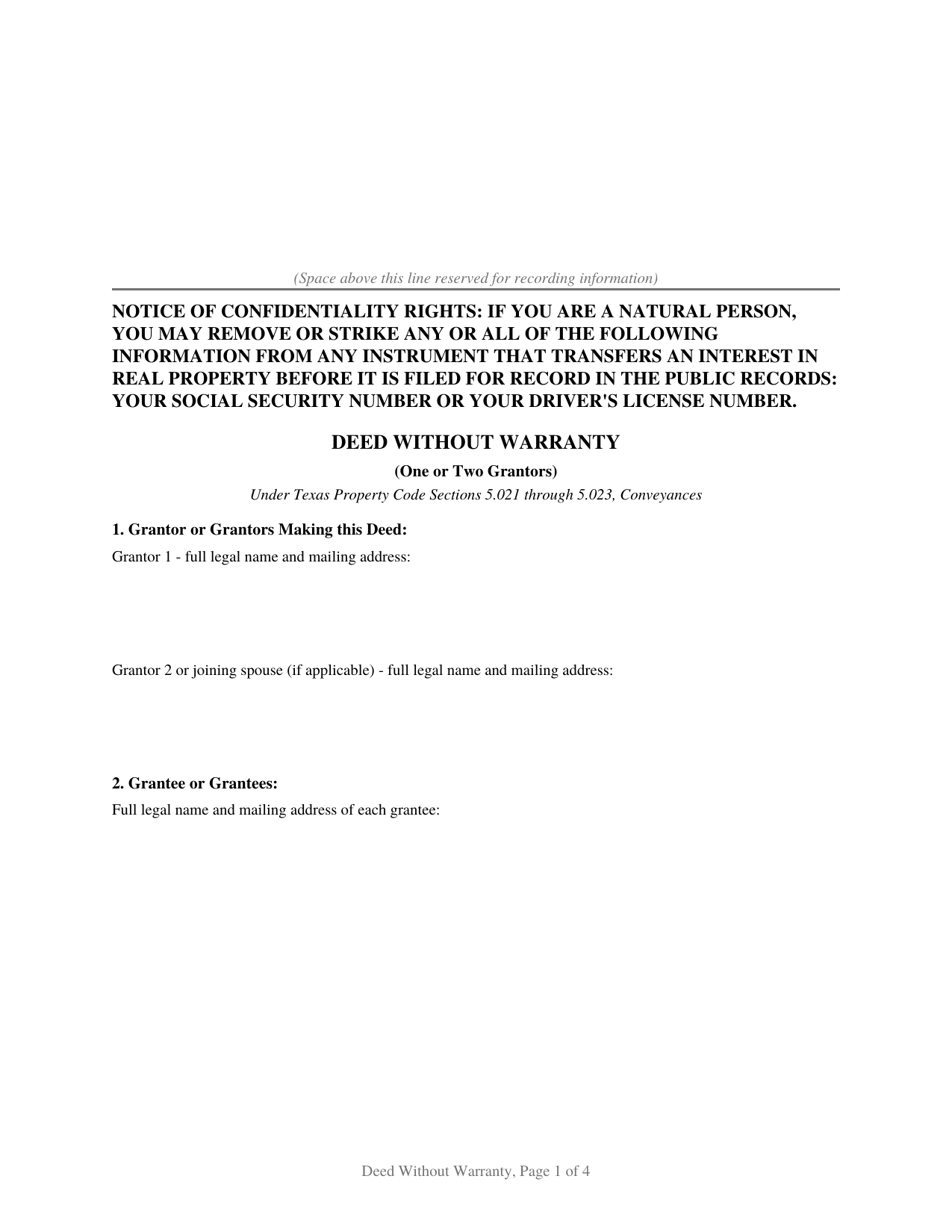
About the Texas Deed Without Warranty
How to Use This Form
- Select your county from the list
- Download the county-specific form
- Fill in the required information
- Have the document notarized if required
- Record with your county recorder's office
What Others Like You Are Saying
"I thought the service was good"
"Very easy to understand and complete the process. This is the third attempt to download a Quit Claim…"
"Thank you for making a difficult time a little easier. The forms are easy to download and complete a…"
"love your Deeds.com website..."
"very good. received what i ordered in a timely fashion despite my incompetence."
4.8/5 from 4,828 reviews. Read all
In 2021 the Texas Legislature put a four year clock on the quitclaim deed. Property Code Section 13.006 provides that once a recorded quitclaim passes its fourth anniversary, it no longer bears on the good faith of a later purchaser or creditor and is no longer notice of an unrecorded conveyance, transfer, or encumbrance. It says nothing about the instrument this form prepares: a deed without warranty conveys the land itself and simply declines to promise anything about the title.
Why the disclaimer has to be written out
Property Code Section 5.022 prints a general warranty form, then adds that a covenant of warranty is not required and that any clause or form not in contravention of law may be used. Texas prints no statutory form for this deed, so it is built inside that permission, and Section 5.023 is why care is needed. Unless the conveyance expressly provides otherwise, the words grant and convey imply two covenants: that the grantor has not already conveyed the estate to someone else, and that the estate is free from encumbrances. Both are actionable as though written into the deed, so a document captioned without warranty that grants and conveys, and stops there, still carries them. Section 10 is the express provision otherwise, naming and excluding both statutory covenants and every other title covenant arising at common law or by statute.
A conveyance of the land, not of a claim
Texas courts read an instrument whole to decide whether it passes the property or only whatever the signer happens to hold, the test applied in Geodyne Energy Income Production Partnership v. Newton Corp., 161 S.W.3d 482 (Tex. 2005), which followed Porter v. Wilson, 389 S.W.2d 650 (Tex. 1965). Language confined to right, title, and interest reads as a release. This deed grants, sells, and conveys the Property, adds a habendum running to the grantee and the grantee's heirs, successors, and assigns, and says in the same section that it passes the Property itself. The no warranty deed, as buyers often search it, moves title the way a warranty deed does and backs it the way a quitclaim does, which is not at all.
One or two names on each side
This is the base configuration of the Texas deed without warranty. The grantor block and the grantee block are free-form and four lines deep, and each holds one or two natural persons signing in their own capacity, with whatever status or vesting words the parties supply; nothing about marital status, capacity, or co-ownership is preprinted. Two signature blocks appear, headed GRANTOR and SECOND GRANTOR (if applicable), each with its own acknowledgment certificate, so two signers may acknowledge on different dates before different notaries, and a conveyance by one grantor leaves the second block and its certificate blank. Partition among cotenants, a strip squared up between adjoining owners, and a resale of land taken at tax foreclosure are patterns that appear in the record with one or two people on each side. Conveyances by a company, a trustee, an agent under a power of attorney, or three or more owners on one side follow other execution patterns.
Texas marital property reaches the signature lines
Two rules can add a signature. Family Code Section 5.001 provides that neither spouse may sell, convey, or encumber the homestead without the other's joinder, whether the homestead is community property or one spouse's separate property, and this deed is a present conveyance. Family Code Section 3.102(c) does independent work: community property that is not sole management property is subject to the joint management, control, and disposition of both spouses.
At the county clerk's window
Recording where the land lies is what makes the conveyance effective against creditors and later purchasers under Property Code Section 13.001. The form is letter size, opens with the Section 11.008 notice of confidentiality rights in bold capitals, sets every line of type at 12 point, and leaves the top two and one half inches of page one open for the clerk's stamp. Section 11.003 contemplates a grantee mailing address, and an instrument filed without one draws a higher fee rather than a rejection.
The package contains the blank deed as a fillable PDF, a completed example built on a Harris County fact pattern in which two people convey a platted lot to two buyers taking as tenants in common, and a plain language guide covering the statutes, every numbered section, signing, and recording. The materials are informational and are not legal advice.
Important: County-Specific Forms
Our deed without warranty forms are specifically formatted for each of the 254 counties in Texas.
After selecting your county, you'll receive forms that meet all local recording requirements, ensuring your documents will be accepted without delays or rejection fees.