Texas Quitclaim Deed
County Specific Legal Forms Validated as recently as September 3, 2026 by our Forms Development Team
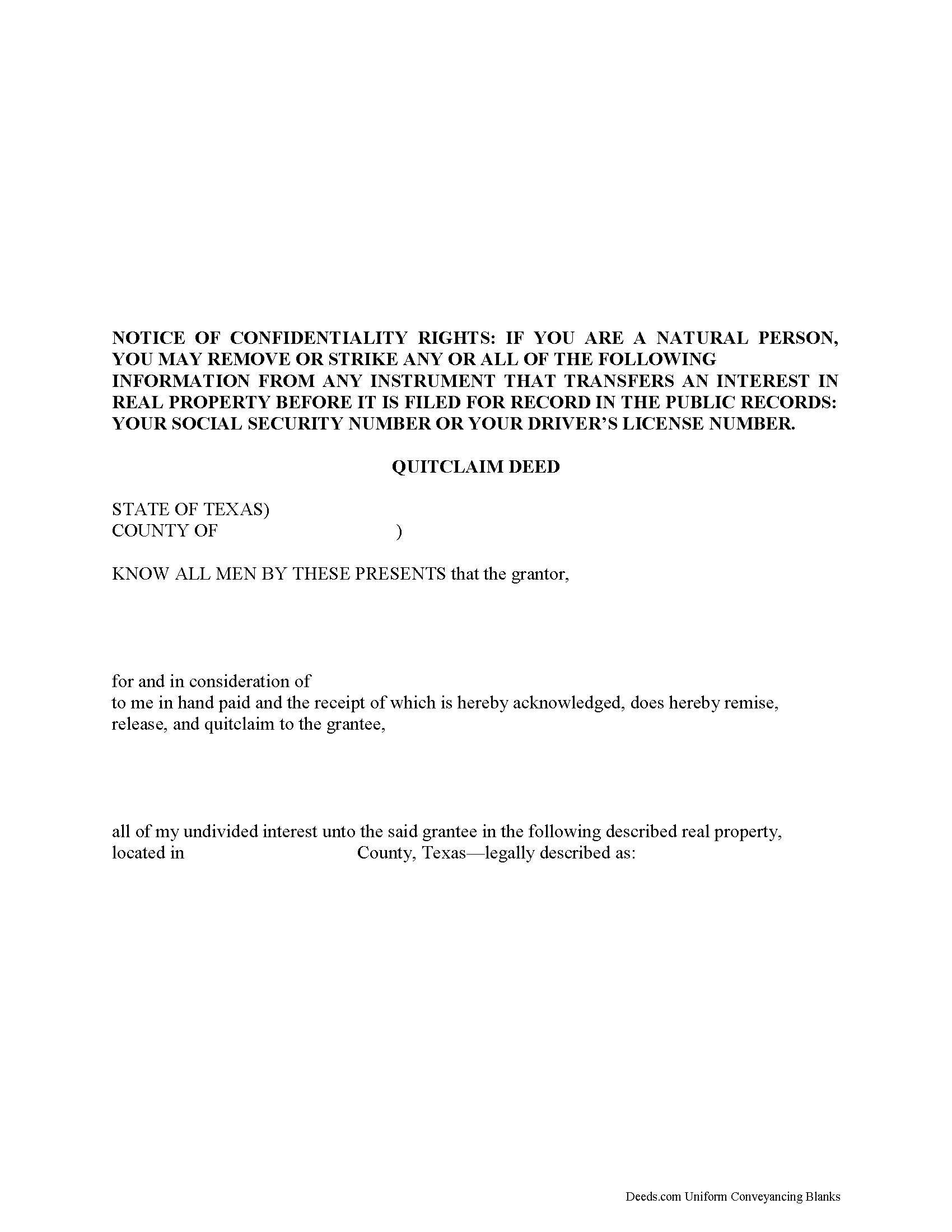
About the Texas Quitclaim Deed
How to Use This Form
- Select your county from the list
- Download the county-specific form
- Fill in the required information
- Have the document notarized if required
- Record with your county recorder's office
What Others Like You Are Saying
"5 stars...thanks for your fast and professional assistance. Charles"
"Bought a transfer on death deed form and it worked great. Easy to fill out and record with the Count…"
"It worked! It was exactly what I needed and was easily understood."
"EXCELLENT, PROMPT SERVICE. I will definitely use again .HIGHLY RECOMMEND."
"excellent...exactly what i need...."
4.8/5 from 4,815 reviews. Read all
A Texas quitclaim deed asserts less than any other deed in the state, and that restraint is the whole design. It does not say the signer owns the land. It hands over whatever interest the signer happens to hold at the moment of delivery, if any, and stops at that boundary. This is the general version of the instrument: individual people on both sides, one or two names releasing, one or two names receiving, and no ownership or marital wording printed anywhere on the page.
Measured at delivery, and not a day later
The interest a quit claim deed passes is fixed when the deed is delivered. If the signer later inherits a share of the same parcel or buys out a cousin, none of that travels back through the earlier release, and Section 10 of this form says so in terms. That section also keeps the two covenants of Property Code Section 5.023 out of the instrument by expressly providing otherwise, the mechanism the statute itself names, and it leans on Section 5.022(b), under which a covenant of warranty is not required in a Texas conveyance at all. Whether a given document lands on the release side or the conveyance side is a question Texas courts answer by reading its words together, which is why the operative language here is written to release, remise, and quitclaim rather than to grant.
Two statutes that track the word quitclaim
Senate Bill 885 gave Texas quitclaims their own pair of rules in 2021. Property Code Section 13.006 puts a four year clock on the record: once four years have run from the filing date, the recorded quitclaim no longer bears on the good faith of a later purchaser or creditor and no longer serves as notice to them of an unrecorded transfer or encumbrance. The second half of that act is less often discussed: Civil Practice and Remedies Code Section 16.025(b) now states that the five year adverse possession period does not apply to a claim based on a quitclaim deed, alongside forged deeds and deeds signed under forged powers of attorney, so possession held under this instrument runs on the longer statutory clocks instead.
One or two names on either side
The party blocks are deliberately empty of preprinted labels. Section 1 takes one or two releasing parties with whatever status wording belongs in the record, Section 3 takes one or two receiving parties plus the words describing how two of them hold, and the deed recites four count patterns: one to one, one to two, two to one, and two to two. Execution follows the same shape: a GRANTOR block, a SECOND GRANTOR block, and one acknowledgment certificate for each, so two signers can appear before different notaries on different days, and both stay blank on a single signer deed. That second block also holds a joining spouse, since Family Code Section 5.001 conditions a conveyance of homestead property on the joinder of both spouses whether the homestead is separate or community property. Two heirs passing inherited fractional interests to one relative, and adjoining owners clearing up a strip of uncertain ownership, present the two grantor pattern this deed recites. Capacity is where the form draws its line: it prints no entity officer recital, no fiduciary capacity, and no third signature block, so an entity signer, a signer acting for another, and three or more owners on a side follow different patterns.
Signing, and the trip to the clerk
Only the releasing side signs; a grantee takes without signing anything. Texas asks for no witnesses on a deed, and the notary's certificate is what makes the instrument recordable. Filing happens at the clerk's office in the county holding the land, where Local Government Code Section 191.007 sets page size, type size, legibility, and the first page heading, and a page outside those standards draws a doubled fee rather than a refusal. Property Code Section 11.008 puts the confidentiality notice in bold capitals at the top of page one, Section 11.003 explains the grantee address blank, and an individual walking a document up to the counter has presented photo identification since early December 2025.
The purchase includes the blank deed as a fillable PDF, a completed example worked through a Bexar County release between family members, and a plain language guide that covers each numbered section, the marital and homestead rules, and the recording steps. The materials are informational and are not legal advice.
Important: County-Specific Forms
Our quitclaim deed forms are specifically formatted for each of the 254 counties in Texas.
After selecting your county, you'll receive forms that meet all local recording requirements, ensuring your documents will be accepted without delays or rejection fees.