Florida Enhanced Life Estate Deed Quitclaim Ladybird Deed
County Specific Legal Forms Validated as recently as October 7, 2026 by our Forms Development Team
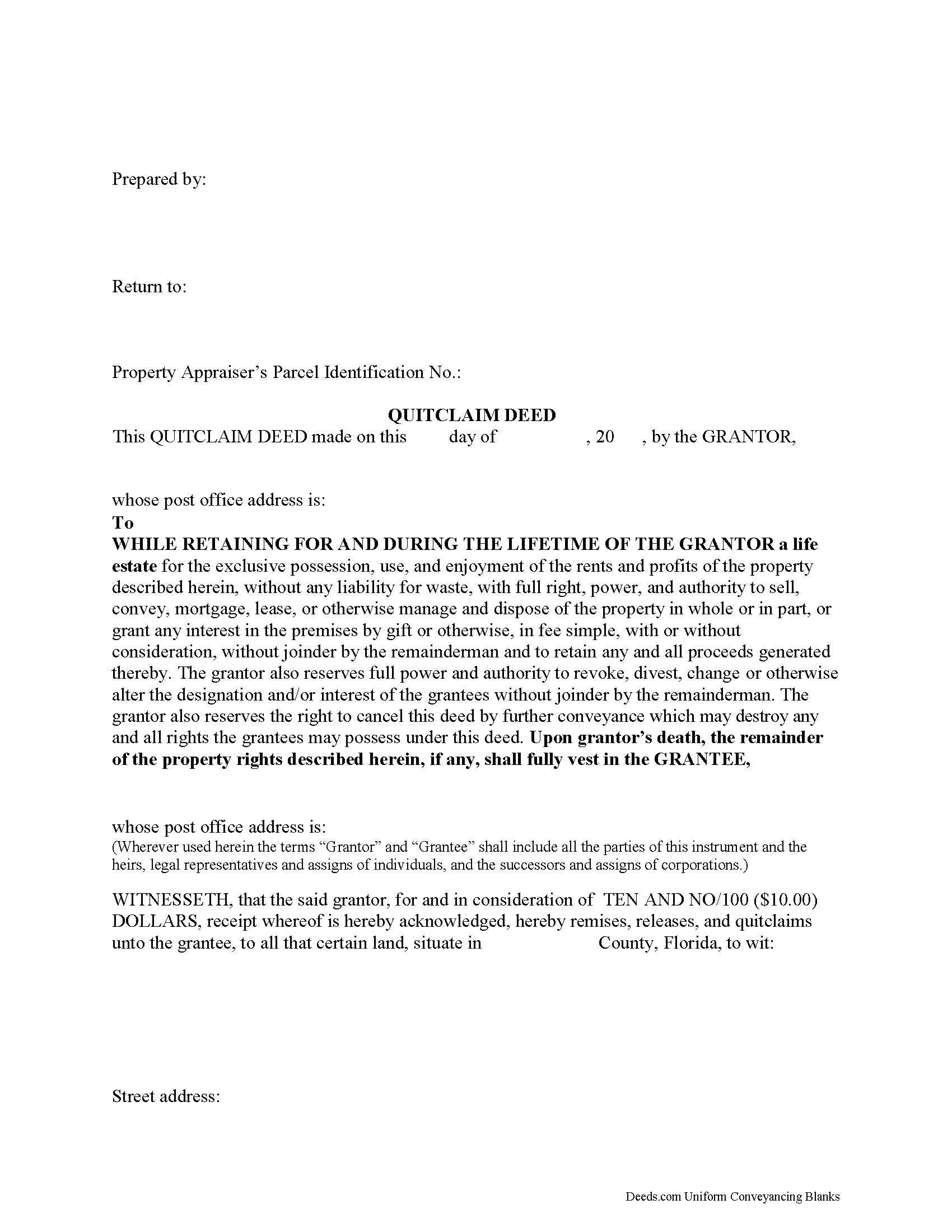
About the Florida Enhanced Life Estate Deed Quitclaim Ladybird Deed
How to Use This Form
- Select your county from the list
- Download the county-specific form
- Fill in the required information
- Have the document notarized if required
- Record with your county recorder's office
What Others Like You Are Saying
"The forms were everything promised. The guide was very helpful and made the process painless."
"It would be really nice if you had an example of the document full size that can be examined/read be…"
"This is a great service. I can't believe how fast my document was recorded!"
"No review provided."
"very easy to use, and comprehensive...I like the e-recording package"
4.8/5 from 4,818 reviews. Read all
The Florida Enhanced Life Estate Deed — commonly called a Lady Bird Deed — in quitclaim form is a non-probate transfer tool used in only a small group of states, and Florida's version operates under rules that set it apart. Florida has not adopted the Uniform Real Property Transfer on Death Act, so unlike most of the country, Florida property owners cannot use a transfer-on-death deed; the Lady Bird Deed fills that gap. The instrument is not a creature of statute. It exists by virtue of common-law principles, decades of title-industry acceptance, and recognition by the Florida Bar's Real Property, Probate and Trust Law Section. The grantor reserves a life estate enhanced with the unilateral power to sell, mortgage, lease, or revoke the deed without the remainder beneficiary's consent — and because the property passes outside probate at death, it sits outside the reach of Florida's probate-limited Medicaid estate recovery program (Section 409.9101, Florida Statutes). For a Florida property owner, that combination — homestead-friendly during life, probate-avoiding at death, Medicaid-compatible — is the central reason the deed is used.
What the Florida Enhanced Life Estate Deed (Quitclaim) Does and When It Is Used
The grantor conveys a remainder interest to one or more named beneficiaries while keeping a life estate that includes the unilateral right to sell, encumber, gift, or revoke. Title vests in the remainder beneficiary automatically at the grantor's death without probate administration. In Florida, this deed is most commonly used by single-property owners who want to keep full control of a home during life, pass it to a chosen beneficiary at death, preserve the homestead exemption while alive, and avoid the cost and delay of probate on the home. The quitclaim form transfers whatever interest the grantor holds without warranties of title — the form most often used in Florida estate planning between family members.
Statutory Framework — Why Florida's Lady Bird Deed Is Different
Florida has no Lady Bird Deed statute. There is no enabling section in Chapter 689 (conveyances) or elsewhere in the Florida Statutes. The instrument is enforced based on the grantor's expressly reserved powers, the doctrine that a fee owner may convey a remainder while retaining a life estate enlarged by reserved powers of disposition, and consistent acceptance by Florida title insurers. The practical consequence is that the language of the reservation matters. Florida deeds in this form must spell out the reserved powers explicitly — to sell, convey, mortgage, lease, gift, encumber, and revoke without joinder of the remainder beneficiary — because there is no statute to fill in the gaps if the language is thin.
Florida Homestead — The Largest Trap
If the property is the grantor's homestead, two constitutional rules in Article X, Section 4 of the Florida Constitution control before any deed language does:
- Spousal joinder. A married owner cannot alienate homestead without the spouse's joinder, even if the spouse does not appear on title. The non-titled spouse must sign the deed. Failure to obtain spousal joinder renders the conveyance void as to homestead.
- Restriction on devise. If the owner is survived by a spouse or a minor child, homestead cannot pass to anyone other than the spouse, with limited exceptions (Section 732.4015, Florida Statutes; descent under Section 732.401). Florida title insurers commonly decline to insure title passing under a Lady Bird Deed that conflicts with the homestead descent rules, even though the remainder interest is technically conveyed during the grantor's lifetime — meaning a Lady Bird Deed naming a non-spouse remainder beneficiary on homestead is risky when the grantor is married or has minor children.
The deed should include a clear recital of the grantor's marital status and, where the property is homestead and the grantor is married, the spouse's signature in the appropriate capacity.
Execution Requirements
Florida requires more witnesses than most states. Section 689.01, Florida Statutes, requires two subscribing witnesses to the grantor's signature on a deed conveying real property. Section 695.03 requires acknowledgment before a notary public or other authorized officer for the deed to be entitled to recording. The notary may serve as one of the two witnesses, but a second separate witness is still required. Each witness must sign in the grantor's presence.
Section 695.26 — Recording Format Requirements
Florida's recording-format rules under Section 695.26, Florida Statutes, are mechanical and frequently cause clerk rejections:
- The name of each person who executed the deed must be legibly printed, typewritten, or stamped beneath the signature.
- The post-office address of each grantor and grantee must appear on the face of the deed.
- The name and address of the natural person who prepared the instrument must appear on the face of the deed.
- A 3-inch by 3-inch space must be reserved at the top right of the first page for the clerk's recording stamp; a 1-inch margin is required on the remaining sides and on subsequent pages.
- Each witness's name must be printed beneath the witness signature.
Many otherwise valid Florida deeds are returned by clerks for failing one of these formatting rules.
Documentary Stamp Tax
Florida imposes a documentary stamp tax on deeds at $0.70 per $100 of consideration under Section 201.02, Florida Statutes (Miami-Dade County applies $0.60 per $100 plus a 45-cent surtax on transfers other than single-family residences). On a Lady Bird Deed used for estate planning, consideration is typically nominal — but if the property is encumbered by a mortgage and the remainder beneficiary will take subject to the loan, the unpaid principal balance is treated as consideration and tax is computed on it. The minimum tax is $0.70. The tax is paid to the clerk of court at recording.
Property Tax — Save Our Homes and the Homestead Exemption
The Florida Lady Bird Deed is generally not treated as a change of ownership during the grantor's lifetime under Section 193.155, Florida Statutes, because the grantor retains all incidents of ownership and the unilateral power to revoke. The Save Our Homes assessment cap and the homestead exemption therefore continue uninterrupted while the grantor is alive. At the grantor's death, whether the homestead exemption and the Save Our Homes cap transfer to the remainder beneficiary depends on the beneficiary's eligibility — Florida residency, ownership of the property as a permanent home, and timely application with the county property appraiser. The cap does not automatically port to a non-homesteading remainder beneficiary.
Recording
The deed is recorded in the official records of the county where the property is located (Section 695.01, Florida Statutes), and the clerk of court collects the recording fee under Section 28.24 (per-page fees plus an indexing fee when the deed names more than four parties) along with the documentary stamp tax. Prompt recording matters: an unrecorded deed is not effective against subsequent purchasers and creditors without notice. Lady Bird Deeds should be recorded during the grantor's lifetime, not held for recording at death — leaving the deed unrecorded creates priority and notice problems and complicates the grantor's title insurance coverage.
Vesting Among Multiple Remainder Beneficiaries
When the deed names more than one remainder beneficiary, Florida defaults to a tenancy in common unless the deed expressly creates a joint tenancy with right of survivorship or a tenancy by the entireties between spouses. To establish survivorship between non-spouse beneficiaries, the deed must include explicit survivorship language — Florida does not presume survivorship from words like "jointly." Tenancy by the entireties is presumed for a husband and wife taking together unless the deed says otherwise.
What's Included in the Download Package
- The Florida Enhanced Life Estate Deed (Lady Bird) — quitclaim form, formatted to Section 695.26 recording requirements
- Step-by-step completion guidelines covering the reserved powers language, marital status recital, witness and notary blocks, and homestead considerations
- A completed example illustrating a typical Florida transaction
Important: County-Specific Forms
Our enhanced life estate deed quitclaim ladybird deed forms are specifically formatted for each of the 67 counties in Florida.
After selecting your county, you'll receive forms that meet all local recording requirements, ensuring your documents will be accepted without delays or rejection fees.