Easement Deed Forms & Complete Guide

Grant Legal Access Rights Without Transferring Ownership

An easement deed grants specific use rights without transferring ownership Perfect for shared driveways, utility access, and right-of-way agreements. Unlike property deeds that transfer ownership, easements create limited use rights while you retain full ownership. Professional surveying typically required, with total costs ranging from $1,000-3,750 including recording.

All 50 States State-Compliant Forms Instant Download Since 1997

Used by 15,000+ customers to transfer property safely and legally

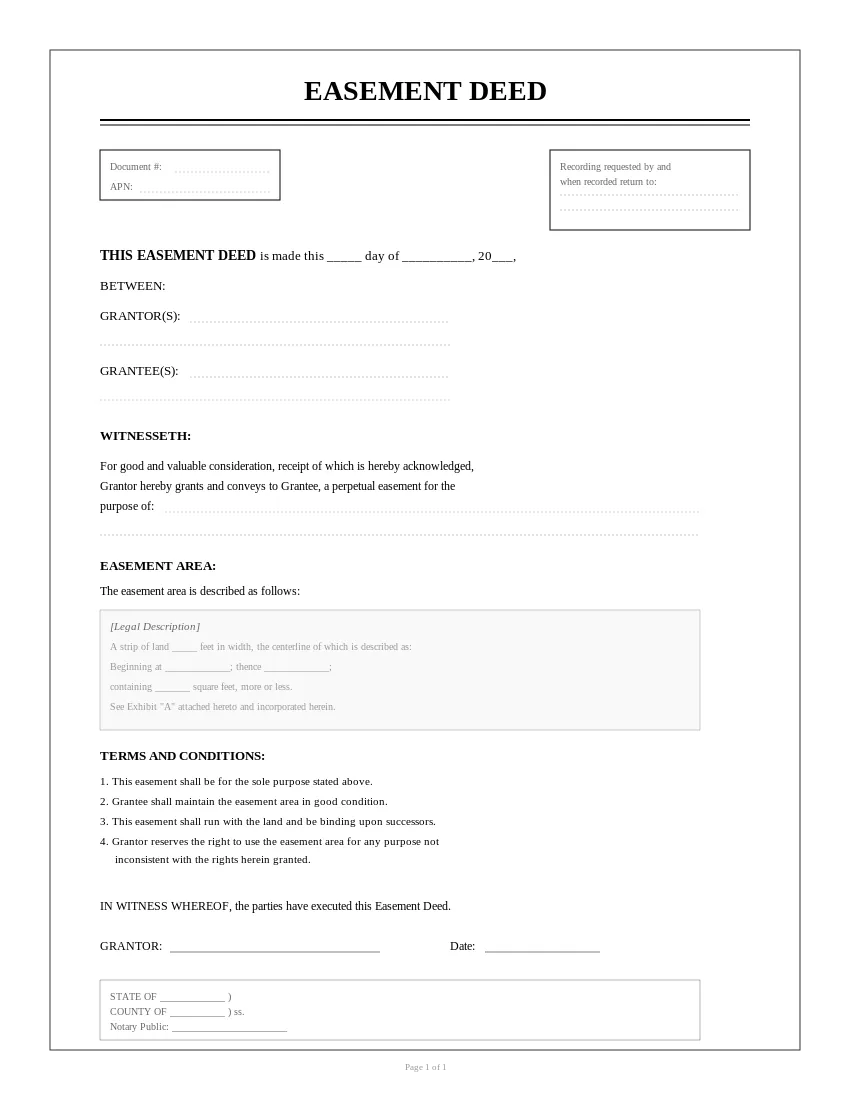
Sample Easement Deed Form

Sample Easement Deed Form

Select Your State

What is a Easement Deed?

An easement deed is a legal document that grants specific use rights to a portion of property without transferring ownership. It creates a non-possessory interest allowing someone else to use your land for a particular purpose.

Key Point

Unlike property deeds that transfer ownership, an easement deed only grants limited use rights while the owner retains full ownership of the land.

How Easement Deeds Work

When you grant an easement, you're saying: "You can use this specific part of my property for this specific purpose, but I still own the land and control everything else about it."

This makes easement deeds:

  • No ownership transfer - Grantor retains full property ownership
  • Specific use only - Limited to stated purpose (access, utilities, etc.)
  • Runs with the land - Transfers to future property owners
  • Requires survey - Professional survey usually necessary

The Easement Deed Process

1

Survey

Mark exact boundaries

2

Define

Specify use & terms

3

Negotiate

Agree on compensation

4

Sign

Execute before notary

Record

File with county

When to Use a Easement Deed

Good Uses

  • Shared driveway - Neighbors sharing access road
  • Utility access - Power, water, sewer lines
  • Landlocked property - Creating legal access
  • Conservation - Preserving land use
  • Beach/lake access - Path to water
  • Drainage - Water flow management
  • View protection - Preventing obstruction
  • Emergency access - Fire road or exit

Never Use For

  • Temporary use - Use license instead
  • Full transfer - Use warranty deed
  • No survey - Boundaries must be clear
  • Verbal agreement - Must be written
  • Unlimited use - Too broad, specify purpose
  • Personal only - Consider license
  • Hostile parties - Requires cooperation
  • Unclear terms - Be specific

Step-by-Step Instructions

Step 1 Survey the Property

Hire a professional surveyor to mark the exact easement area:

  • Get licensed surveyor recommendations
  • Mark boundaries with stakes or flags
  • Create detailed survey map with measurements
  • Include GPS coordinates if applicable
  • Prepare legal description for deed

Time: 1-2 weeks

Step 2 Define Easement Terms

Clearly specify all aspects of the easement:

  • Purpose: Exact use allowed (e.g., "vehicle access only")
  • Users: Who can use the easement
  • Duration: Permanent or temporary with end date
  • Restrictions: What's not allowed
  • Maintenance: Who maintains and pays

Time: 2-3 days

Step 3 Negotiate Compensation

Determine payment or exchange value:

  • Get property appraisal for easement area
  • Research comparable easement values
  • Negotiate one-time payment or annual fee
  • Consider reciprocal easements
  • Document all financial terms

Time: 1-2 weeks

Step 4 Draft the Easement Deed

Create the legal document:

  • Use state-specific easement deed form
  • Include complete legal descriptions
  • Add all negotiated terms and restrictions
  • Attach survey as exhibit
  • Have attorney review for completeness

Time: 2-3 days

Step 5 Execute and Record

Sign and file the easement:

  • Schedule signing with all parties
  • Sign before notary public
  • Some states require witnesses
  • File with county recorder immediately
  • Get certified copies for all parties

Time: 1-3 days

Complete After Recording

Final administrative steps:

  • Notify property insurance company
  • Update property tax records if needed
  • Provide copies to affected utilities
  • Mark easement physically if appropriate
  • Store documents safely

Easement Deed Costs & Fees (2025)

Survey

$500-2,000

Professional boundary survey

Attorney

$500-1,500

Draft and review

Recording

$50-200

County fees

Additional Potential Costs

  • Easement deed form: $27.97 from Deeds.com
  • Property appraisal: $300-500 (if compensation needed)
  • Notary fees: $10-50
  • Title search: $75-200 (recommended)
  • Environmental assessment: $1,500-3,000 (conservation easements)

Tax Consideration

Granting easements may affect property value and taxes. Conservation easements may provide tax benefits. Consult a tax professional.

Easement Deed vs Other Deed Types

Easement Deed

Protection: Use Rights Only

Speed: 2-4 weeks

Cost: $1,000-3,750

Best for: Access/Utilities

Quitclaim Deed

Protection: None

Speed: 1-3 days

Cost: $15-250

Best for: Family/Divorce

Grant Deed

Protection: Limited

Speed: 15-30 days

Cost: $500-1,500

Best for: CA Real Estate

Warranty Deed

Protection: Full

Speed: 30-45 days

Cost: $1,000-3,000+

Best for: Home Purchase

* Costs and timeframes are estimates and vary by location

Common Easement Deed Scenarios & Examples

Scenario: Two adjacent property owners need to formalize a shared driveway that crosses both properties.

Process:

  1. Survey exact driveway location on both properties
  2. Create reciprocal easement agreements
  3. Define maintenance responsibilities (50/50 split typical)
  4. Both parties grant easements to each other
Tip: Reciprocal easements ensure both parties have equal rights and responsibilities.

Scenario: Electric company needs to run power lines across private property to serve new development.

Process:

  1. Utility company surveys proposed route
  2. Negotiate compensation (one-time or annual)
  3. Grant 20-foot wide utility easement
  4. Include maintenance and access provisions
Important: Utility easements typically prevent building structures in the easement area.

Scenario: Property owner subdivides land, creating a parcel without road access.

Process:

  1. Determine most logical access route
  2. Survey 20-30 foot wide access easement
  3. Include road construction and maintenance terms
  4. Record before selling landlocked parcel
Critical: Without recorded access easement, landlocked property may be unmarketable.

Scenario: Landowner wants to preserve 100 acres of farmland from development permanently.

Process:

  1. Contact qualified land trust organization
  2. Complete baseline documentation and appraisal
  3. Negotiate terms restricting development
  4. Claim tax deduction for value reduction
Benefit: May qualify for significant income tax deductions and estate tax benefits.

Common Mistakes to Avoid

❌ Mistake #1: Vague Location

Using general descriptions like "along the fence line" instead of surveyed boundaries.

Solution: Always include professional survey with exact measurements.

❌ Mistake #2: Not Recording

Failing to record the easement with the county recorder.

Solution: Record immediately to protect rights and notify future buyers.

❌ Mistake #3: Unclear Maintenance

Not specifying who maintains the easement area and pays for repairs.

Solution: Include detailed maintenance responsibilities and cost allocation.

❌ Mistake #4: Too Broad Rights

Granting "general access" instead of specific use rights.

Solution: Limit easement to specific stated purposes only.

❌ Mistake #5: No Termination Terms

Creating permanent easement when temporary would suffice.

Solution: Include termination conditions when appropriate.

❌ Mistake #6: Ignoring Utilities

Not checking for existing utility easements before granting new ones.

Solution: Order title search to identify all existing easements.

Frequently Asked Questions

Generally, easements are permanent unless the deed specifies termination conditions. Easements can end through: mutual agreement, abandonment (non-use for statutory period), merger (when one owner acquires both properties), or expiration of stated term. Courts rarely terminate easements without consent.

Easement values vary widely based on location, size, and use type. Utility easements might pay $1-10 per linear foot. Access easements can range from nominal amounts between neighbors to thousands for commercial access. Get a professional appraisal for valuable properties.

Yes, the property owner continues paying taxes on the entire property, including easement areas. However, granting an easement may reduce assessed value. Conservation easements often result in significant tax reductions.

Generally no. Most easements prohibit permanent structures or deep-rooted trees that would interfere with the easement's purpose. You may be able to use the surface for lawns, gardens, or parking if it doesn't obstruct access.

A right-of-way is a specific type of easement for passage across property. All rights-of-way are easements, but easements can also be for utilities, drainage, conservation, or other non-passage purposes.

Typical widths: Pedestrian path (5-10 feet), Single driveway (12-20 feet), Shared driveway (16-24 feet), Emergency access (20-26 feet), Utility easement (10-30 feet). Check local fire codes for minimum emergency access requirements.

Yes, but you must disclose all easements to potential buyers. The easement "runs with the land" meaning it automatically transfers to the new owner. Easements may affect property value depending on their impact on use.

While not always legally required, attorneys are strongly recommended for easements because they're permanent, affect property value, require precise legal descriptions, and can have complex terms. Simple neighbor agreements might use forms, but valuable properties need legal review.

Related Articles & Guides

Ready to Create Your Easement?

Get your state-specific easement deed form instantly

Attorney-drafted forms
Step-by-step instructions
Only $27.97

Select your state from the dropdown above to get started ↑