Utah Quitclaim Deed
County Specific Legal Forms Validated as recently as October 20, 2026 by our Forms Development Team
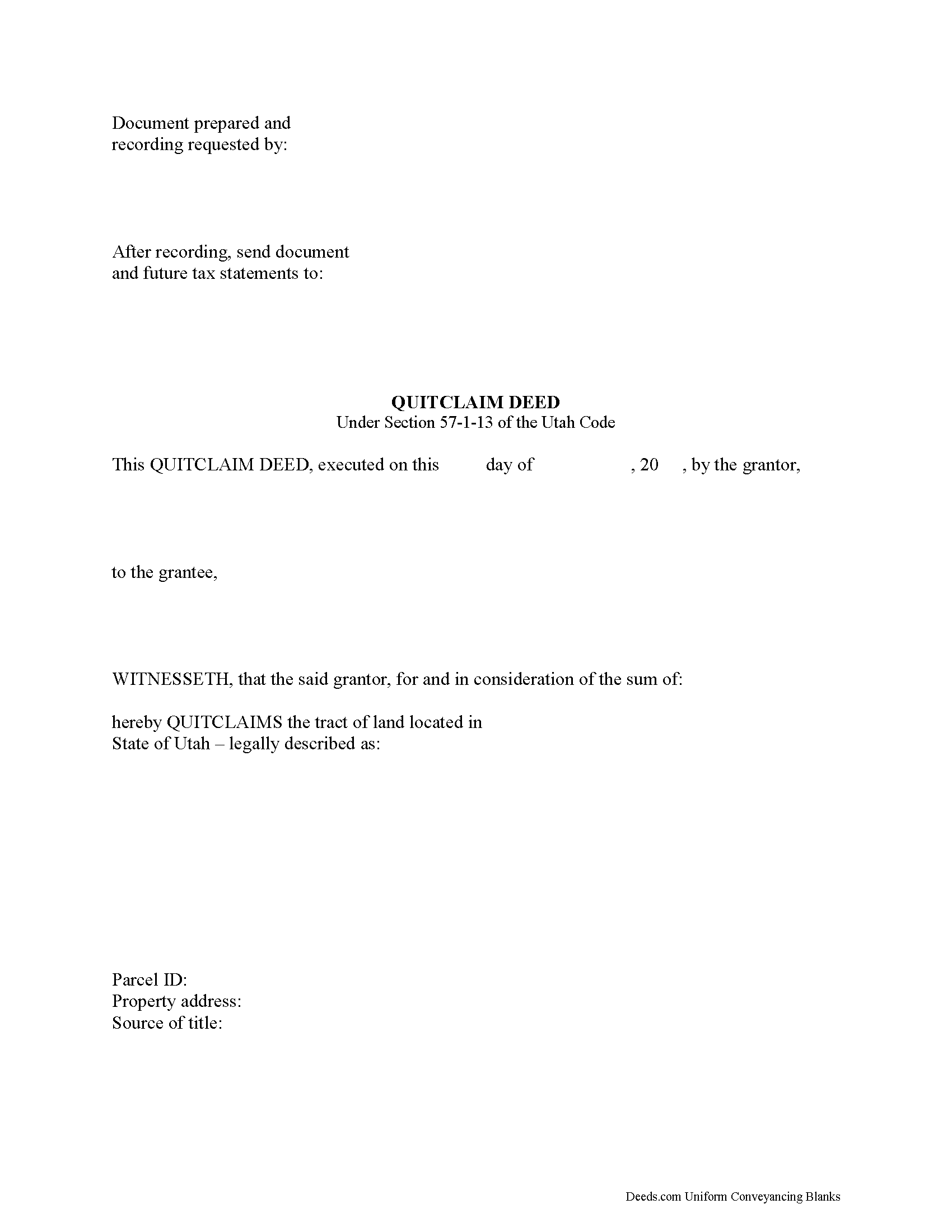
About the Utah Quitclaim Deed
How to Use This Form
- Select your county from the list
- Download the county-specific form
- Fill in the required information
- Have the document notarized if required
- Record with your county recorder's office
What Others Like You Are Saying
"Very simple to use. I am a private homeowner with no experience in such things and it was very easy …"
"Very impressed with how fast the service was. Got what I needed within 20 to 30 minutes."
"Very easy site to navigate. The quit claim deed I downloaded was perfect for my needs. Would like to…"
"Great service"
"Excellent service, very user friendly"
4.8/5 from 4,836 reviews. Read all
Utah prints the deed's operative words in its own code and leaves everything about the parties open. Section 57-1-13 sets out a quitclaim deed a conveyance may follow substantially: one verb does the legal work, quitclaims, and blanks carry the rest. This is the base configuration of the Utah quitclaim deed, built the same way: one or two people on each side, signing in their own right, and nothing about status or co-ownership preprinted on the page.
One verb, and the reach the statute gives it
A quitclaim deed executed as Utah law requires carries the effect the same section states: a conveyance of all right, title, interest, and estate of the grantor in the premises described, with the rights, privileges, and appurtenances belonging to them, measured at the date of the conveyance. No covenant of title travels with those words, so a trust deed, judgment lien, easement, or plat restriction of record survives the filing untouched. Utah also settles by statute what most states leave to their courts: Section 57-1-10(2) holds quitclaim deeds outside the after acquired title rule, so an interest a grantor picks up later stays with that grantor.
Blank party lines, and the words Utah reads in them
The grantor line takes one or two names as the current vesting deed writes them, with whatever status wording the parties use, and the grantee line does the same, leaving room for a co-ownership designation after the names. Utah reads those entries closely. Since May 1, 2024, Section 57-1-5 has read a grant to two or more people in their own right as a joint tenancy carrying survivorship unless the deed severs it, converts it, or declares another form, so two grantee names and no designation land in survivorship by force of statute, while wording such as as tenants in common displaces it. Section 57-1-3 supplies the other half, deeming an estate a fee simple unless a lesser one appears in the conveyance.
The count patterns this form recites
One grantor to one grantee, one grantor to two, two grantors to one, and two grantors to two are the four patterns the party blocks accommodate, in every case natural persons conveying in their own right. The form is not arranged as a conveyance by a company, a partnership, a trustee in whose name record title stands, or an attorney in fact, each of which recites a capacity and a source of authority this page does not collect, and its two-name blocks do not reach three or more owners on a side. Section 57-1-5 gives that boundary teeth, barring a joint tenancy between a person and an entity or a trustee, so survivorship wording behaves differently the moment either reaches the grantee line.
Two signature blocks, two certificates, and the single-owner deed
Execution follows the count. The instrument draws a GRANTOR block and a SECOND GRANTOR block, each carrying the printed name line Section 17-71-403 has the county recorder index, and each with its own certificate written to the Statutory Short Form of Acknowledgment at Section 57-2a-7. Two certificates let two owners appear before different notaries on different days; where a single owner conveys, the second block and the certificate under it stay empty. No subscribing witness is called for, and because Section 75-2-112 abolished dower and curtesy, no marital release rides the page.
What the county recorder is looking for
Recordability turns on content. Under Section 57-3-105 a document executed to convey title reaches the record only when it names the grantees, recites the mailing address for their assessment and tax notices, and carries a legal description; Section 57-3-106 lets a recorder refuse what does not comply and asks for a first page caption, which the words QUITCLAIM DEED supply. Page geometry answers the format menu of Section 17-71-402, the county serial number riding in the first page margin that subsection (5) opens to it. Utah levies no transfer tax and prices the instrument rather than the page, at 40 dollars under Section 17-71-407 for as many as ten legal descriptions, with 5 more in second through sixth class counties.
The purchase brings the fillable Utah form, a completed example worked out on a Sanpete County pattern where two owners quitclaim a platted lot to two grantees taking with survivorship, and a plain language guide covering the numbered sections, the co-ownership choices Utah recognizes, the notarization, and recording. Everything here describes Utah statutes in general terms; none of it is legal advice.
Important: County-Specific Forms
Our quitclaim deed forms are specifically formatted for each of the 29 counties in Utah.
After selecting your county, you'll receive forms that meet all local recording requirements, ensuring your documents will be accepted without delays or rejection fees.