Alabama Correction Deed
County Specific Legal Forms Validated as recently as October 15, 2026 by our Forms Development Team
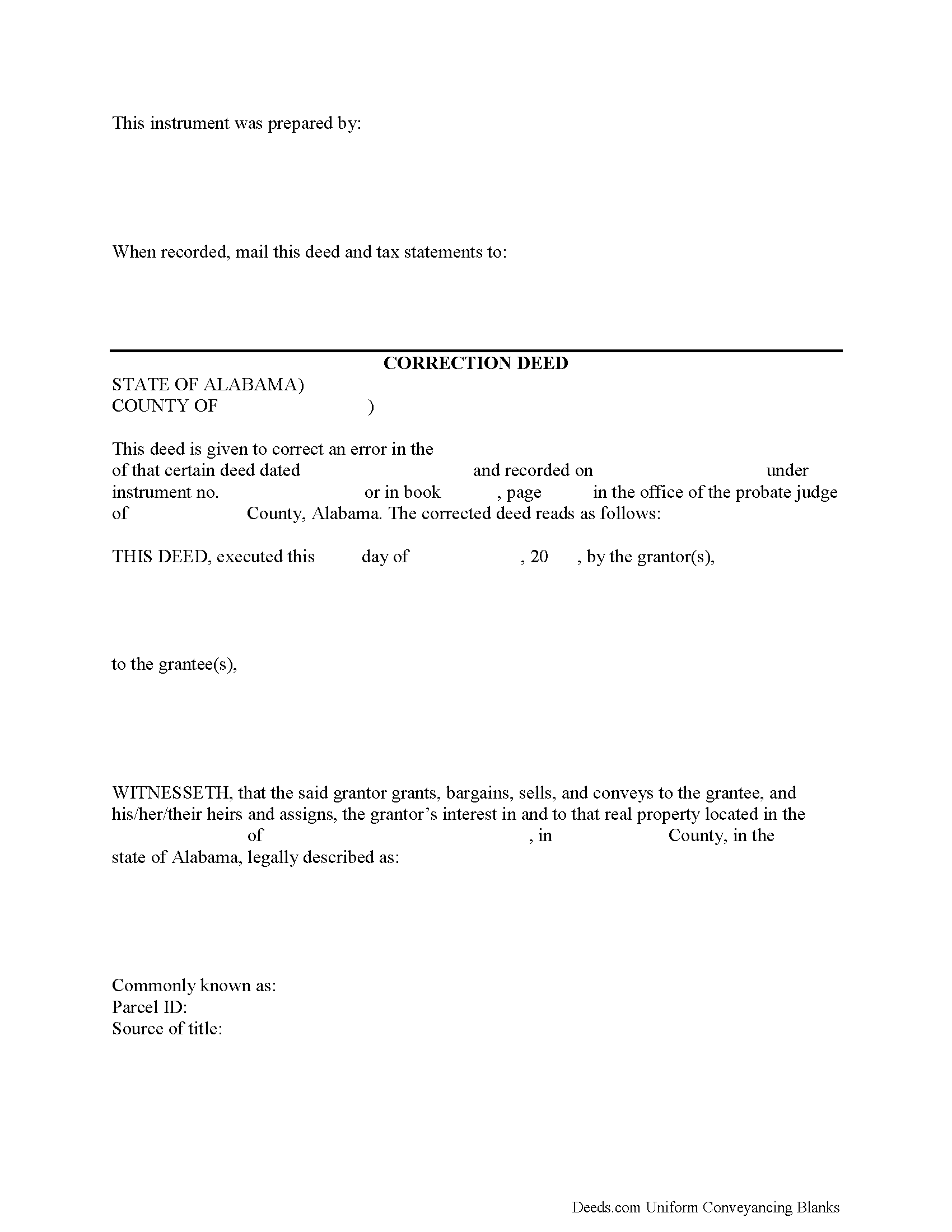
About the Alabama Correction Deed
How to Use This Form
- Select your county from the list
- Download the county-specific form
- Fill in the required information
- Have the document notarized if required
- Record with your county recorder's office
What Others Like You Are Saying
"I recomemed this webside"
"This was a great service! I was having trouble recording something and found this was the best, and …"
"easy to use website."
"Great website to find state documents. I do like the one-time charge also vs a recurring charge. Tha…"
"LOVE this site.. easy to use and very very quick to record"
4.8/5 from 4,828 reviews. Read all
Alabama property records live at the county Probate Court, not a recorder's office, and that single distinction shapes how a correction deed works in the state. When a deed has already been recorded with the Judge of Probate and it contains an error — a misspelled name, a defective legal description, an incorrect book and page reference, or a flawed notary acknowledgment — a corrective instrument must be prepared, signed, notarized, and filed in the same Probate Court. Alabama's correction deed accomplishes that: it identifies the prior instrument by execution date, recording date, and book/page or instrument number; states the nature of the error; and sets out the corrected information within a complete re-recording of the deed. The result is a clean chain of title at the Probate Court rather than a recorded defect that resurfaces at closing or during a title search.
When a Correction Deed Is Used in Alabama
A correction deed is the appropriate instrument when a previously recorded Alabama deed contains a scrivener's error or technical defect that does not reflect the original intent of the parties. Common situations include misspelled grantor or grantee names, an incorrect legal description, a missing or inaccurate plat reference, a defective notary acknowledgment, and erroneous recording data cited in the chain of title. Because the correction deed re-records the prior instrument in its corrected form, it does not convey new title — it memorializes what the parties originally intended and corrects the public record to reflect that intent.
Alabama Statutory Requirements
Alabama law governs the conveyance of real property under Title 35 of the Alabama Code. A correction deed must meet the same formal requirements as any deed subject to recording in the state. The instrument must be in writing, signed by all grantors, and must reference the prior deed with specificity — including its execution date, recording date, and the book and page number or instrument number under which it was indexed at the Probate Court. The correction deed then restates the deed in its entirety, identifies the error, and provides the corrected information in the appropriate place within the instrument.
Alabama requires that the person or firm who prepared the instrument be identified on the face of the deed. The preparer's name and address must appear on the document before it will be accepted for recording at the Probate Court. Omitting the preparer identification line is one of the most common reasons Alabama deeds are returned unfiled.
Execution Requirements
All parties who signed the original deed must also sign the correction deed. Alabama requires that a deed offered for recording be either attested by one witness or acknowledged before a notary public (Ala. Code § 35-4-20; § 35-4-50). In practice, notarization is the standard — the grantor signs before a notary public, who completes the acknowledgment block with the date, the notary's signature, and the notary's commission expiration date. If the original deed had a defective acknowledgment — a missing date, an incorrect venue, or a blank commission expiration — the correction deed provides an opportunity to supply a properly completed acknowledgment, which is one of the more common reasons a corrective instrument becomes necessary in Alabama.
Alabama-Specific Traps
Homestead and Spousal Assent
Alabama homestead law requires that a conveyance of property used as the family homestead be signed by both spouses, even if title is held in only one spouse's name (Ala. Code § 6-10-3). This requirement applies to the correction deed as well. If the property being corrected is or was homestead at the time of the original deed, and the non-titled spouse did not sign the original instrument, the correction deed presents an opportunity to cure that deficiency — but only if both spouses now execute the corrective instrument. Failure to include the non-titled spouse's signature on a homestead correction deed leaves the title objection in place.
Marital Status Recital
Alabama deed practice requires that the grantor's marital status be stated in the instrument. A correction deed should include an accurate marital status recital for each grantor. If the original deed omitted or misstated marital status, the correction deed should supply or correct it. This is not merely a drafting convention — it directly affects whether the homestead spousal assent requirement is triggered and whether a title examiner can evaluate the instrument without raising an exception.
Legal Description and Plat References
A defective legal description is one of the most serious errors a correction deed can address, and Alabama courts treat legal descriptions strictly. Where the property was conveyed by reference to a recorded subdivision plat, the correction deed must identify the plat book and page number in the legal description. A metes-and-bounds description must close. If the prior deed's description was ambiguous or referenced survey data incorrectly, the correction deed must provide a description sufficient to identify the parcel without resort to extrinsic evidence. Where there is doubt about the accuracy of an existing description, a current survey is advisable before preparing the corrective instrument.
Deed Tax
Alabama imposes a state deed tax (also called a real estate transfer tax) on instruments conveying real property, calculated at $0.50 per $500 of value. A correction deed that does not convey new consideration — one that merely corrects an error in a previously recorded instrument — is generally not subject to the transfer tax because no new transfer is occurring. However, the Probate Court may require documentation or a recital confirming that no new consideration is passing. Grantors should be prepared to address the tax question at the time of recording, and the instrument should make clear on its face that it is corrective rather than a new conveyance.
Recording with the Judge of Probate
Unlike most states, Alabama records deeds not with a county recorder but with the Judge of Probate in the county where the property is located. This is a critical distinction for anyone accustomed to recording in other states. The correction deed must be submitted to the same Probate Court that recorded the original instrument, and the filing must be indexed under the same parties and property. Alabama follows a race-notice recording statute, meaning a subsequent purchaser who records first without notice of a prior unrecorded interest takes priority — prompt recording of the correction deed is important to preserve the corrected title's standing in the chain.
What Is Included in the Download Package
The Alabama Correction Deed package includes the form itself, a set of detailed instructions for completing each section of the instrument, and a completed example showing how a typical correction deed is prepared for recording with an Alabama Judge of Probate. The package is designed for use in Alabama only and is specific to the requirements of Alabama law and Probate Court practice.
Important: County-Specific Forms
Our correction deed forms are specifically formatted for each of the 67 counties in Alabama.
After selecting your county, you'll receive forms that meet all local recording requirements, ensuring your documents will be accepted without delays or rejection fees.