Alabama Durable Power of Attorney
County Specific Legal Forms Validated as recently as September 24, 2026 by our Forms Development Team
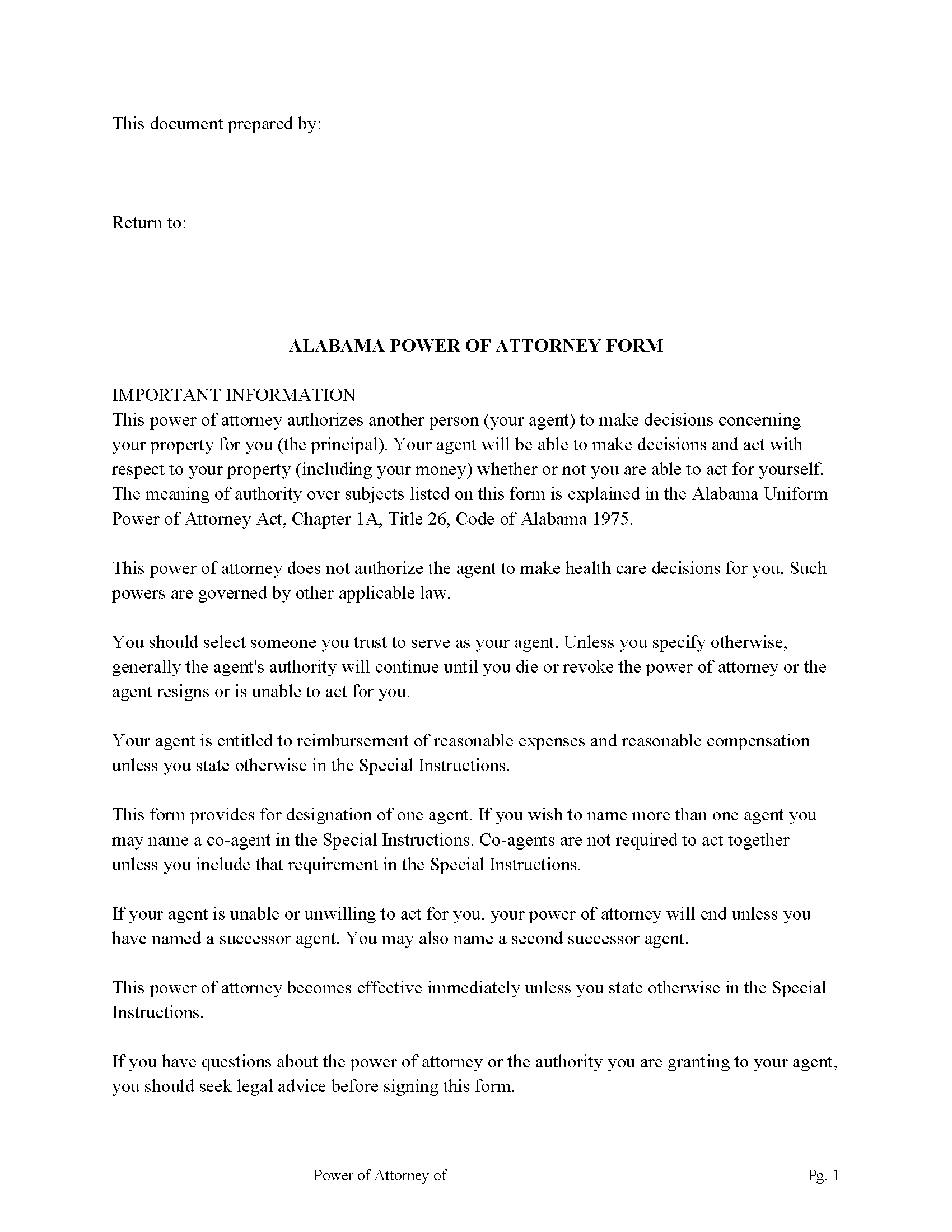
About the Alabama Durable Power of Attorney
How to Use This Form
- Select your county from the list
- Download the county-specific form
- Fill in the required information
- Have the document notarized if required
- Record with your county recorder's office
What Others Like You Are Saying
"Easiest way I've found to get Warranty Deeds in different parts of the country. Highly recommend."
"amazing job!!"
"An excellent service!"
"Excellent service and customer support. Thank you for your help and time."
"Deeds.com was so simple and easy to use! My local recorders office is closed due to COVID-19 and the…"
4.8/5 from 4,823 reviews. Read all
Alabama's Durable Power of Attorney operates under a comprehensive statutory framework — the Alabama Uniform Power of Attorney Act (Chapter 1A, Title 26) — that defines every authority the agent receives by reference to a specific code section. That structure matters in practice: a broadly worded grant that works in a non-UPOAA state may fall short in Alabama because the Act enumerates what each granted power actually authorizes. If the power is not expressly listed or tied to a statutory category, third parties — banks, title companies, county probate offices — are entitled to refuse it. Understanding how Alabama's version differs from generic power of attorney forms is the first step toward executing one that actually works.
What the Alabama Durable Power of Attorney Does
A durable power of attorney authorizes an agent (also called an attorney-in-fact) to act on behalf of the principal in legal and financial matters. Under Alabama law, "durable" means the authority survives the principal's incapacity — the power is not terminated by the principal's loss of capacity (26-1A-102(2)). This is the default under the Act: unless the document expressly provides otherwise, incapacity does not end the agent's authority. The instrument becomes effective when executed unless the principal specifies a future date or a triggering event or contingency, such as a physician's certification of incapacity (26-1A-109). These two provisions — durability and immediate effectiveness — are the baseline in Alabama, but both can be modified by the document itself.
Alabama Statutory Authority Structure
The Alabama UPOAA takes a catalog approach to agent authority. Each category of power — real property transactions, personal property transactions, stock and bond transactions, banking and financial institution transactions, business operations, insurance, estates and trusts, claims and litigation, government benefits, tax matters, and more — is defined by its own statutory section (26-1A-204 through 26-1A-216). When the principal grants authority over "real property transactions," the agent receives exactly the powers described in 26-1A-204, no more and no less, unless the document expands or limits that grant.
This means a form drafted for another state's common-law POA framework may leave gaps or create ambiguities that Alabama recorders and financial institutions will flag. The Alabama-specific form links each granted power to the corresponding statutory definition, giving third parties a clear basis for reliance.
Hot Powers Requiring Express Authorization
Alabama law identifies a set of actions so significant that they require explicit authorization in the document — a grant of general authority is not enough. These are sometimes called "hot powers." Unless the power of attorney expressly grants one of the following, the agent cannot exercise it:
- Create, amend, revoke, or terminate an inter vivos trust
- Make gifts
- Create or change rights of survivorship
- Create or change a beneficiary designation
- Delegate authority to another person
- Waive the principal's right as a beneficiary of a joint and survivor annuity
- Exercise fiduciary powers the principal has authority to delegate
- Disclaim property, including a power of appointment
Each of these categories must be called out specifically in the document (26-1A-201). A form that includes checkboxes or signature lines for each hot power — and leaves unselected items visibly excluded — gives the principal the clearest record of intent and gives third parties the clearest basis for reliance or refusal.
Execution Requirements
The principal must sign the power of attorney, or direct another individual to sign in the principal's presence. The signature must be acknowledged before a notary public (26-1A-105). Alabama does not require witness signatures for a durable power of attorney to be valid under the Act itself, which differs from states that mandate one or two disinterested witnesses at execution. However, if the power of attorney will be recorded in the county probate office — necessary when the agent will conduct real property transactions — notarization is required for recording, and some financial institutions impose their own witness requirements regardless of the statutory minimum.
The agent is not required to sign the document at execution, but Alabama law provides a statutory agent certification form that agents can use when presenting the power of attorney to third parties (26-1A-302). Many Alabama banks and title companies expect the agent to sign an acknowledgment of their duties and the scope of their authority before honoring the instrument.
Agents, Co-Agents, and Successor Agents
A principal may name one agent, co-agents who act jointly or severally, or successor agents. Successor agents become active only when all predecessor agents have resigned, died, become incapacitated, lost qualification, or declined to serve (26-1A-111(b)). Unless the document says otherwise, a successor agent has the same authority as the original agent — there is no need to re-enumerate powers in the successor designation. The principal may also grant an agent or a named third party the power to designate successors, which is useful when the principal cannot predict who will be available years in the future.
Co-agent arrangements require careful drafting. If co-agents must act jointly and one becomes unavailable, the power may be paralyzed unless the document addresses that contingency. If co-agents may act severally (independently), third parties dealing with one agent cannot verify what the other may have done. Alabama's Act does not default to one arrangement or the other — the document controls.
Real Property Transactions and Recording
When the agent will execute deeds, mortgages, or other instruments affecting Alabama real property, the power of attorney should be recorded in the County Probate Office of the county where the property is located. Alabama's probate courts serve as the recorder of deeds and real property instruments, so a power of attorney used in a real estate closing will need to meet the same acknowledgment standards as the deed it authorizes. Recording protects third parties who rely on the agent's authority and establishes a public record of the grant. An unrecorded power of attorney used in a real estate transaction creates title risk that title insurers and subsequent purchasers will scrutinize.
The power of attorney form includes lines for real property to be specifically identified, which is useful when the principal intends to authorize the agent to act on one or more specific parcels rather than all real property the principal owns.
Agent Duties and Limitations
Alabama's Act imposes a baseline of fiduciary duties on the agent regardless of what the document says. The agent must act in good faith, within the scope of authority granted, and in accordance with the principal's reasonable expectations to the extent known. The agent must act loyally, avoid conflicts of interest, and keep the principal's property separate from the agent's own. These duties cannot be waived by the document — they are statutory minimums (26-1A-114). The principal can expand or restrict certain default rules, but the core loyalty and good-faith obligations remain.
Termination
A durable power of attorney terminates when the principal revokes it, when the principal dies, when the purpose of the power is accomplished, or when the agent's authority terminates and no successor agent is available to serve (26-1A-110). Revocation is effective when communicated to the agent, but it does not affect a third party who acts in good faith without notice of the revocation. For revocations affecting real property authority, recording a revocation in the County Probate Office provides constructive notice. A principal who has recorded the original power of attorney should record the revocation in the same office.
Download Package
The Alabama Durable Power of Attorney package includes the power of attorney form drafted to conform to the Alabama Uniform Power of Attorney Act (Chapter 1A, Title 26), a completed example showing how a properly executed instrument looks, and a guide covering execution, agent responsibilities, recording in the County Probate Office, and revocation. The form includes enumerated statutory authority grants, express lines for hot-power authorization, successor agent designation, and space to identify specific real property. Everything needed to prepare, execute, and record the instrument is included in a single download.
Important: County-Specific Forms
Our durable power of attorney forms are specifically formatted for each of the 67 counties in Alabama.
After selecting your county, you'll receive forms that meet all local recording requirements, ensuring your documents will be accepted without delays or rejection fees.