Alaska Transfer on Death Deed (Unmarried Sole Owner)
Borough or Census Area Specific Legal Forms Validated as recently as October 19, 2026 by our Forms Development Team
About the Alaska Transfer on Death Deed (Unmarried Sole Owner)
How to Use This Form
- Select your borough or census area from the list
- Download the borough or census area-specific form
- Fill in the required information
- Have the document notarized if required
- Record with your borough or census area recorder's office
What Others Like You Are Saying
"good place to get documents and it seems like a sound place to get forms. Self explainitory and help…"
"Awesome and quick service again, just like always from KvH. Thanks!"
"Fast and professional service."
"so far so good. was hoping to have the recorded document already. i need the recorded document by fr…"
"Fast, honest company Worth every penny! DO IT YOURSELF SAVE THOUSANDS"
4.8/5 from 4,828 reviews. Read all
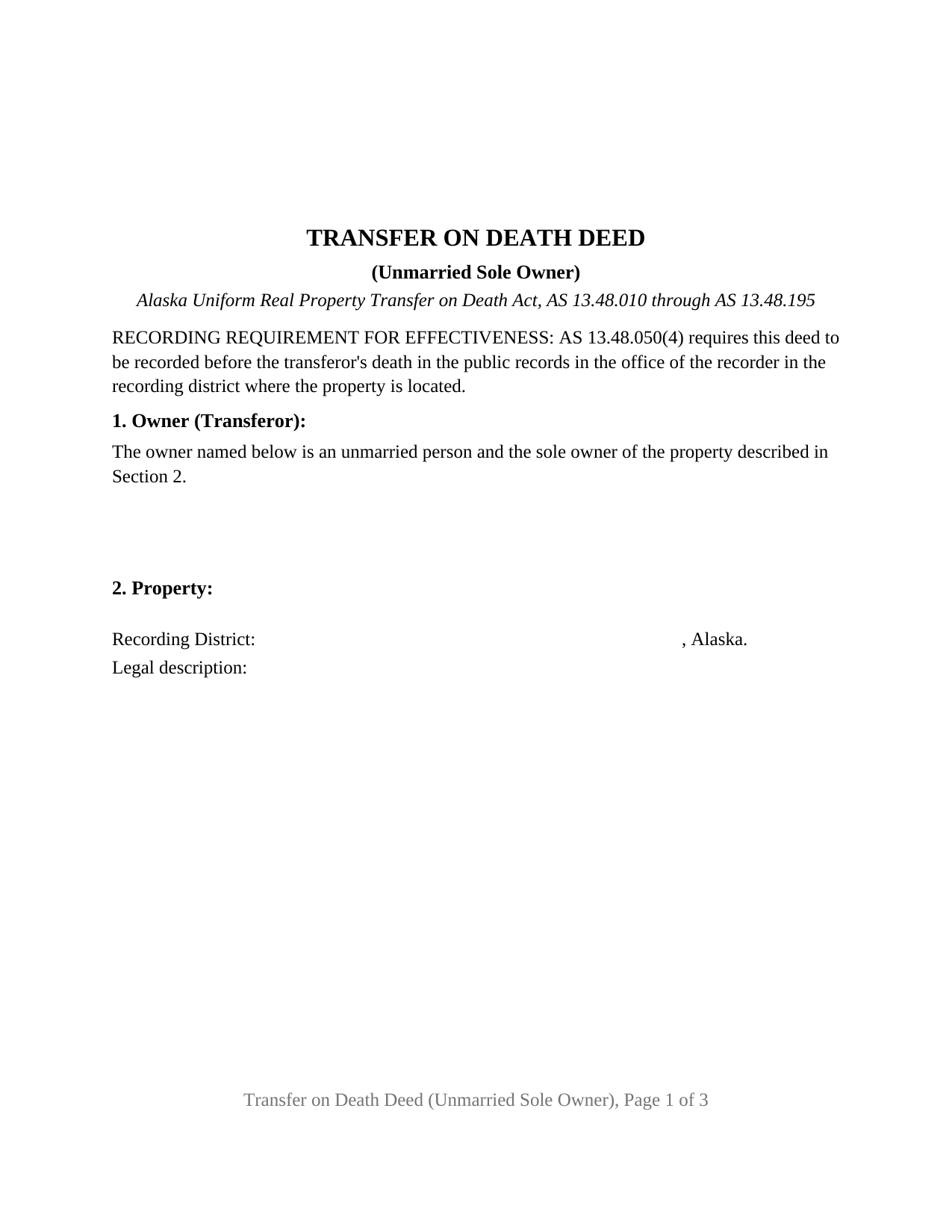
This Alaska transfer on death deed recites one owner: an unmarried person who holds the property alone. The owner recital is printed as fixed deed text, so the owner side takes only a name and mailing address, and the instrument carries one signature block and one acknowledgment certificate. What the Alaska Uniform Real Property Transfer on Death Act, AS 13.48, asks of a beneficiary deed is built in.
A recital the deed prints, not one the owner drafts
Section 1 states that the owner named is an unmarried person and the sole owner of the property described in Section 2. The recital states the status the owner asserts; nothing on the form invites a marital-status selection, a second-owner line, or a description of how title is held. An owner who never married, an owner widowed after a spouse's interest passed, and an owner holding title alone after divorce present this pattern. The AS 34.15.010(b) joinder rule for a lifetime conveyance of the family home and the tenancy by the entirety of AS 34.15.110(b) each depend on a spouse, and the deed recites none.
Why a sole owner's deed reads differently from a joint owner's
AS 13.48.090(c) postpones a joint owner's transfer: where a transferor is survived by another joint owner, the property belongs to the survivor and the deed operates only at the last joint owner's death. That rule turns on survivorship title and has no work to do on a sole owner's deed, so this instrument carries the single statutory trigger and nothing about a second death: the operative sentence of the AS 13.48.120 optional form, printed word for word, under which the owner's interest passes at the owner's death to the beneficiaries designated above it, followed by the form's line preserving the right to revoke and the AS 13.48.090(d) rule that the transfer carries no covenant or warranty of title.
Beneficiaries, alternates, and an optional agent
The primary beneficiary section receives each beneficiary individually, by name with mailing address, since AS 13.48.050(3) voids a designation that identifies beneficiaries only as a class. A beneficiary may be a natural person, a trust identified by its name and trustee, or an entity identified by its legal name, because AS 13.48.190(4) defines a person to include each of them. An optional alternate section takes the share of a primary beneficiary that lapses, as AS 13.48.090(a)(5) permits, and a further optional section carries the statutory form's grant of authority to a designated agent to revoke the deed, the express grant AS 13.48.070(e) requires. Where either optional section is unused, the entry reads None designated.
One signature, one certificate, one recording district
The owner signs once, and the acknowledgment certificate below the notary line is the AS 09.63.100 short form with the State of and Judicial District venue lines the Alaska forms print. Alaska records through the Department of Natural Resources Recorder's Office by recording district, not by county, and AS 13.48.050(4) makes recording in the district where the property lies, before the owner's death, the condition of the deed's effect; the form prints that requirement above its first section, collects the recording district in its property section, and collects the return name and address and the mailing addresses AS 40.17.030 requires.
What stays the same while the owner lives
Under AS 13.48.080 the recorded deed changes nothing during life: the owner keeps the right to sell or encumber the property, no creditor's position shifts, and the beneficiary acquires no interest. Revocation follows AS 13.48.070, by a later transfer on death deed, an instrument of revocation, or a lifetime deed that expressly revokes it, each acknowledged after this deed and recorded before death in the same recording district; a will does not revoke it. At death, AS 13.48.090(b) passes the property subject to every mortgage, lien, and other interest of record, and where the probate estate is insufficient AS 13.48.110 lets claims reach it through a proceeding begun within 12 months after death.
The instrument prints at 12 point on letter paper with the first-page reserve and margins 11 AAC 06.040 requires, and Alaska charges a per-page recording fee with no transfer tax. The package contains the fillable transfer on death deed, a completed example for a Fairbanks Recording District owner naming one beneficiary and one alternate, and a guide covering every section, the signing rules, and the recording process. This description and the guide are general descriptions of the form and the statutes that govern it, not legal advice.
Important: Borough or Census Area-Specific Forms
Our transfer on death deed (unmarried sole owner) forms are specifically formatted for each of the 27 borough or census areas in Alaska.
After selecting your borough or census area, you'll receive forms that meet all local recording requirements, ensuring your documents will be accepted without delays or rejection fees.