Alaska Warranty Deed (Married Grantor with Spouse Joinder)
Borough or Census Area Specific Legal Forms Validated as recently as August 27, 2026 by our Forms Development Team
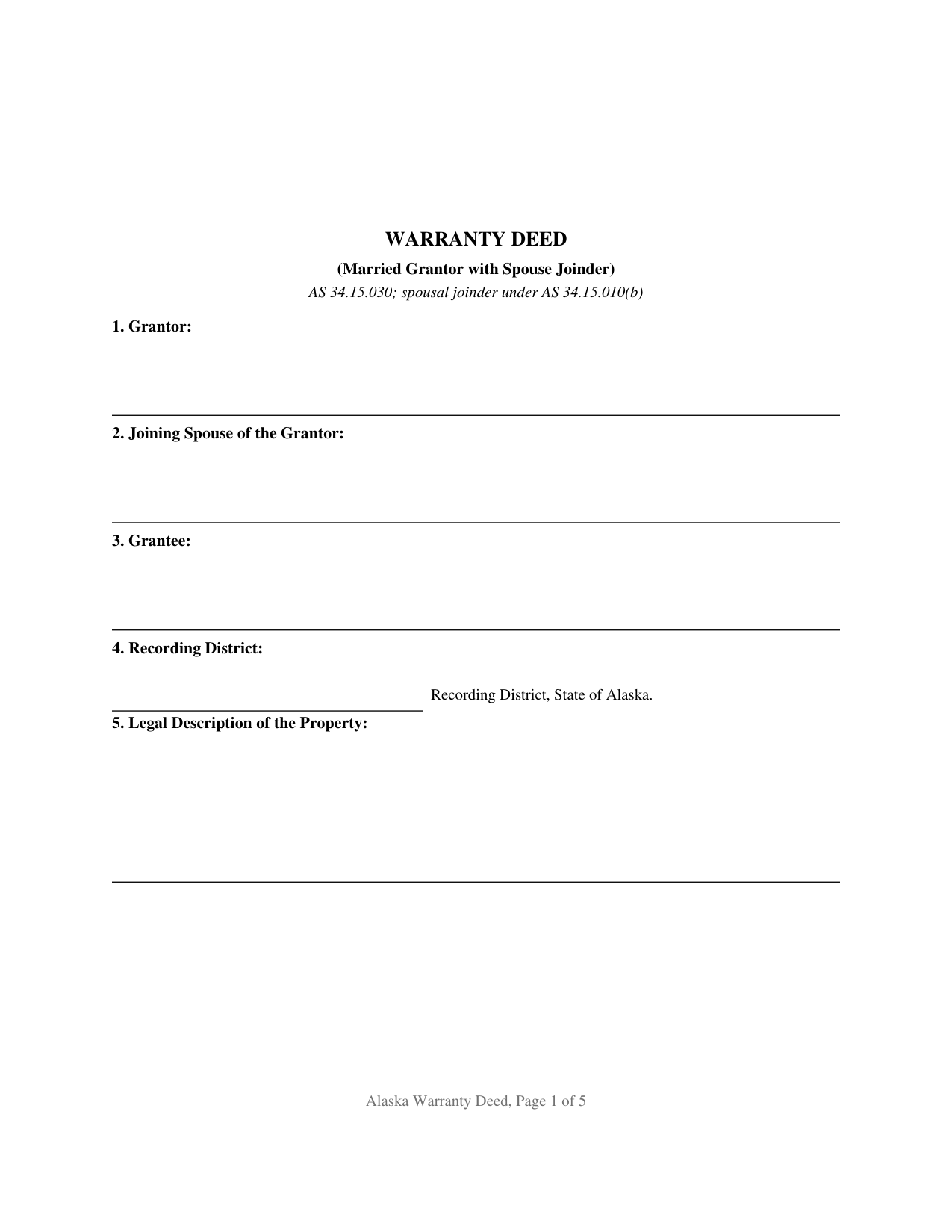
About the Alaska Warranty Deed (Married Grantor with Spouse Joinder)
How to Use This Form
- Select your borough or census area from the list
- Download the borough or census area-specific form
- Fill in the required information
- Have the document notarized if required
- Record with your borough or census area recorder's office
What Others Like You Are Saying
"Great Service. Not only the required form, but also the state guidelines. Thank you for making it ea…"
"Deeds was very easy to use. I thought it might take weeks to complete, but the whole process was com…"
"So far so good! I haven't had an opportunity to populate the forms but they seem to be very easy to …"
"I had a wonderful experience and am looking forward to doing business with you again."
"Forms and instructions are very easy to access. Thank you!"
4.8/5 from 4,819 reviews. Read all
When a married property owner conveys Alaska real estate, the deed may carry a second signature alongside the grantor's own: the grantor's spouse, joining to satisfy the family home or homestead requirement Alaska law places on that transfer. This form prepares exactly that instrument, a warranty deed under AS 34.15.030 with a Section 11 spousal joinder block, built for the one-married-grantor pattern.
Why a second signature appears on a married owner's deed
AS 34.15.010(b) provides that in a deed or conveyance of the family home or homestead by a married person, the husband and wife join in the deed. The Alaska Supreme Court has drawn the statute's edges: the protected property is the residence in which the family resides, a family-home conveyance that a title-holding spouse did not join is invalid, and a conveyance made without a non-title spouse's joinder remains open to a suit or a recorded notice of interest for one year. The joinder section of this deed carries the second signature that settles the statutory question on the face of the record, together with the AS 34.15.010(c) statement that the joinder vests no proprietary right, title, or interest in the joining spouse.
What the statutory operative words carry
Alaska places the full warranty in two words: conveys and warrants. A deed substantially in the AS 34.15.030 form draws three title covenants from the statute by operation of law. First, the grantor holds an indefeasible fee simple estate and has power to make the conveyance. Second, the property is free of encumbrances at delivery, except for the matters the deed lists in its exceptions section. Third, the grantor stands behind the title and will defend possession against all claimants. Because AS 34.15.080 bars any implied covenant in an Alaska conveyance, these protections exist only where the deed carries the statutory operative language. AS 34.15.075 adds that after-acquired title flows to the grantee by operation of law under this form of deed.
The configuration this deed carries
The form recites one grantor, a married record owner, and one joining spouse, each identified with a full name and complete mailing address. It carries two signature blocks and two acknowledgment certificates, so the grantor and the joining spouse may acknowledge on different dates, before different officers, or in different states, with the Alaska judicial-district venue of AS 09.63.100 printed in each certificate. The grantee section takes one or more grantees together with the ownership form they select, and the completed example shows a married couple taking as tenants by the entirety. The single-grantor pattern appears in the record where a residence is titled in one spouse's name during the marriage; a deed in which both spouses hold record title and both convey follows a different configuration, with both owners in the grantor section, and this form is not set up that way.
Recording in Alaska's district system
Alaska records deeds through a statewide recorder's office organized into 34 recording districts rather than county offices, and this deed names its recording district on its face, as AS 40.17.030(a)(9) requires. The layout follows the state format rules: a two-inch recording reserve at the top of the first page, one-inch margins elsewhere, 10 point type, and the return-address block the recorder requires before accepting a document. Alaska imposes no statewide transfer tax or deed transfer declaration, so the signed and acknowledged deed, with the recording fee, is the complete package presented for recording in the district where the property is located.
The purchase includes the blank deed as a fillable PDF formatted to Alaska recording standards, a completed example showing the entire document filled in for an Anchorage fact pattern, and a plain-language guide that walks through each numbered section, the joinder statute and the decisions construing it, and the recording steps. The materials describe Alaska law in general terms and are not legal advice.
Important: Borough or Census Area-Specific Forms
Our warranty deed (married grantor with spouse joinder) forms are specifically formatted for each of the 27 borough or census areas in Alaska.
After selecting your borough or census area, you'll receive forms that meet all local recording requirements, ensuring your documents will be accepted without delays or rejection fees.