Cochise County Affidavit of Successor Trustee Form
Last validated September 23, 2026 by our Forms Development TeamFormatted for recording in Cochise County, for property anywhere in the county: rural and unincorporated areas as well as Benson, Bisbee, Bowie, Cochise, Douglas, Dragoon, Elfrida, Fort Huachuca and 12 more.
- 3 documents included
- Immediate PDF download
- Formatting guarantee
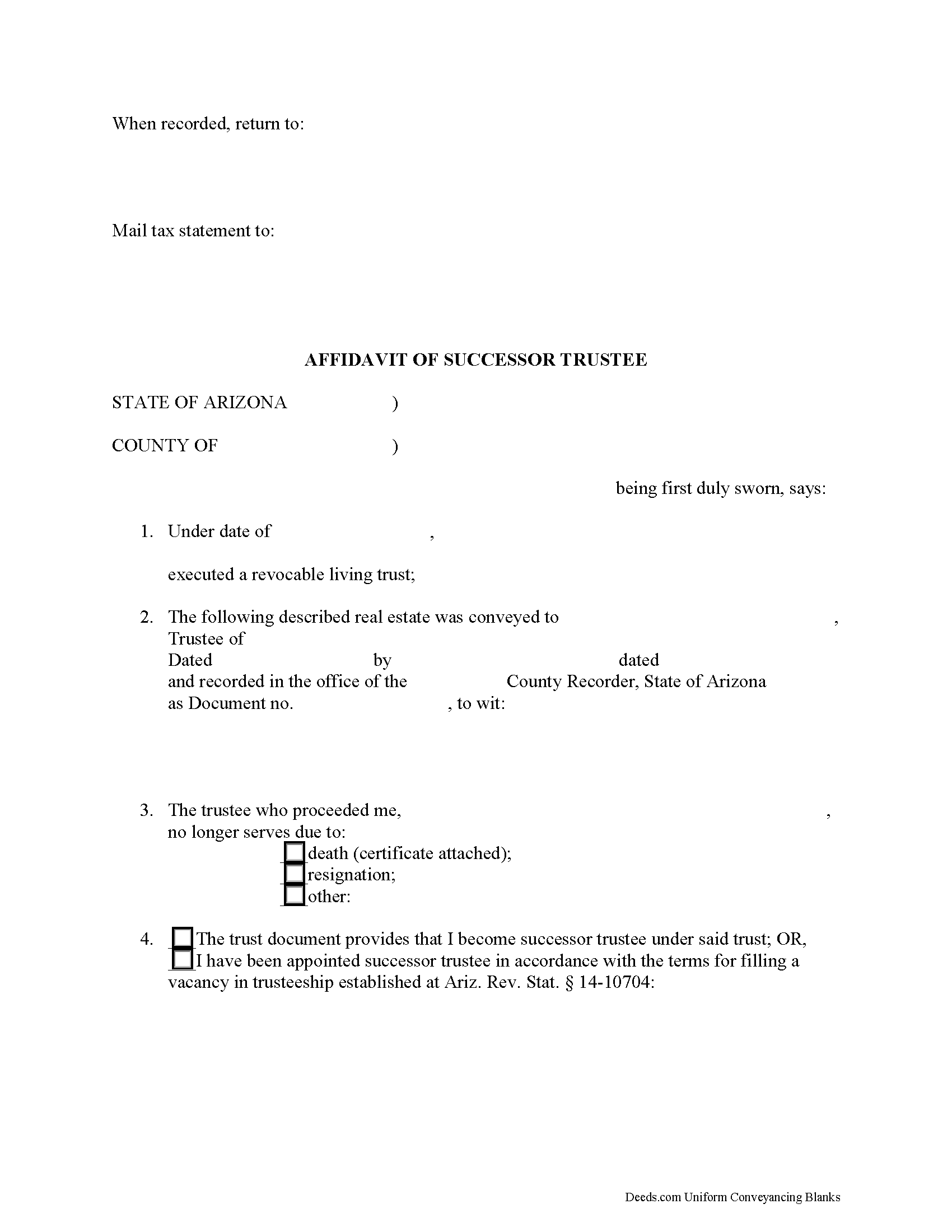
Cochise County Affidavit of Successor Trustee Form
Fill in the blank form formatted to comply with all recording and content requirements.
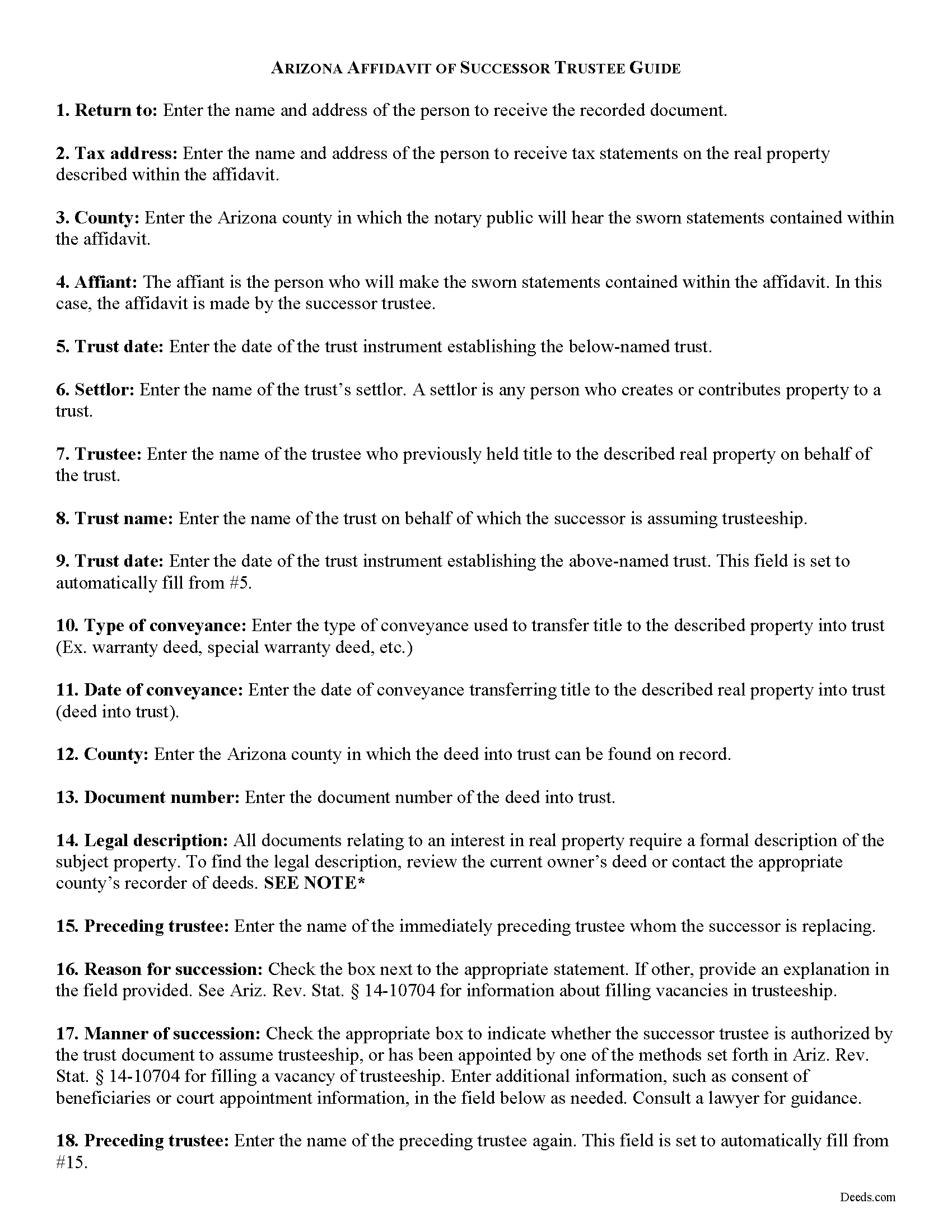
Cochise County Affidavit of Successor Trustee Guide
Line by line guide explaining every blank on the form.
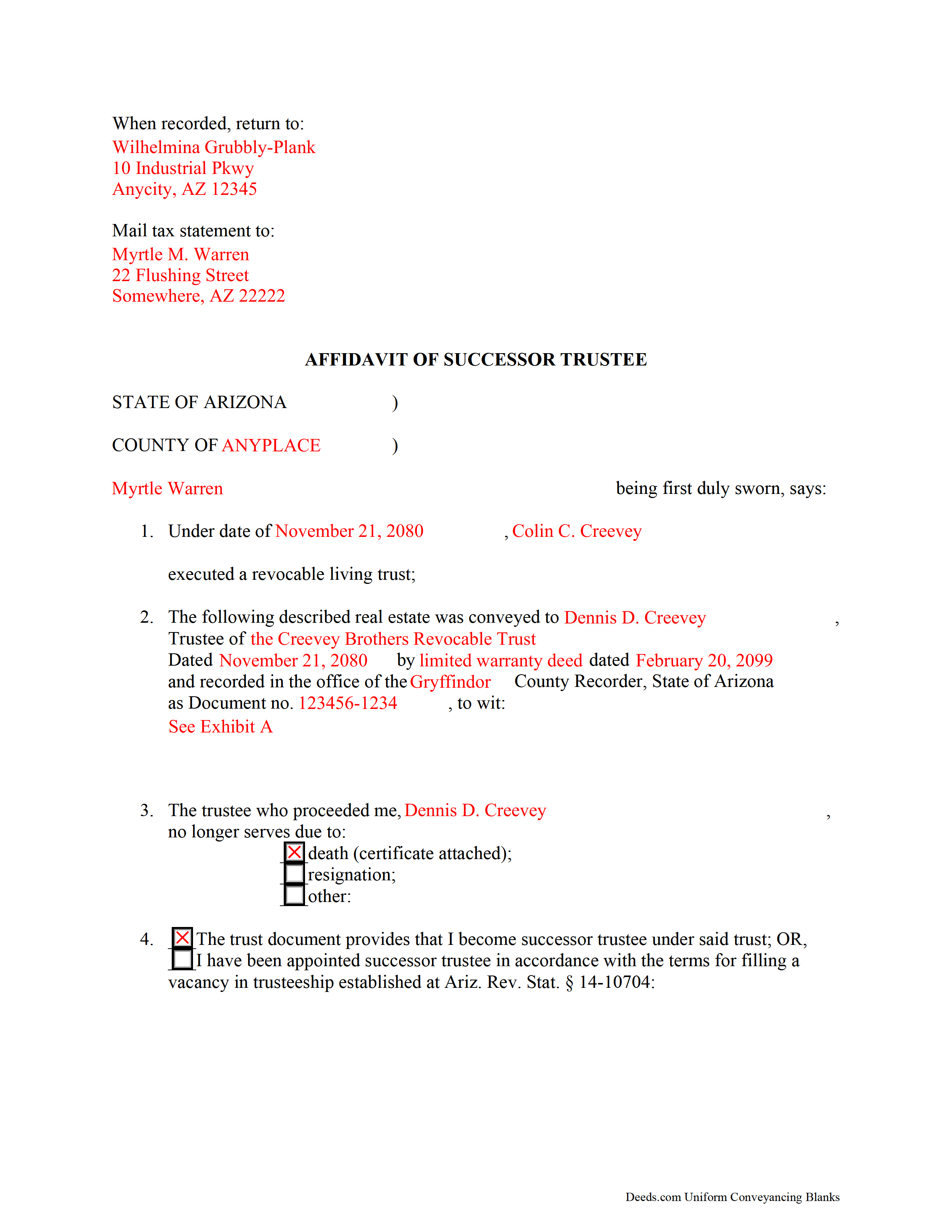
Cochise County Completed Example of the Affidavit of Successor Trustee Document
Example of a properly completed form for reference.
All 3 documents above included • One-time purchase • No recurring fees
Immediate Download • Secure Checkout
Additional Arizona and Cochise County documents included at no extra charge:
Where to Record Your Documents
Recorder's Office
Bisbee, Arizona 85603
Hours: 8:00am - 5:00pm Monday - Friday
Phone: 520-432-8350
Recording Tips for Cochise County:
- Bring your driver's license or state-issued photo ID
- Ensure all signatures are in blue or black ink
- Leave recording info boxes blank - the office fills these
- Make copies of your documents before recording - keep originals safe
- Recorded documents become public record - avoid including SSNs
Cities and Jurisdictions in Cochise County
Properties in any of these areas use Cochise County forms:
- Benson
- Bisbee
- Bowie
- Cochise
- Douglas
- Dragoon
- Elfrida
- Fort Huachuca
- Hereford
- Huachuca City
- Mc Neal
- Naco
- Pearce
- Pirtleville
- Pomerene
- Saint David
- San Simon
- Sierra Vista
- Tombstone
- Willcox
Hours, fees, requirements, and more for Cochise County
How do I get my forms?
Forms are available for immediate download after payment. The Cochise County forms will be in your account ready to download to your computer. An account is created for you during checkout if you don't have one. Forms are NOT emailed.
Are these forms guaranteed to be recordable in Cochise County?
Yes. Our form blanks are guaranteed to meet or exceed the applicable formatting requirements used for recording in Cochise County, including margin requirements, font requirements, and other layout standards. This guarantee applies to formatting, not to the legal sufficiency of information entered by the user or the suitability of a form for a particular transaction.
Can I reuse these forms?
Yes. You can reuse the forms for your personal use. For example, if you have multiple properties in Cochise County you only need to order once.
What do I need to use these forms?
The forms are PDFs that you fill out on your computer. The free Adobe Acrobat Reader is recommended, and most PDF apps also work. You do NOT enter your property information online - you download the blank forms and complete them privately on your own computer.
Are there any recurring fees?
No. This is a one-time purchase. Nothing to cancel, no memberships, no recurring fees.
How much does it cost to record in Cochise County?
Recording fees in Cochise County vary. Contact the recorder's office at 520-432-8350 for current fees.
Questions answered? Let's get started!
The Arizona Affidavit of Successor Trustee is the sworn recorded instrument that documents the change of trusteeship over Arizona real property held in a living trust and establishes the new trustee's authority to act with respect to that property. The affidavit does not itself transfer the property from one trustee to another — a trust holds its assets through the person of the acting trustee, and when trusteeship changes, the trust's property moves with it by operation of trust law rather than by deed. What the affidavit does is put the change on the record in the county where the property is located, so that future title examiners, lenders, and buyers can see who has authority to deal with the trust's real estate. Without a recorded affidavit, the public record continues to show the prior trustee as the holder of record title, even though that person no longer has any authority — a gap that can delay or derail subsequent transactions.
When the Arizona Affidavit of Successor Trustee Is Used
This affidavit is used whenever an Arizona living trust experiences a change in trusteeship that leaves a new trustee acting individually with authority over trust real property. Typical triggers include the death of the original settlor-trustee of a revocable trust (the successor trustee named in the trust document takes over), the resignation of a trustee in favor of a successor, removal of a trustee by court order or by action of the beneficiaries under the trust instrument, incapacity of an individual trustee, appointment of a guardian or conservator for an individual serving as trustee, and declination of trusteeship by a designated trustee who does not accept the role. The affidavit is also used when multiple trustees have been serving and only one remains after the others have died, resigned, or been removed, if the trust instrument requires or the remaining trustee wishes to document the sole-trustee status on the record.
Vacancy in Trusteeship Under ARS 14-10704
ARS 14-10704 specifies the circumstances that create a vacancy in trusteeship requiring a new trustee to be appointed. Vacancies occur when a designated trustee rejects the trusteeship, when the designated trustee cannot be identified, when the trustee resigns, when the trustee is disqualified or removed, when the trustee dies, and when a guardian or conservator is appointed for an individual serving as trustee. Each of these events terminates the prior trustee's authority and requires someone else to act — either another designated successor under the trust instrument, a trustee appointed under the instrument's appointment procedure, a trustee selected by unanimous agreement of the qualified beneficiaries, or a trustee appointed by the court. The affidavit of successor trustee documents whichever of these succession mechanisms actually happened, providing the record evidence that the new trustee has authority to act.
When the trust has multiple trustees and one leaves while others continue, ARS 14-10703(B) generally allows the remaining co-trustees to continue serving without filling the vacancy, unless the trust instrument provides otherwise. In that situation, an affidavit may still be useful to document the change and update the record about who the acting trustees are, but the formal succession-to-individual-trusteeship framework of 14-10704 does not apply.
How a Successor Trustee Is Selected
ARS 14-10704(C) establishes a hierarchy for filling vacancies in trusteeship, applicable to noncharitable trusts. The first source is the trust instrument itself: most well-drafted revocable living trusts name a series of successor trustees, and the first-named successor who is able and willing to serve takes over. If the trust instrument's successor designations are exhausted or ineffective, the second source is a person with authority in the trust instrument to appoint a successor (sometimes called a trust protector or a designated appointer). The third source is appointment by unanimous agreement of the qualified beneficiaries. The fourth and final source is appointment by the court under ARS 14-10704(E), which provides broad authority for the court to appoint a trustee when necessary for the administration of the trust.
The affidavit should recite which of these succession mechanisms produced the successor trustee's authority. An affidavit that says "I am the successor trustee" without explaining why — without reference to the trust instrument's succession provisions, the prior trustee's death, resignation, or removal, or a court order — leaves questions that a title examiner may follow up on before accepting the affidavit as sufficient.
What the Affidavit Contains
The affidavit is a sworn statement that puts the facts of the trustee succession on the record. Content typically includes the identity of the affiant (the new successor trustee making the sworn statement), the name of the trust and the date of the trust instrument, the identity of the settlor who created the trust, the identity of the prior trustee and the event that created the vacancy (death, resignation, incapacity, removal, declination), reference to the provision of the trust instrument or the mechanism under ARS 14-10704 by which the affiant became the acting trustee, reference to the deed that originally conveyed the real property into the trust (by recording date and recording number), the legal description of the property, and a statement that the affiant is currently acting as trustee and has the authority under the trust instrument to deal with the property.
When the prior trustee died, the affidavit should reference the death and typically be accompanied by a certified copy of the death certificate for recording. When the prior trustee resigned, the affidavit should reference the resignation — some practitioners record a copy of the resignation as an exhibit or as a separate recorded instrument. When removal occurred by court order, reference to the order (and often a certified copy of the order) provides the record evidence. When the affiant was selected by the qualified beneficiaries, documentation of the unanimous agreement should accompany the affidavit or be referenced in it. The goal is that someone reviewing the record months or years later can understand exactly how the affiant became the acting trustee without having to pull the trust instrument or obtain extrinsic evidence.
Variations in Naming
This instrument is sometimes called by different names depending on the triggering event. An Affidavit of Death of Trustee is used specifically when the prior trustee died; it accomplishes the same function but is limited to the death scenario. An Affidavit of Acceptance of Trust or Acceptance of Trusteeship is used when a successor trustee is formally accepting the role, often recorded together with or separate from an affidavit documenting the succession. The Affidavit of Successor Trustee form is the more general instrument and works for any succession scenario, whether the trigger was death, resignation, or removal. The substantive requirements are the same across the variations — the record needs evidence of what changed and who now has authority — but the title and recitals of the affidavit are adapted to the specific triggering event.
Relationship to the Certification of Trust Under ARS 14-11013
Arizona's certification of trust mechanism at ARS 14-11013 lets a trustee document the trust's existence, the current trustee's identity, and the trustee's authority without disclosing the full trust instrument. For many working transactions with trust property — dealing with banks, signing contracts, executing leases — a certification of trust is the standard working document, renewable and updatable as circumstances change. The affidavit of successor trustee is different: it is recorded against specific real property to update the chain of title, while the certification is typically used in closing files and bank records rather than being recorded. Many Arizona transactions involving trust real estate use both — a certification for the title company's and buyer's working files, and an affidavit of successor trustee recorded against the property to update the chain. The two work together and do not substitute for each other.
Community Property and Marital Considerations
When the trust property was originally community property of a married couple and one spouse has died, triggering the succession to the survivor as trustee of a revocable living trust, the affidavit should be drafted with attention to the community property character of the property. Preserving the community property characterization supports the full stepped-up basis at the first death under federal tax law, which is one of the primary reasons Arizona married couples use revocable living trusts in the first place. The affidavit's recitals — particularly the reference to the original deed into the trust and any recitals about the community property character — should support rather than undermine the basis position when it is documented later on a tax return.
Execution and Acknowledgment
Under ARS 33-401, the affidavit must be in writing, signed by the successor trustee in fiduciary capacity, and acknowledged before a notary public or other officer authorized to take acknowledgments. Arizona does not require subscribing witnesses. The acknowledgment should reflect the fiduciary capacity in which the affiant signs — the notarial certificate typically identifies the signer as the "successor trustee of the [name of trust]" rather than individually. Acknowledgments taken outside Arizona must comply with ARS 33-501, which recognizes notaries, judges and clerks of courts of record, and other officers authorized to perform notarial acts in the jurisdiction where the acknowledgment is taken.
Affidavit of Property Value Exemption
Arizona generally requires an Affidavit of Property Value to accompany instruments affecting interests in real property (ARS 11-1133), but an affidavit of successor trustee documents a change in fiduciary capacity rather than a transfer of property and typically qualifies for an exemption under ARS 11-1134. The exemption should be claimed on the face of the affidavit with a statement that the transfer is exempt and a citation to the specific exemption subsection, placed below the legal description. As with other exempt instruments in Arizona practice, recorders routinely reject affidavits that omit the exemption recital even when the transaction plainly qualifies.
Formatting and Recording
ARS 11-480 sets the formatting requirements for every recordable instrument: legible type of at least ten points, white paper no larger than 8.5 by 14 inches, a caption identifying the document (for example, "Affidavit of Successor Trustee"), a top margin of at least two inches on the first page reserved for the recorder's stamp, and minimum half-inch margins elsewhere. Record the affidavit in the county where the real property is located. When the trust holds property in more than one Arizona county, the affidavit should be recorded in each county where property is situated. Confirm current recording fees and accepted forms of payment with the county recorder's office in advance.
What's Included in the Download Package
The Arizona Affidavit of Successor Trustee package includes the affidavit form drafted to identify the trust, the settlor, the prior trustee, and the successor trustee, reference the deed that vested the property in the trust, recite the basis for the succession under the trust instrument and ARS 14-10704, and claim the ARS 11-1134 exemption on the face of the instrument, detailed guidelines covering the Arizona-specific drafting and recording requirements and the interaction with the Arizona Trust Code's succession framework, and a completed example showing how the form should look for a typical trustee succession. All files are available for instant download after purchase.
Important: Your property must be located in Cochise County to use these forms. Documents should be recorded at the county recording office listed above.
This Affidavit of Successor Trustee meets all recording requirements specific to Cochise County.
Our Promise
The documents you receive here are guaranteed to meet or exceed the applicable Cochise County recording format requirements. If there is a rejection caused by our formatting, we will correct the issue or refund your payment. This guarantee applies to document formatting only and does not extend to information entered by the user, the selection of the form, or the legal effect of the completed document.
Save Time and Money
Get your Cochise County Affidavit of Successor Trustee form done right the first time with Deeds.com Uniform Conveyancing Blanks. At Deeds.com, we understand that your time and money are valuable resources, and we don't want you to face a penalty fee or rejection imposed by a county recorder for submitting nonstandard documents. We constantly review and update our forms to meet rapidly changing state and county recording requirements for roughly 3,500 counties and local jurisdictions.
4.8 out of 5 - ( 4,824 Reviews )
Johnnie W. 5 out of 5 stars
Five stars for quick retrieval/no hassle of forms. Will review them again once I have completed the forms and they have been accepted.
Thank you for your feedback. We really appreciate it. Have a great day!
Robert B. 5 out of 5 stars
Excellent service. Unbelievably rapid and detailed responses. Was not happy to have to pay the fee but totally worth it.
Thank you for your feedback. We really appreciate it. Have a great day!
Chris D. 5 out of 5 stars
Easy and affordable. I would recommend deeds.com
Thank you!
Robert R. 5 out of 5 stars
Big savings and easy to use. Thanks so much.
We appreciate your business and value your feedback. Thank you. Have a wonderful day!
Robert B. 5 out of 5 stars
Found this sight on the internet looking for information to add my fiance' to the house deed. Looks like the right place to be. Looking forward to getting the forms I need.
Thank you!
Kimberaley J. 5 out of 5 stars
I had no problem printing out the forms, very easy. Also when I called, customer service was very helpful and very polite. Thank you for that, have a great day.
Thank you!
Kimberly F. 5 out of 5 stars
Ordered and received the quitclaim form. Exactly what I expected, perfect.
Thank you for your feedback. We really appreciate it. Have a great day!
Giuseppina M. 5 out of 5 stars
Fast, reliable excellent service
Your feedback is greatly appreciated. Thank you for taking the time to share your experience!
Sara D. 3 out of 5 stars
Would have been beneficial to have more information about the previous sale history of the property. The report was received in a very timely manner.
Thank you for your feedback. We really appreciate it. Have a great day!
John T. 5 out of 5 stars
I bought a quitclaim deed package, and it was very easy to use. Prints nicely. Two thumbs up!
We appreciate your business and value your feedback. Thank you. Have a wonderful day!
Timothy S. 5 out of 5 stars
The Quit Claim form was submitted, accepted, and processed by Davidson County with no hiccups. Recommended service!
Thank you!
Jan O. 5 out of 5 stars
This was so easy and just what I needed.
Thank you for your feedback. We really appreciate it. Have a great day!
Marilyn G. 5 out of 5 stars
Easy to follow instructions
Thank you for your feedback. We really appreciate it. Have a great day!
Kimberly S. 4 out of 5 stars
I wasted a lot of my time because I didn't do any research to know what I needed. Nobody fault but mine.
Thank you!
Charles F. 5 out of 5 stars
Quick and Easy
Thank you for your feedback. We really appreciate it. Have a great day!