Arizona Durable Power of Attorney
County Specific Legal Forms Validated as recently as October 14, 2026 by our Forms Development Team
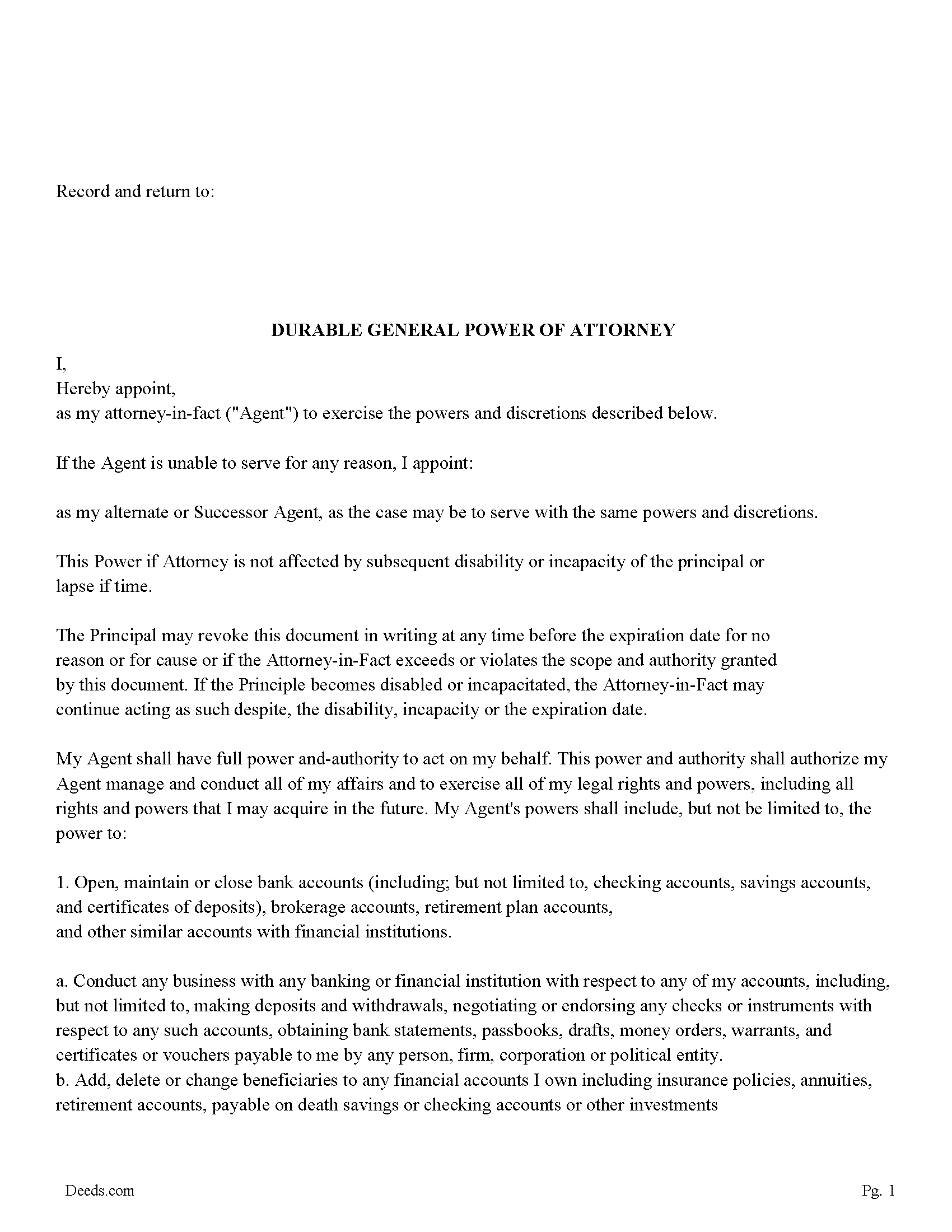
About the Arizona Durable Power of Attorney
How to Use This Form
- Select your county from the list
- Download the county-specific form
- Fill in the required information
- Have the document notarized if required
- Record with your county recorder's office
What Others Like You Are Saying
"The team is very responsive and gets the job done. Thank you."
"Very user friendly website and service."
"Seems to be just what I needed. I will certainly keep your services handy in the future. I will reco…"
"EXCELLENT resource for ALL state documents! The forms come with explanations and examples. A real De…"
"very simple to use"
4.8/5 from 4,834 reviews. Read all
The Arizona Durable Power of Attorney authorizes an agent to act on the principal's behalf and — critically — continues in effect if the principal later becomes incapacitated, which is what distinguishes it from an ordinary power of attorney that terminates on incapacity. Arizona's execution rule under ARS 14-5501 is stricter than most states: a durable power of attorney must be signed by the principal, witnessed by a qualified person, and acknowledged before a notary. The combined witness-and-notary requirement catches practitioners who assume notarization alone is sufficient (as it is in many other states), and failures on this point are a common reason Arizona powers of attorney are rejected by banks, brokerages, title companies, and county recorders. Getting the execution right is the single most important part of using this form.
When the Arizona Durable Power of Attorney Is Used
A durable power of attorney is a foundational piece of adult financial planning. Typical uses include aging parents designating an adult child to handle banking, bill-paying, and investment decisions if needed, a spouse appointing the other spouse as agent as part of a coordinated estate plan, an owner of real property in Arizona appointing an out-of-state relative to manage the property or handle a future sale, a business owner designating an agent to operate or dispose of the business during an incapacity, and pre-deployment planning by members of the military. The durable power of attorney operates during the principal's lifetime and ends at death — it is not a substitute for a will or a trust, and the agent's authority ceases the moment the principal dies.
Durability: The Language That Makes the POA Survive Incapacity
Under ARS 14-5501, a power of attorney is "durable" only if it contains language demonstrating the principal's intent that the authority continue notwithstanding the principal's later incapacity or disability. Without that durability language, the authority terminates automatically when the principal loses capacity — which is the exact moment the principal most needs someone to act. The standard phrasing used in Arizona is a variant of "This power of attorney shall not be affected by my subsequent disability or incapacity" or "This power of attorney shall be exercisable notwithstanding my subsequent disability or incapacity." The specific wording matters less than the clear expression of intent; what cannot be omitted is some version of that intent stated plainly on the face of the document.
Execution: Signature, Qualified Witness, and Notary
ARS 14-5501 imposes a three-part execution requirement. First, the document must be signed or marked by the principal personally, or signed in the principal's name by another individual in the principal's conscious presence and at the principal's direction — the latter available when the principal is physically unable to sign. Second, the signature must be witnessed by a qualified individual. Third, the signature must be acknowledged before a notary public. All three are required; none substitutes for another. This is materially different from an ordinary acknowledged deed, which requires only notarization, and it is the source of most failed Arizona POAs.
The witness qualifications in ARS 14-5501 are strict and easy to get wrong. The witness cannot be the agent named in the power of attorney, the agent's spouse, the agent's children, or the notary public who is taking the acknowledgment. The policy behind these disqualifications is to prevent anyone with a direct interest in the agent's appointment — or the neutral official who is attesting to the signature — from serving as the corroborating witness. The notary disqualification in particular is a trap: the natural impulse is to have the notary double as the witness, which is exactly what the statute prohibits. A separate human being, not related to the agent, must serve as the witness, and that person signs alongside the principal and the notary.
"Hot Powers" That Must Be Expressly Granted
Arizona, like most states, recognizes a category of powers that are so consequential they cannot be exercised by an agent acting under a general grant of authority — they must be expressly given to the agent in the document itself. These "hot powers" typically include the power to make gifts from the principal's assets, the power to create, modify, or revoke a revocable trust, the power to change the beneficiaries on life insurance or retirement accounts, the power to exercise or waive rights under an employee benefit plan, the power to delegate the agent's authority to another, and the power to disclaim interests that would otherwise pass to the principal. A general grant of "authority to handle my financial affairs" does not, by itself, reach these specific powers. A principal who wants the agent to be able to make gifts (for Medicaid planning, estate tax planning, or family support purposes) must say so expressly in the document, and the same goes for each of the other hot powers. Omissions are not fatal to the rest of the document — they just limit what the agent can do.
Financial Powers Are Separate from Healthcare Powers
The Arizona Durable Power of Attorney under ARS 14-5501 covers financial, legal, and business matters — banking, real estate, tax filings, contracts, gifts, insurance, business operations, and similar matters. It does not cover healthcare decision-making. Healthcare powers of attorney in Arizona are governed by a separate statutory framework under Title 36 (ARS 36-3221 et seq.) and require their own specific document, signed and witnessed under rules that differ from the financial POA. A complete incapacity plan for an Arizona adult typically includes both instruments — one for financial decisions, one for healthcare decisions — ideally naming either the same agent or carefully coordinated agents. Using a financial POA to try to direct medical treatment does not work, and the reverse is equally true.
Agent's Duties and Standard of Care
The agent under an Arizona durable power of attorney is a fiduciary. The agent must act in good faith, within the scope of the authority granted, and in accordance with the principal's reasonable expectations to the extent known. The agent may not use the principal's property for the agent's own benefit (absent express gift authority), must keep the principal's assets separate from the agent's own, and must keep records of transactions taken under the power. These duties are implied by Arizona law even if the document itself does not spell them out, and a breach exposes the agent to personal liability. When the principal is still competent, the agent is expected to follow the principal's instructions; when the principal becomes incapacitated, the agent acts in the principal's best interests based on prior known wishes and reasonable judgment.
Third-Party Acceptance
A recurring practical problem with powers of attorney — in Arizona and elsewhere — is that banks, brokerages, and other third parties sometimes refuse to honor them, particularly when the document is old, unfamiliar, or technical. Arizona law provides some protection against unreasonable refusals, and reputable financial institutions are generally willing to accept a properly executed durable power of attorney, especially when supported by an agent's certification confirming that the POA is in effect and has not been revoked. The agent's certification — typically notarized, and often recorded alongside the POA when real estate is involved — gives the third party the comfort of a current sworn statement rather than requiring reliance on a document that may be years old. The certification form included in this package is designed for exactly this purpose.
Recording When Real Estate Is Involved
When the agent uses the power of attorney to sign a deed, mortgage, lease, or other instrument affecting Arizona real property, the power of attorney itself must be recorded in the county where the property is located, so the authority under which the agent signed appears in the chain of title. The POA is recorded either immediately before the deed it authorizes or simultaneously, and many title companies require confirmation of the POA's current effectiveness through the agent's certification in addition to the POA itself. ARS 11-480 formatting requirements apply to the POA when recorded — ten-point or larger legible type, white paper no larger than 8.5 by 14 inches, a caption identifying the document, a top margin of at least two inches on the first page reserved for the recorder's stamp, and half-inch minimums elsewhere. A POA that is otherwise valid but not formatted for recording has to be re-executed or accompanied by a conforming affidavit before real estate can close.
Revocation and Termination
The principal may revoke a durable power of attorney at any time while the principal has capacity, by executing a written revocation, by executing a new power of attorney that expressly supersedes the earlier one, or by physically destroying the original with revocatory intent. Written revocations should be delivered to the agent and to any third parties who have been relying on the POA, and when the original was recorded against real property, the revocation should be recorded in the same county to clear the record. The power of attorney also terminates automatically at the principal's death, regardless of the durability language — the durable feature survives incapacity, not death — and on the principal's divorce from an agent who is the principal's spouse, the spouse's authority is automatically revoked under Arizona law unless the document expressly provides otherwise.
What's Included in the Download Package
The Arizona Durable Power of Attorney package includes the POA form drafted with the ARS 14-5501 durability language and the execution framework for the combined witness-and-notary requirement, an agent's certification form for use when third parties request current confirmation of the agent's authority, detailed guidelines covering the Arizona-specific drafting and execution requirements, and a completed example showing how the form should look for a typical appointment. All files are available for instant download after purchase.
Important: County-Specific Forms
Our durable power of attorney forms are specifically formatted for each of the 15 counties in Arizona.
After selecting your county, you'll receive forms that meet all local recording requirements, ensuring your documents will be accepted without delays or rejection fees.