Arizona Quitclaim Deed Condominium
County Specific Legal Forms Validated as recently as August 27, 2026 by our Forms Development Team
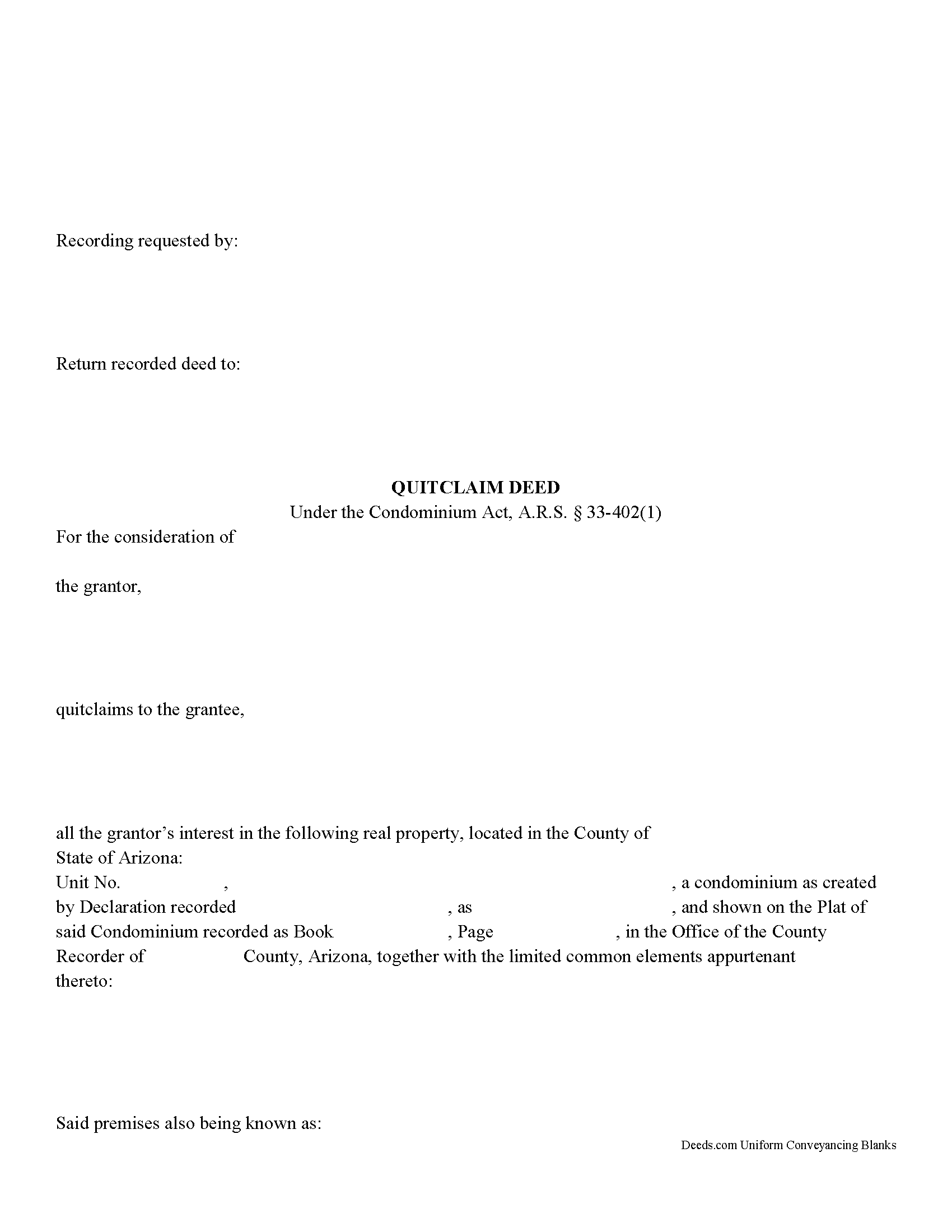
About the Arizona Quitclaim Deed Condominium
How to Use This Form
- Select your county from the list
- Download the county-specific form
- Fill in the required information
- Have the document notarized if required
- Record with your county recorder's office
What Others Like You Are Saying
"Quick turnaround (about 24hrs) easy process."
"Very professional service, they were timely and proficient with answers and sending in the documents…"
"You should list the address of where to mail the forms, so we don't have to look it up. It would mak…"
"I gave your site and forms 5 stars because it is very easy to use and included all the information n…"
"Thank you! My husband and I went in the get notary stamps for a Special Warranty Deed and a Post Nup…"
4.8/5 from 4,818 reviews. Read all
The Arizona Quitclaim Deed Condominium form transfers a unit under Arizona's Condominium Act (ARS 33-1201 et seq.), which treats each unit as a distinct parcel bundled with an undivided interest in the project's common elements. Because of that hybrid structure, an Arizona unit deed cannot simply describe a parcel by metes and bounds — it must identify the unit by number, name the condominium, recite the recording information for the declaration, and account for the allocated interests appurtenant to the unit. This form is built to satisfy the unit-specific requirements under ARS 33-1214 along with the general conveyancing rules under Title 33 and the recorder's formatting rules under ARS 11-480.
When the Arizona Quitclaim Deed Condominium Is Used
A quitclaim deed is a statutory form under ARS 33-402(1) that passes whatever interest the grantor holds in the described property without any covenants of title. For condominium units, it is most commonly used inside the family or to clean up title — transfers between spouses pursuant to divorce or a community property agreement, adding or removing a co-owner, conveying a unit into or out of a revocable living trust, correcting a name change or spelling error on a prior recorded deed, or releasing an heir's interest during estate administration. Because the form carries no warranties, the grantor conveys only what they have; a quitclaim cannot manufacture title that does not already exist.
Unit-Specific Legal Description
The legal description for a condominium unit differs materially from the description used for standard real property. Under ARS 33-1214, the instrument must identify the unit by its designation in the declaration, name the condominium, and reference the recording date and recording location of the declaration that established the project. The description must also account for the common elements — the portions of the condominium outside the unit boundaries, such as hallways, entryways, exterior walls, parking structures, landscaping, and recreational facilities (ARS 33-1212(7)) — and the unit's allocated interest, which is the undivided interest in the common elements, the share of common expense liability, and the votes in the unit owners' association assigned to the unit (ARS 33-1202(2)).
Pulling the correct unit designation, declaration recording information, and allocated interest from the recorded declaration is the single most common source of rejected condominium deeds in Arizona. The details on the prior deed into the current grantor are a reliable starting point, but the recorded declaration — and any recorded amendments — is the authoritative source.
Community Property, Marital Status, and Vesting
Arizona is a community property state, and that changes how condominium deeds are drafted and executed. The conveyancing clause must recite the marital status of each grantor and each grantee. If the unit is community property and only one spouse signs, the deed is voidable by the non-signing spouse; both spouses should appear on the deed and both should sign, even when record title stands in one spouse's name alone. If the unit is the separate property of one spouse, the deed should say so expressly, and in many transactions a disclaimer deed from the other spouse is recorded alongside it to remove any presumption of community interest.
Grantee vesting options under Arizona law include sole and separate property, tenancy in common, joint tenancy with right of survivorship, community property, and community property with right of survivorship. The last two are available only to married grantees, and the survivorship variant — which avoids probate on the death of the first spouse and allows a full stepped-up basis for the survivor — must be stated expressly in the vesting clause. A deed to spouses that reads only "husband and wife" without specifying community property with right of survivorship creates community property without survivorship rights, and the decedent's half-interest passes by will or through probate rather than automatically to the surviving spouse.
Execution and Acknowledgment
Under ARS 33-401, a conveyance of real property in Arizona must be subscribed by the grantor and acknowledged before an officer authorized to take acknowledgments — typically a notary public. Arizona does not require subscribing witnesses, which distinguishes it from the handful of states that still require witness signatures on recorded deeds. When the deed is acknowledged outside Arizona, the officer's authority and the form of the certificate must satisfy Arizona's rules for foreign acknowledgments.
Affidavit of Property Value and Exemption Statements
Arizona requires an Affidavit of Property Value (also called an Affidavit of Real Value) to accompany nearly every instrument that transfers an interest in real property, including condominium unit deeds (ARS 11-1133). The affidavit is completed and signed by both the grantor and the grantee and is filed with the deed at the county recorder's office. It captures the sale price, financing terms, and characteristics of the property for use by county assessors, and the statement of consideration on the deed itself must reconcile with it (ARS 11-1131(2)).
Arizona recognizes a list of exempt transactions at ARS 11-1134 — transfers to correct a prior deed, transfers between spouses or to a former spouse pursuant to a decree of dissolution, gift transfers for no consideration, transfers to or from a revocable trust by the trustor, and others. When a transfer is exempt, the deed itself must contain a statement that the transfer is exempt and cite the specific exemption number on the face of the deed, below the legal description. A missing or incorrect exemption recital is one of the most common reasons an otherwise complete Arizona quitclaim deed is rejected at the recorder's window.
Formatting and Recording
Arizona's recording rules at ARS 11-480 impose specific formatting requirements that apply to every recordable instrument. Print must be legible and at least ten-point type, paper must be white and no larger than 8.5 by 14 inches, the document must carry a caption identifying the type of instrument, and margins must meet the statutory minimums — the first page must have a top margin of at least two inches, reserved for the recorder's stamp, and the remaining margins must be at least one-half inch. Some counties enforce these margin rules strictly and will reject a document that crowds the top of the first page.
Record the deed with the county recorder in the county where the condominium is situated, and contact the office in advance to confirm current recording fees and accepted forms of payment. Arizona is a race-notice jurisdiction under ARS 33-412, meaning an unrecorded conveyance is void as against a subsequent purchaser for value who records first without notice of the prior transfer. Prompt recording is the only reliable protection for the grantee's interest and for the priority of any related instruments.
Resale Disclosures for Condominium Units
Arizona imposes statutory disclosure obligations when a unit is sold, and the responsibility shifts based on the size of the project. Under ARS 33-1260, in condominiums with fewer than fifty units the selling unit owner must furnish the buyer with specified information — including the declaration, bylaws, the association's current budget, and certain financial and insurance statements — within ten days after receipt of a notice of pending sale. In projects of fifty or more units, that obligation rests with the association. Quitclaim transfers between family members or into revocable trusts often do not involve a purchase, and whether a formal disclosure package is required depends on the nature of the specific transaction.
What's Included in the Download Package
The Arizona Quitclaim Deed Condominium package includes the deed form itself, detailed guidelines that walk through the Arizona-specific drafting and recording requirements, and a completed example showing how the form should look for a typical unit transfer. All files are available for instant download after purchase.
Important: County-Specific Forms
Our quitclaim deed condominium forms are specifically formatted for each of the 15 counties in Arizona.
After selecting your county, you'll receive forms that meet all local recording requirements, ensuring your documents will be accepted without delays or rejection fees.