Yuma County Beneficiary Deed Form
Last validated August 31, 2026 by our Forms Development TeamFormatted for recording in Yuma County, for property anywhere in the county: rural and unincorporated areas as well as Eckley, Idalia, Joes, Kirk, Vernon, Wray, Yuma.
- 3 documents included
- Immediate PDF download
- Formatting guarantee
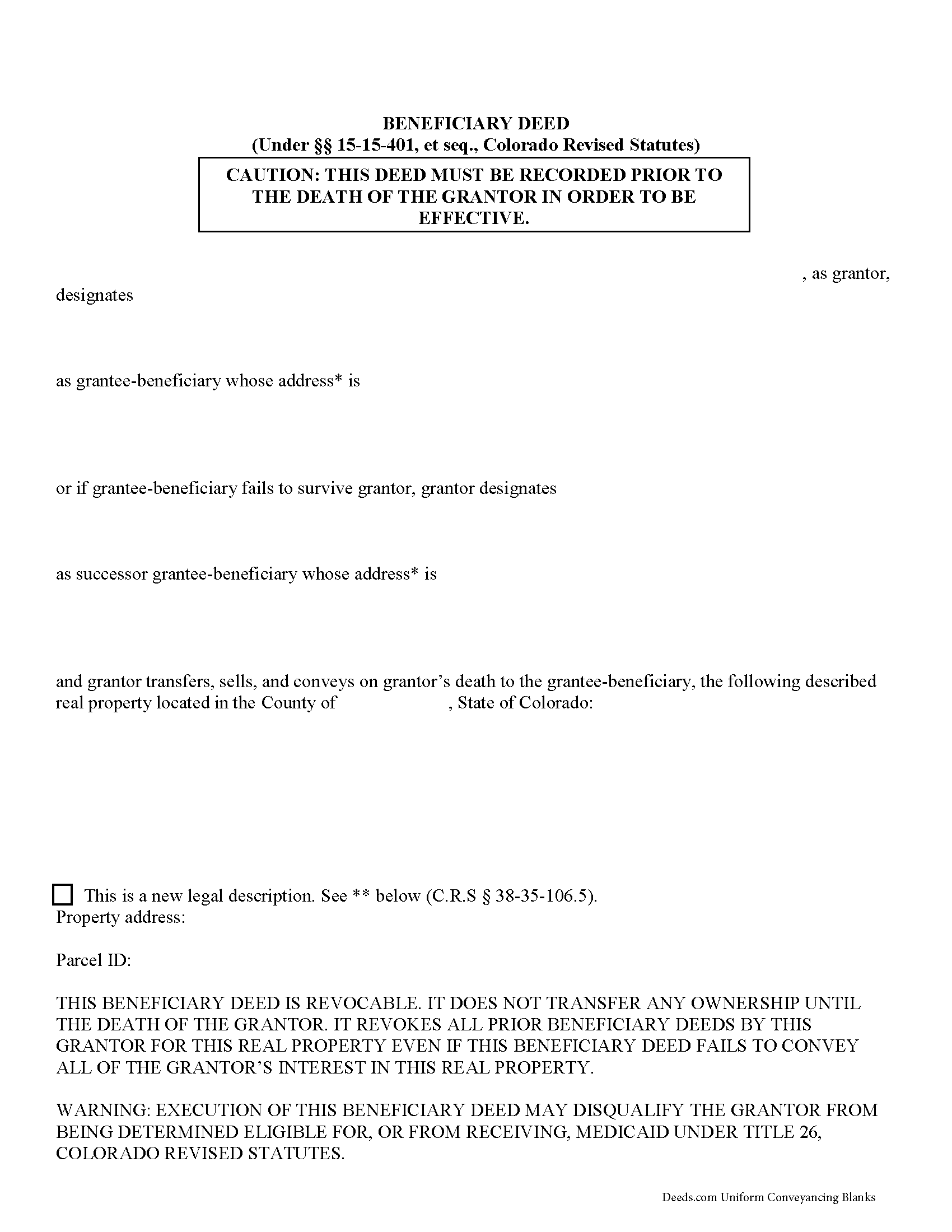
Yuma County Beneficiary Deed Form
Fill in the blank form formatted to comply with all recording and content requirements.
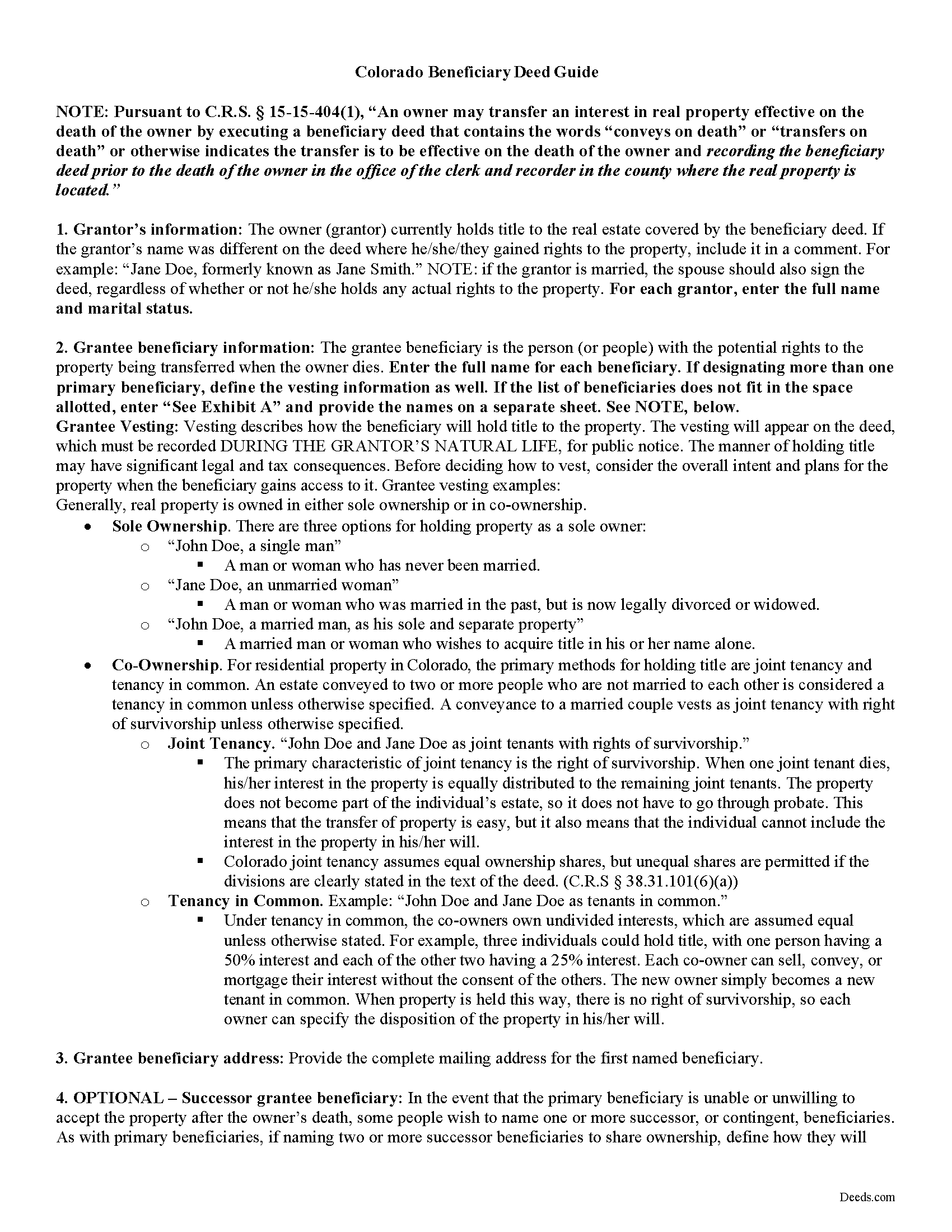
Yuma County Beneficiary Deed Guide
Line by line guide explaining every blank on the form.
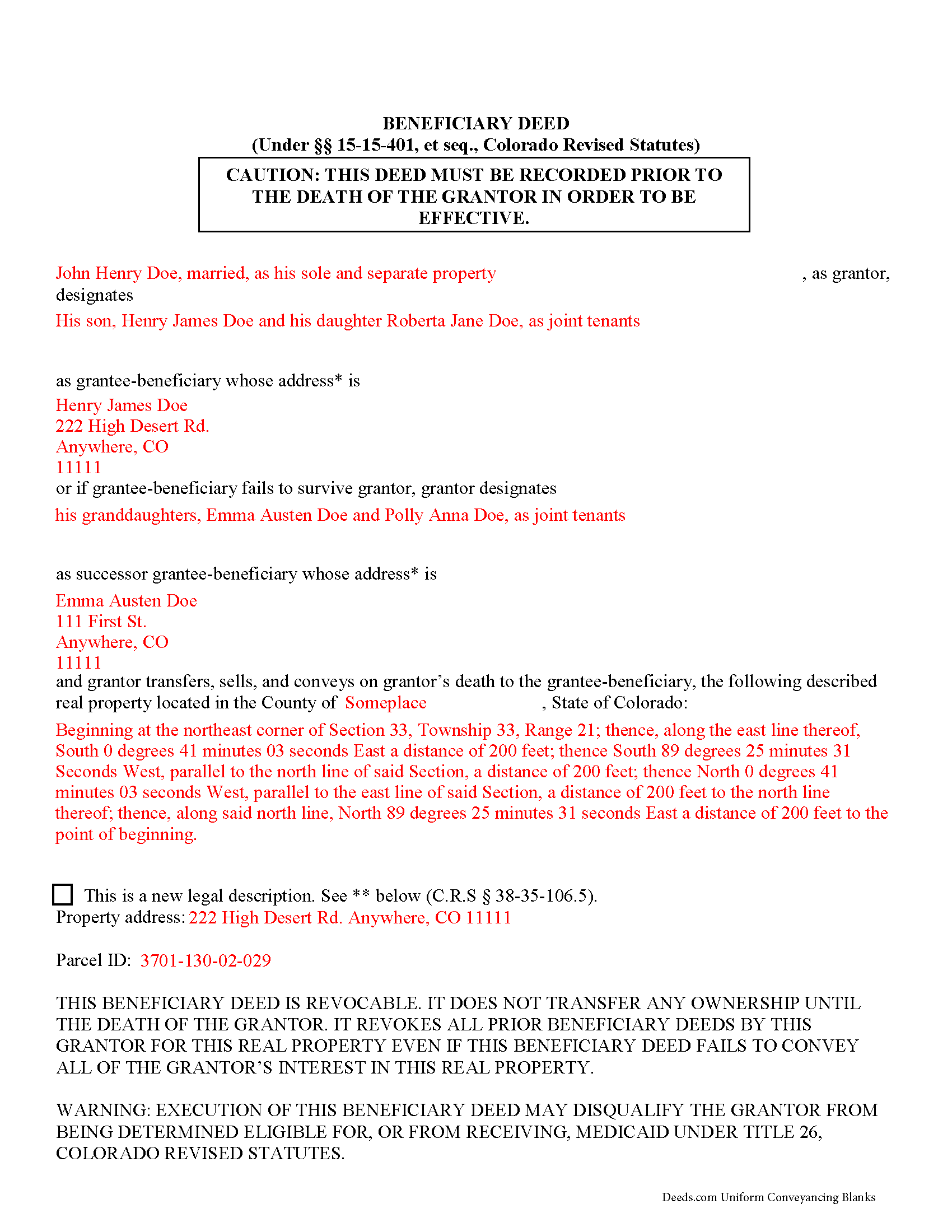
Yuma County Completed Example of the Beneficiary Deed Document
Example of a properly completed form for reference.
All 3 documents above included • One-time purchase • No recurring fees
Immediate Download • Secure Checkout
Additional Colorado and Yuma County documents included at no extra charge:
Where to Record Your Documents
Yuma County Clerk and Recorder
Wray, Colorado 80758
Hours: 8:30 to 4:30 Monday through Friday
Phone: (970) 332-5809
Recording Tips for Yuma County:
- Bring your driver's license or state-issued photo ID
- Ensure all signatures are in blue or black ink
- Bring extra funds - fees can vary by document type and page count
- Check margin requirements - usually 1-2 inches at top
- Leave recording info boxes blank - the office fills these
Cities and Jurisdictions in Yuma County
Properties in any of these areas use Yuma County forms:
- Eckley
- Idalia
- Joes
- Kirk
- Vernon
- Wray
- Yuma
Hours, fees, requirements, and more for Yuma County
How do I get my forms?
Forms are available for immediate download after payment. The Yuma County forms will be in your account ready to download to your computer. An account is created for you during checkout if you don't have one. Forms are NOT emailed.
Are these forms guaranteed to be recordable in Yuma County?
Yes. Our form blanks are guaranteed to meet or exceed the applicable formatting requirements used for recording in Yuma County, including margin requirements, font requirements, and other layout standards. This guarantee applies to formatting, not to the legal sufficiency of information entered by the user or the suitability of a form for a particular transaction.
Can I reuse these forms?
Yes. You can reuse the forms for your personal use. For example, if you have multiple properties in Yuma County you only need to order once.
What do I need to use these forms?
The forms are PDFs that you fill out on your computer. The free Adobe Acrobat Reader is recommended, and most PDF apps also work. You do NOT enter your property information online - you download the blank forms and complete them privately on your own computer.
Are there any recurring fees?
No. This is a one-time purchase. Nothing to cancel, no memberships, no recurring fees.
How much does it cost to record in Yuma County?
Recording fees in Yuma County vary. Contact the recorder's office at (970) 332-5809 for current fees.
Questions answered? Let's get started!
Beneficiary deeds in Colorado are governed by C.R.S. 15-15-401, et seq. (2012).
Under this statute, which was signed into law in 2004, a beneficiary deed is defined as "a deed, subject to revocation by the owner, which conveys an interest in real property and which contains language that the conveyance is to be effective upon the death of the owner and which may be in substantially the form described in section 15-15-404" (15-15-401(1)). To expand on this rather bare-bones definition, beneficiary deeds are useful estate planning tools that allow an individual who owns real estate in Colorado to pass that property to one or more designated grantee beneficiaries, but only after the owner's death. Note that this is a non-testamentary transfer, however, which means it is not included in a will, nor can it be cancelled by one (15-15-404(1), 15-15-405(4)). In addition, the conveyance is finalized without need for probate supervision.
The aspect of beneficiary deeds that makes them unique (and differentiates them from an ordinary life estate or joint tenancy deed) is the fact that the owner retains absolute ownership of and control over the property during his/her lifetime, and may revoke or change the beneficiary designation at will, without any obligation to notify the current grantee beneficiary (15-15-402). There is generally no consideration involved with these instruments because the future interest is not guaranteed. In fact, there is not even an obligation to inform the grantee beneficiary about the deed in the first place.
To revoke an executed and recorded beneficiary deed, the owner has two options:
1. Complete and record a revocation form (15-15-405(1)).
2. Complete and record another beneficiary deed, granting the land to someone else when the owner dies (15-15-405(2)).
Both options require that the revised instruments must be recorded during the owner's life to take effect, and any changes to the beneficiary designation are applied in order of execution, not by the recording date (15-15-405(3)). Even so, an unrecorded but executed revocation or modified beneficiary deed is void.
While beneficiary deeds are relatively straightforward instruments, there are a few important things to keep in mind about them:
- To take effect, the executed beneficiary deed must be recorded "prior to the death of the owner in the office of the clerk and recorder in the county where the real property is located" (15-15-404(1)).
- According to 15-15-403, no "person who is an applicant for or recipient of medical assistance for which it would be permissible for the department of health care policy and financing to assert a claim pursuant to section 25.5-4-301 or 25.5-4-302, C.R.S., shall be entitled to such medical assistance if the person has in effect a beneficiary deed. Notwithstanding the provisions of section 15-15-402 (1), the execution of a beneficiary deed by an applicant for or recipient of medical assistance as described in this section shall cause the property to be considered a countable resource in accordance with section 25.5-4-302 (6), C.R.S., and applicable rules."
- If the property identified on the beneficiary deed is held in joint ownership, 15-15-408 states that "title to the interest shall vest in the designated grantee-beneficiary only if the joint tenant-grantor is the last to die of all of the joint tenants of such interest. If a joint tenant-grantor is not the last joint tenant to die, the beneficiary deed shall not be effective, and the beneficiary deed shall not make the grantee-beneficiary an owner in joint tenancy with the surviving joint tenant or tenants. A beneficiary deed shall not sever a joint tenancy."
A word about grantee beneficiaries:
In most cases, the owner leaves the property to a family member. The statute does not, however, limit the conveyance to relatives. It defines grantee beneficiaries as "one or more persons or entities capable of holding title to real property designated in a beneficiary deed to receive an interest in real property upon the death of the owner. "Grantee-beneficiary" includes, but is not limited to, a successor grantee-beneficiary" (15-15-401(3)). If one or more named grantee beneficiaries are part of the owner's family, they are frequently identified as such for additional clarity.
Many owners wish to designate one or more successor grantee beneficiaries, in case the original one(s) are unable or unwilling to accept the real estate. If no successor is named and "one of multiple grantee-beneficiaries fails to survive the owner, and no provision for such contingency is made in the beneficiary deed, the share of the deceased grantee-beneficiary shall be proportionately added to, and pass as a part of, the shares of the surviving grantee-beneficiaries" (15-15-407(5)). Further, if no successor is named and there are no previously identified grantee beneficiaries in whom to vest title, the property typically reverts back to the deceased owner's estate for probate distribution.
As defined in 15-15-414, a "grantee-beneficiary may refuse to accept all or any part of the real property interest described in a beneficiary deed. A grantee-beneficiary may disclaim all or any part of the real property interest described in a beneficiary deed by any method provided by law. If a grantee-beneficiary refuses to accept or disclaims any real property interest, the grantee-beneficiary shall have no liability by reason of being designated as a grantee-beneficiary under this part 4."
Overall, Colorado beneficiary deeds are useful estate planning tools that can streamline the process of conveying ownership of real property to one or more designated grantee beneficiaries, free from the cost and complication of probate. They may, however, have an impact on taxes as well as eligibility for asset-based local, state, or federal programs. To ensure the most favorable outcome, carefully consider the associated risks and advantages before finalizing this or any other estate planning decision.
(Colorado Beneficiary Deed Package includes form, guidelines, and completed example)
Important: Your property must be located in Yuma County to use these forms. Documents should be recorded at the county recording office listed above.
This Beneficiary Deed meets all recording requirements specific to Yuma County.
Our Promise
The documents you receive here are guaranteed to meet or exceed the applicable Yuma County recording format requirements. If there is a rejection caused by our formatting, we will correct the issue or refund your payment. This guarantee applies to document formatting only and does not extend to information entered by the user, the selection of the form, or the legal effect of the completed document.
Save Time and Money
Get your Yuma County Beneficiary Deed form done right the first time with Deeds.com Uniform Conveyancing Blanks. At Deeds.com, we understand that your time and money are valuable resources, and we don't want you to face a penalty fee or rejection imposed by a county recorder for submitting nonstandard documents. We constantly review and update our forms to meet rapidly changing state and county recording requirements for roughly 3,500 counties and local jurisdictions.
4.8 out of 5 - ( 4,823 Reviews )
Kevin M. 5 out of 5 stars
Maricopa County Recorders office directed to use Deeds.com for all forms, etc. Easily found the Warranty Deed form, instructions & sample form I was looking for.
Thank you!
Wes C. 5 out of 5 stars
The forms are easy to use and the examples and guidance are easy to understand and follow.
Thank you for your feedback. We really appreciate it. Have a great day!
Elizabeth K. 5 out of 5 stars
I found what I needed easily.
We are delighted to have been of service. Thank you for the positive review!
donald h. 5 out of 5 stars
very informative and thank everyone involved,my deed needed to be changed and will adjusted.
Thank you!
ALEX A. 5 out of 5 stars
Yes I appreciate your services everything so far looking good this shows the facts the reasons most of all format I enjoy it I hopefully I can use it for some other legal forms also for Fry's Baker's fraud title fraud I'm interested in a lot of services that will provide me with a preferences of a fraud situations on mortgage security loans but other than that the services are awesome and I appreciate it appreciate your services and I'll keep on using it and thanks again thumbs up
Thank you!
DARLA L. 5 out of 5 stars
I was happy with the quick response to obtain the requested forms. Effective and easy website to use.
We appreciate your business and value your feedback. Thank you. Have a wonderful day!
Lois B. 5 out of 5 stars
It works pretty well, had trouble with the word December. It printed out Decedmber with weird spacing but I think it will be ok.
Thank you for the feedback. We will take a look at the date field to see if there are any issues. Have a great day!
Gerry A. 5 out of 5 stars
It was easy, affordable and I appreciate this service.
Thank you!
Mark & Linda W. 4 out of 5 stars
Quite simple and easy. Only one critique: It would be easier if the names of the PDF would reflect the name of the deed/form such as 'Controlling tax return' rather than '1579101185SF56863.pdf'. However I love downloading forms rather than mail.
Thank you for your feedback. We really appreciate it. Have a great day!
Robert O. 5 out of 5 stars
A very easy site to use and got the documents that I needed without any problems. Would highly recommend this site.
Thank you Robert, Have a great day!
Kevin H. 5 out of 5 stars
I was able to find the forms I needed and questions answered
Thank you for your feedback. We really appreciate it. Have a great day!
Judy H. 5 out of 5 stars
great response to my question.
We are delighted to have been of service. Thank you for the positive review!
Emanuel W. 5 out of 5 stars
Excellent service! We surely use again
Thank you for your feedback. We really appreciate it. Have a great day!
Lori W. 5 out of 5 stars
Great resource! Nice to have these forms and information available. No problems at the recorder, in fact it was the recorder that referred me to deeds.com they like their forms so much.
Thank you for your feedback. We really appreciate it. Have a great day!
Michael D. 1 out of 5 stars
I did not like the size of the Warranty Deed form which took 2 pages to print. It should be no larger than 8 1/2 by 14 inches. I did not like that I could not reformat it to be smaller, could not eliminate unused lines, could not delete the excessive 4 signature lines, could not copy or paste into text editor. Very unsatisfactory rating.
Thank you for your feedback Michael. Unfortunately we don't make the requirements, we only make the documents to be compliant with the requirements. Have a great day!