District Of Columbia Quitclaim Deed
County Specific Legal Forms Validated as recently as October 13, 2026 by our Forms Development Team
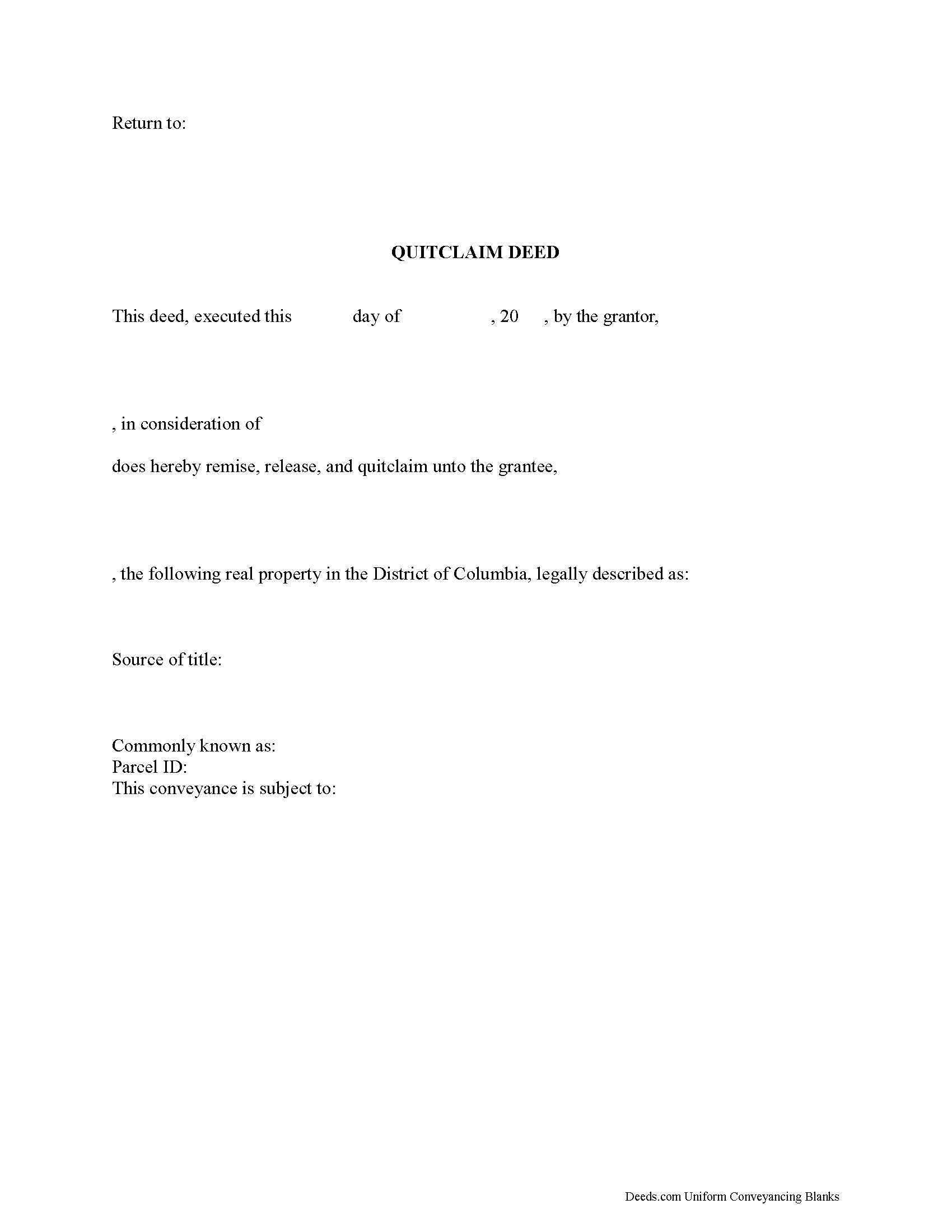
About the District Of Columbia Quitclaim Deed
How to Use This Form
- Select your county from the list
- Download the county-specific form
- Fill in the required information
- Have the document notarized if required
- Record with your county recorder's office
What Others Like You Are Saying
"Looks good and provides lots of instruction."
"It's so easy to use. Well worth the price. Thank you."
"Prompt efficient service."
"Great was not hard at all to do and process only wished it told how much it cost to actually submit …"
"Professional and convenient."
4.8/5 from 4,830 reviews. Read all
The blank that decides the most on a District of Columbia quitclaim deed is the one that follows the grantee names. The deed releases the interest one or two individuals hold in a Washington property and warrants nothing about it; the words after the grantee names settle how the new owners hold what arrives, because D.C. Code section 42-516(a) reads a silent deed as a tenancy in common even where the two grantees are married to each other.
The default the District wrote against expectation
Section 42-516(a) makes every estate granted to two or more persons in their own right, spouses and domestic partners as defined in section 32-701(3) expressly included, a tenancy in common unless expressly declared to be a joint tenancy. Survivorship in the District is therefore something a deed says rather than something a relationship supplies: a joint tenancy takes the express declaration the subsection names, and a tenancy by the entirety, which section 42-516(c) authorizes for spouses and domestic partners, takes express entireties words. The grantee block is free-form for that reason, and the guide walks the forms the District recognizes.
A release with no promises in it
A District quit claim deed works by leaving words out. Sections 42-604 through 42-608 attach a title covenant only where their own express phrases appear, so an instrument printing none of them conveys with no covenant of title at all, as the operative section states. Section 42-702 still carries over the whole present estate each grantor holds, so the grantee receives the actual interest along with every deed of trust, easement, and restriction already of record. Section 6 takes an informational listing of those matters above a printed sentence keeping it free of warranty.
Signed and sealed, or the estate never moves
Section 42-306(b) is blunter than most execution statutes: no estate in District real property is created or takes effect except by a deed signed and sealed by the grantor. The seal belongs to the operation of the conveyance, not to the paperwork of recording, so each signature line closes with the bracketed notation every statutory deed form in section 42-601 prints, and the operative text adopts it as that grantor's seal. Section 42-404(b) preserves that requirement even while deeming an unsealed recorded deed sealed. Acknowledgment carries it to the counter under section 42-407(1), which bars the Recorder of Deeds from accepting an instrument not executed and acknowledged according to law.
How this form is set up
The form takes individuals signing in their own names, in any of four counts: one or two grantors releasing to one or two grantees. Nothing about marital status, capacity, or vesting is preprinted, so those words go into the blanks. Two signature blocks each end in the seal notation and each carries its own acknowledgment certificate, so two grantors may appear before different officers on different dates; where one grantor conveys, the second block and its certificate stay blank. Other configurations sit outside this one: an entity signature under section 42-602, a signature by an attorney in fact under a power of attorney, a trustee signing in a representative capacity, and any conveyance running from or to three or more owners.
One counter, square suffix and lot, and a 30 day clock
Every deed in the city goes to one office, the Recorder of Deeds at the Office of Tax and Revenue, because the District has no counties. Section 47-1431(a) puts the lot and square from the Office of the Surveyor inside the recorded copy and calls for recording within 30 days of execution, with a $250 penalty behind it. Form FP-7/C rides along, sworn to by the parties, and both deed taxes are collected there: 1.1 percent of consideration each below $400,000, 1.45 percent each at or above it, and fair market value where a deed passes for a nominal sum. A transfer without actual consideration between spouses, domestic partners, or a parent and child carries a statutory exemption from both. One gate has nothing to do with the deed's contents: under section 42-407(2) an unpaid District tax bill on the property stops the recording where it stands.
The purchase delivers the deed as a blank fillable PDF, a completed example worked through for a Trinidad rowhouse released by two owners to a couple taking by the entirety, and a plain-language guide covering the eight numbered sections, the vesting forms, the sealing and acknowledgment steps, and recording. The materials are informational and are not legal advice.
Important: County-Specific Forms
Our quitclaim deed forms are specifically formatted for each of the 1 counties in District Of Columbia.
After selecting your county, you'll receive forms that meet all local recording requirements, ensuring your documents will be accepted without delays or rejection fees.