District Of Columbia Transfer on Death Deed
County Specific Legal Forms Validated as recently as October 20, 2026 by our Forms Development Team
About the District Of Columbia Transfer on Death Deed
How to Use This Form
- Select your county from the list
- Download the county-specific form
- Fill in the required information
- Have the document notarized if required
- Record with your county recorder's office
What Others Like You Are Saying
"Super easy to use! Totally satisfied. Thanks."
"I'm 84 and not all that smart when it comes to what a Lawyer usually helps you with, but I took a ch…"
"Excellent experience. Quickly responded and was able to get us exactly what we needed!"
"I received exactly what I was looking for on Deeds.com. Not only that, but this website provided ins…"
"No review provided."
4.8/5 from 4,851 reviews. Read all
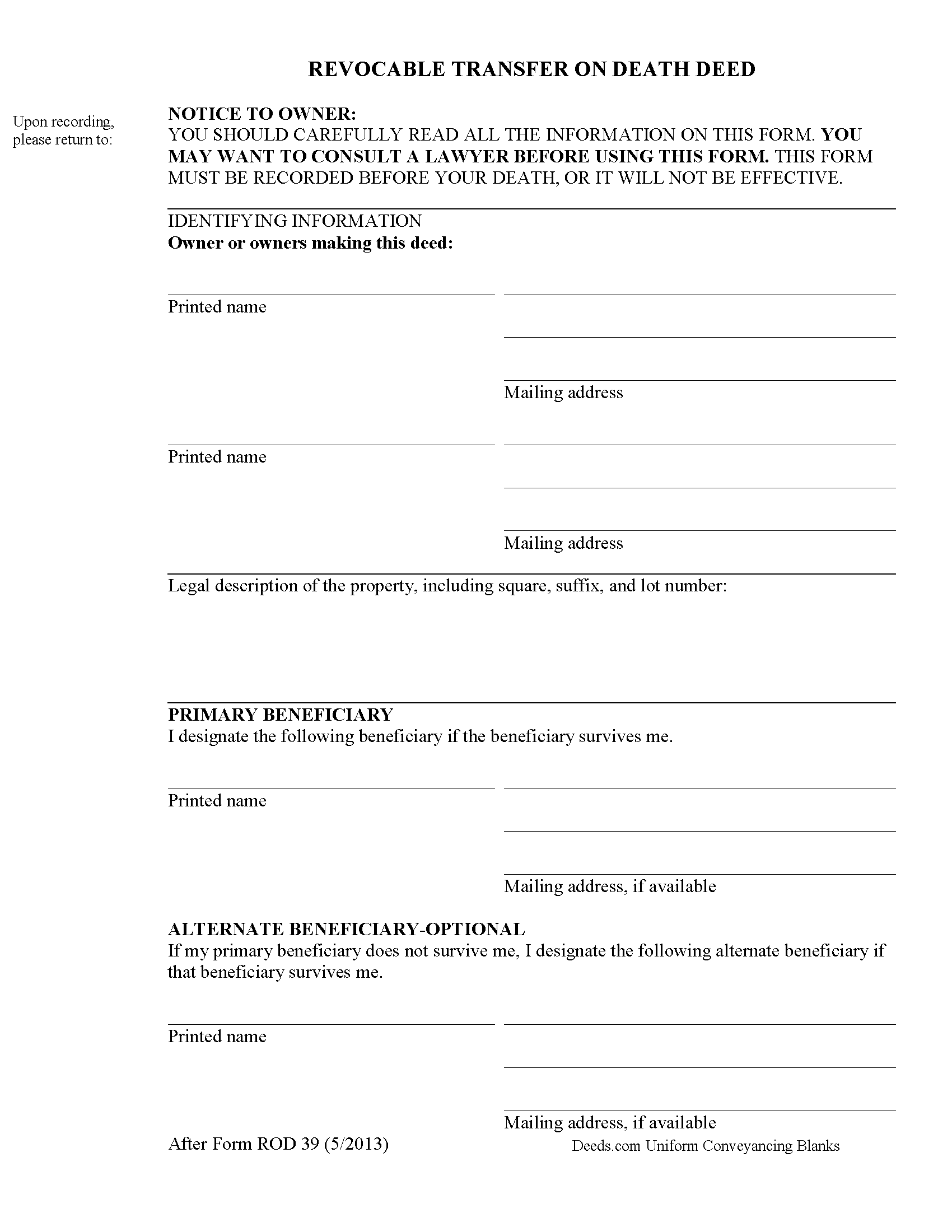
A District of Columbia transfer on death deed names who receives an owner's real property at death and does nothing else until then. At the owner's death the named beneficiary takes the owner's interest without probate. This form prepares that deed under D.C. Code sections 19-604.01 to 19-604.19, the District's enactment of the Uniform Real Property Transfer on Death Act, for one owner or for two owners who sign together.
A deed that is nothing until it is recorded
Most deeds work when they are signed and delivered. A District transfer on death deed is different: section 19-604.09(c) makes recording in the Office of the Recorder of Deeds before the transferor's death a condition of the deed's effect. A signed, sealed, and notarized deed left in a drawer transfers nothing. The statutory form in section 19-604.16 opens with a notice saying exactly that, and this form prints the same notice above its first section. The District has no counties, so one office, the Recorder of Deeds at the Office of Tax and Revenue, serves every parcel.
What the statutory sentence transfers
The operative words are the statutory form's own: at my death, I transfer my interest in the described property to the beneficiaries as designated above. Each owner who signs transfers that owner's interest, and only that; a co-owner who does not sign transfers nothing. During life the deed affects no right of the owner, creditor, or purchaser and creates no interest in the beneficiary (section 19-604.12). At death the beneficiary takes subject to every mortgage, lien, and other interest then affecting the property (section 19-604.13(b)), without covenant or warranty of title (section 19-604.13(e)). Only a later recorded instrument revokes the deed; a will cannot.
The seal scroll the District still requires
Section 42-306(b) of the D.C. Code provides that an estate in District real property is created only by a deed signed and sealed by the grantor, a formality most states abandoned long ago. The District's statutory forms satisfy it with a printed scroll after the signature line, and the transfer on death deed form prints its scroll as [(SEAL)]. This form prints the same scroll at the end of each owner's signature line. Each acknowledgment certificate carries the District's statutory short form sentence and a reserved area for the official seal that section 1-1231.14 places on a paper certificate.
One owner, or two owners on one deed
The form recites one free-form owner block, two signature blocks, and two acknowledgment certificates, and it preprints no words about how the owners hold title. A sole owner signs alone and leaves the second block blank. Two owners who hold with a right of survivorship, as joint tenants or as tenants by the entirety, sign one deed together, and the chapter supplies the timing: under section 19-604.13(c) and (d) the property belongs to the surviving joint owner at the first death, and the deed operates at the last surviving joint owner's death, with no extra sentence on the deed. Two owners who hold as tenants in common, the District's default under section 42-516(a) even for spouses, each transfer their own undivided share at their own death. The form is not set up as an instrument signed by a trustee, an entity, or an attorney-in-fact, and it carries no room for a third owner.
Beneficiaries, alternates, and the rules behind them
The primary beneficiary section carries the statutory sentence designating a beneficiary who survives the owner; the optional alternate section carries the sentence designating an alternate if the primary does not survive. A beneficiary may be an individual, an estate, an entity, or a governmental body under section 19-604.02(4). Where two or more beneficiaries are named together, section 19-604.13(a)(3) gives them equal undivided shares with no survivorship, and a lapsed share passes to the other concurrent beneficiaries under section 19-604.13(a)(4). After the owner's death, the deed to the beneficiary is exempt from the District's recordation and transfer taxes under sections 42-1102(34) and 47-902(26); the beneficiary's confirmatory deed, death certificate, and FP-7/C return are recorded separately at that time and are not part of this package.
The package includes the fillable transfer on death deed with its non-recorded instructions page, a completed example filled in for a realistic District of Columbia fact pattern, and the guide that walks through every section, the signing formalities, and recording. This description and the guide describe the form and the governing statutes in general terms; they are not legal advice.
Important: County-Specific Forms
Our transfer on death deed forms are specifically formatted for each of the 1 counties in District Of Columbia.
After selecting your county, you'll receive forms that meet all local recording requirements, ensuring your documents will be accepted without delays or rejection fees.