District Of Columbia Transfer on Death Revocation
County Specific Legal Forms Validated as recently as October 20, 2026 by our Forms Development Team
About the District Of Columbia Transfer on Death Revocation
How to Use This Form
- Select your county from the list
- Download the county-specific form
- Fill in the required information
- Have the document notarized if required
- Record with your county recorder's office
What Others Like You Are Saying
"Had a difficult time finding my download after purchase. Thankfully I had printed the form and had. …"
"great"
"The deeds were a very reasonable price. However, it was made to seem like it was part of Jefferson C…"
"Thank you so much for your time."
"My recent experience with Deeds.com has been outstanding. I especially appreciated the sample filled…"
4.8/5 from 4,850 reviews. Read all
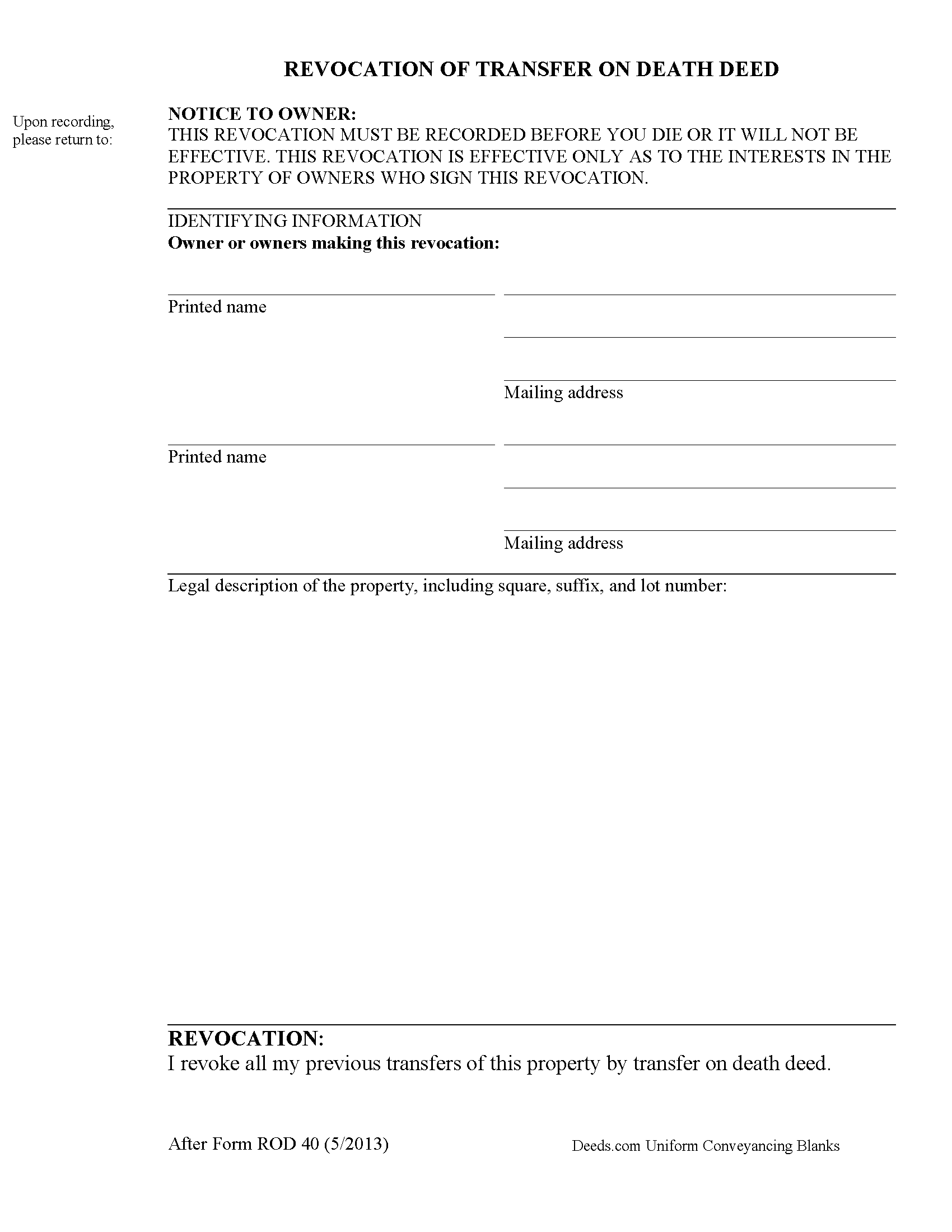
A District of Columbia transfer on death deed stays revocable for the owner's whole life, but the District lets it be undone in only one way: by another recorded instrument. This form prepares the instrument of revocation that D.C. Code Section 19-604.11 describes, for one or two owners who made a TOD deed (also called a beneficiary deed) for real property in the District.
A deed that cannot be torn up
Section 19-604.11 lists three instruments that revoke a recorded transfer on death deed: a later transfer on death deed that revokes it expressly or by inconsistency, an instrument of revocation that expressly revokes it, and a lifetime deed that expressly revokes it. Once a TOD deed is recorded it may not be revoked by a revocatory act on the deed, so crossing it out changes nothing, and the chapter's own form states that a will does not revoke a recorded TOD deed. This package is the second path: a standalone revocation that names no new beneficiary and conveys nothing, leaving the owner's interest to pass at death under a will, by intestacy, or by survivorship title.
Acknowledged after, recorded before
Two timing conditions ride with every District revocation: the instrument must be acknowledged by the transferor after the acknowledgment of the deed being revoked, and it must be recorded before the transferor's death in the Office of the Recorder of Deeds. A revocation left unrecorded at death revokes nothing. The instrument carries the statutory form's notice of that condition at its head, and its third section identifies the deed being revoked by its acknowledgment date, recording date, and instrument number. Because the District is a single recording jurisdiction, the form names the Office of the Recorder of Deeds as fixed text rather than leaving a county blank.
One owner or two, each for that owner's own interest
This is the General configuration of the District's transfer on death revocation: a free-form owner block that takes one natural person or two, with whatever status recital the signer states, and nothing about marital status, vesting, or capacity preprinted. The form carries two signature blocks headed OWNER and SECOND OWNER (if applicable) and a separate acknowledgment certificate for each, so two owners may acknowledge on different dates, before different officers, or in different states; on a one-owner revocation the second block and its certificate stay blank. The operative sentence is the one the District's optional statutory form prints, followed by an express revocation of the identified deed. A sole owner revoking a deed made alone, two co-owners revoking a deed they made together, and one of two co-owners withdrawing only that owner's own interest all present the pattern this instrument recites. The form is not set up as an entity, trustee, or attorney-in-fact revocation, and it does not carry three or more owners.
The chapter supplies the joinder rules: one transferor's revocation does not affect the deed as to another transferor's interest, and a deed of joint owners, a term the chapter defines to include joint tenants and tenants by the entirety but not tenants in common, is revoked only when all of the living joint owners revoke it. The statutory form's notice says the same thing plainly: the revocation is effective only as to the interests of the owners who sign it.
Signed, sealed, and acknowledged the District way
District conveyancing law requires a deed to be signed and sealed by the grantor, and the statutory revocation form prints its own seal scroll, [(SEAL)], after each signature line, and this instrument reproduces it. Each acknowledgment certificate carries the District's statutory short form sentence, with a reserved area for the notary's seal, and an acknowledgment taken before a Maryland or Virginia notary has the same effect under District law as one taken in the District. The form also collects the square, suffix, and lot the Recorder of Deeds requires on every recorded document.
What arrives in the package
The package includes the fillable revocation form with its non-recorded instructions cover page, a completed example filled in for a realistic District of Columbia fact pattern in which two married owners revoke a recorded deed, and the guide that walks through every section, the signing and sealing formalities, the co-owner joinder rules, and recording at the Recorder of Deeds with the FP-7/C tax form. This description and the guide describe the form and the governing statutes in general terms; they are not legal advice.
Important: County-Specific Forms
Our transfer on death revocation forms are specifically formatted for each of the 1 counties in District Of Columbia.
After selecting your county, you'll receive forms that meet all local recording requirements, ensuring your documents will be accepted without delays or rejection fees.