Florida Durable Power of Attorney
County Specific Legal Forms Validated as recently as October 8, 2026 by our Forms Development Team
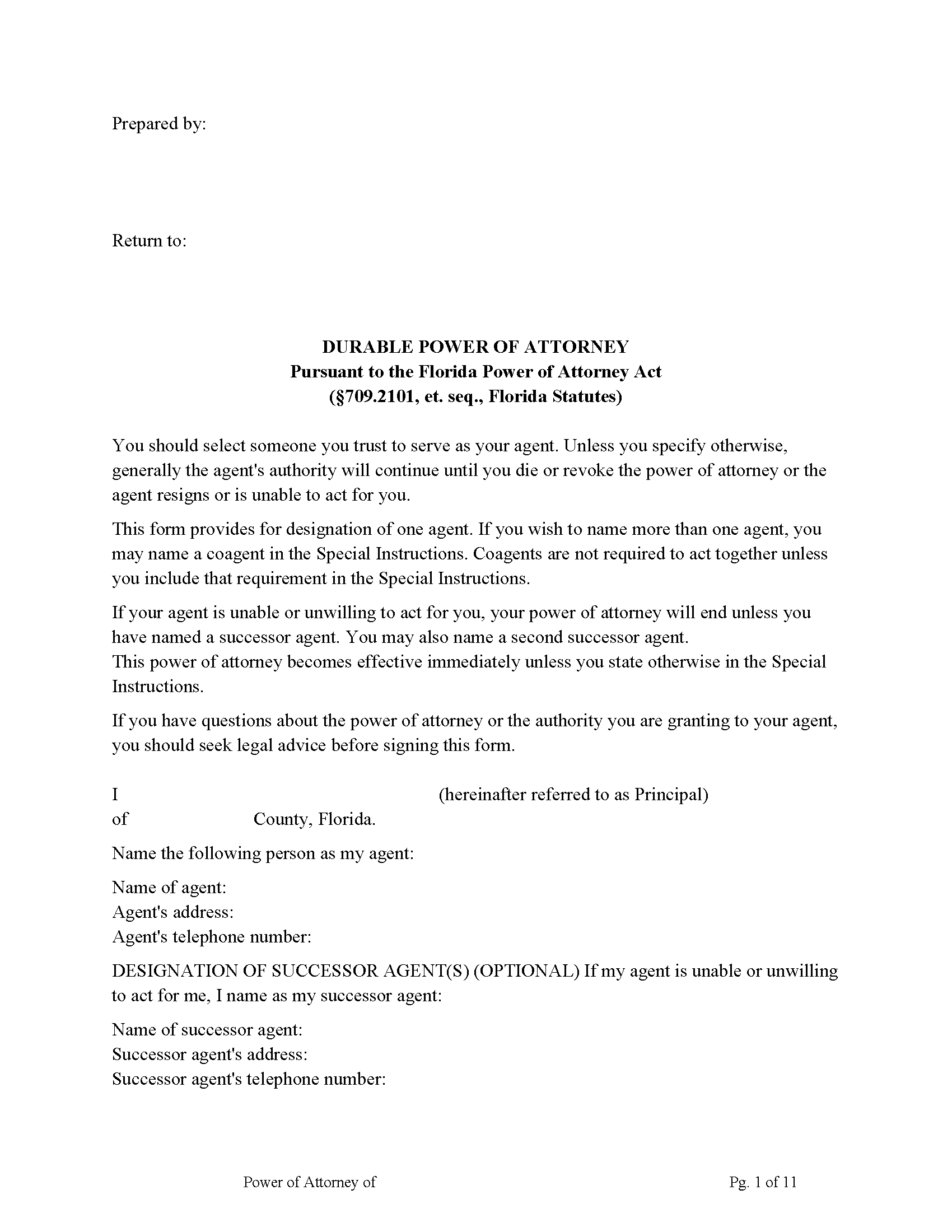
About the Florida Durable Power of Attorney
How to Use This Form
- Select your county from the list
- Download the county-specific form
- Fill in the required information
- Have the document notarized if required
- Record with your county recorder's office
What Others Like You Are Saying
"Good find, provides guide to use."
"I have had it reviewed by a mortgage broker and a title manager and both said it was done correctly!…"
"a refreshing web based legal form site Thanks I will recommend to friend"
"Very nice. Especially liked that I could re-use the form since I have a couple of properties."
"This service was very helpful, quick, inexpensive and easy to use. Should I ever need it again, I kn…"
4.8/5 from 4,828 reviews. Read all
A Florida Durable Power of Attorney lets a principal—the person granting authority—name an agent to handle Florida real estate, financial accounts, tax matters, and other listed transactions while the authority continues after later incapacity. Florida’s version is not a generic “do everything” form: the Florida Power of Attorney Act requires express, specific powers; new powers of attorney are generally usable as soon as signed; and real-property use must account for Florida homestead, witness, notary, and recording rules under Chapter 709.
When to Use a Florida Durable Power of Attorney
In Florida, this form is commonly used to let an agent sign documents, manage bank and investment accounts, handle taxes and government-benefit matters, conduct business transactions, deal with claims or litigation, and act in connection with Florida real property when the principal is unavailable, traveling, preparing for possible incapacity, or needs someone else to manage financial affairs. It does not itself transfer title; when real estate is involved, the deed, mortgage, or other recorded instrument signed under the authority must still meet Florida’s separate real-property requirements.
Florida Statutory Requirements Under Chapter 709
The Florida Durable Power of Attorney is governed by the Florida Power of Attorney Act, which appears in Chapter 709, Part II, of the Florida Statutes. Key state-specific requirements include:
- Durability language. The document must contain words showing that the authority is exercisable even after the principal’s later incapacity, such as the statutory durability wording or similar language (Fla. Stat. § 709.2104).
- Qualified agent. The agent must be a natural person who is at least 18 years old, or a financial institution with trust powers, a place of business in Florida, and authority to conduct trust business in Florida (Fla. Stat. § 709.2105(1)).
- Specific grants of authority. Florida does not treat a broad statement that the agent may do all acts the principal could do as an express grant of authority. The powers must be specifically listed in the document (Fla. Stat. § 709.2201(1)).
- Separate signed or initialed powers. Certain powers require the principal to sign or initial next to each specific authority, including powers to create or amend a trust, make gifts, create or change survivorship rights, change beneficiary designations, waive certain retirement-plan survivor benefits, or disclaim property (Fla. Stat. § 709.2202(1)).
- Agent duties. A Florida agent is a fiduciary who must act within the granted authority, act in good faith, avoid known conflicts with the principal’s reasonable expectations, and keep required records (Fla. Stat. § 709.2114).
- Termination at death. Durability preserves authority after incapacity; it does not make the power continue after the principal’s death (Fla. Stat. § 709.2109(1)(a)).
Florida Signing, Witness, and Notary Requirements
A Florida power of attorney must be signed by the principal, signed by two subscribing witnesses, and acknowledged by the principal before a notary public or as otherwise provided for real-property acknowledgments (Fla. Stat. § 709.2105(2)). The agent’s signature is not what creates the principal’s authorization; the required act is the principal’s execution with the Florida witness and notary formalities. If the principal is physically unable to sign, the notary may sign the principal’s name as provided by Florida law (Fla. Stat. §§ 709.2105(3), 117.05(14)).
Florida has an additional trap for the separate signed or initialed powers listed in § 709.2202. If the principal is physically unable to sign or initial those powers, the notary may sign or initial for the principal only when the principal directs it, the act occurs in the principal’s presence, two disinterested subscribing witnesses witness it, and the notary includes the required statutory statement (Fla. Stat. § 709.2202(2)). A power of attorney executed by a Florida-domiciled principal and witnessed remotely is not effective to grant the special powers listed in § 709.2202(1) if the witness was not in the principal’s physical presence (Fla. Stat. § 709.2202(6)).
When Authority Starts and How Copies Work in Florida
For a Florida power of attorney, authority is generally exercisable when the document is executed. Except for limited rules involving pre-October 1, 2011 springing powers and deployment-contingent military powers of attorney, a provision making the power effective at a future date or upon a future event is ineffective (Fla. Stat. §§ 709.2108, 709.2106(4)). A photocopy or electronically transmitted copy generally has the same effect as the original, but an original may be required for recording when the power is relied on to affect title to Florida real property (Fla. Stat. § 709.2106(5)). A power of attorney executed in another state may be valid in Florida if it complied with the law of the state where it was executed, although a third person may request an opinion of counsel on that issue at the principal’s expense (Fla. Stat. § 709.2106(3)).
Florida Acceptance Rules for Banks and Other Third Parties
Florida law gives third parties a framework for accepting or rejecting a power of attorney. A person asked to accept a power of attorney must accept or reject it within a reasonable time, and four days, excluding weekends and legal holidays, is presumed reasonable for certain banking and investment transactions when the power expressly includes the required authority (Fla. Stat. § 709.2120(1)). A third person may not require a different power-of-attorney form for authority already granted in the document, but may request items such as an agent affidavit, a certified English translation, an opinion of counsel, or an electronic journal or record for remotely witnessed or notarized documents when allowed by statute (Fla. Stat. §§ 709.2119, 709.2120).
Florida Real Estate, Homestead, and Survivorship Traps
- Real-property authority must be express. Because Florida requires specific grants of authority, a deed or mortgage signed by an agent depends on the document’s express real-property powers, not on a catchall clause (Fla. Stat. § 709.2201(1)).
- Homestead spouse joinder is not waived. An agent may be authorized to convey or mortgage homestead property, but if the principal is married, the agent may not convey or mortgage the homestead without the joinder of the principal’s spouse or the spouse’s guardian. That joinder may be accomplished through the spouse’s own power of attorney (Fla. Stat. § 709.2201(2)(b)). Florida’s homestead power-of-attorney statute also states that a power of attorney used for a homestead deed or mortgage must be executed in the same manner as a deed, and it does not dispense with required husband-and-wife joinder (Fla. Stat. § 689.111).
- Marital status can affect title review. Because Florida homestead rules turn on marriage, a deed signed under a power of attorney may raise title questions if the principal’s marital status and any required spouse joinder are not clear in the transaction documents.
- Survivorship changes need separate authority. Creating or changing rights of survivorship is one of the powers that requires a separate signed or initialed authorization (Fla. Stat. § 709.2202(1)(d)). Florida also presumes co-owners take as tenants in common unless the instrument expressly provides for survivorship, except for estates by the entireties (Fla. Stat. § 689.15).
- Recording details can stop a real-estate filing. Florida instruments affecting title must include, among other details, printed or stamped names and post-office addresses for signers and witnesses, the preparer’s name and address, the notary’s printed or stamped name, required blank space for the clerk, and grantee name and address for non-mortgage conveyances (Fla. Stat. § 695.26).
- Documentary stamps and descriptions belong to the title instrument. The power of attorney authorizes signature authority; it does not supply or cure the legal description, plat or condominium reference, parcel information, consideration statement, or documentary stamp tax treatment needed for the Florida deed, mortgage, or other title instrument. Florida documentary stamp tax applies to documents that transfer an interest in Florida real property for consideration (Fla. Stat. § 201.02).
Recording a Florida Durable Power of Attorney for Real Estate
An original, properly executed Florida power of attorney may be presented for recording with the clerk of the circuit court in the county’s Official Records (Fla. Stat. §§ 709.2106(6), 28.222). Recording becomes especially important when the agent signs a deed, mortgage, or other instrument by virtue of the power of attorney. Florida’s recording statute provides that an instrument made or executed under a power of attorney is not effective against creditors or later purchasers for value without notice unless the power of attorney is recorded before that creditor’s or purchaser’s right accrues (Fla. Stat. § 695.01(1)). Recording the power in the county where the real property is located helps place the agent’s authority in the public chain of title.
What Is Included in the Florida Durable Power of Attorney Download
- Florida Durable Power of Attorney form designed for use under the Florida Power of Attorney Act.
- Guidelines explaining Florida signing, witness, notary, and real-property recording considerations.
- Completed example showing how the form is filled out.
Important: County-Specific Forms
Our durable power of attorney forms are specifically formatted for each of the 67 counties in Florida.
After selecting your county, you'll receive forms that meet all local recording requirements, ensuring your documents will be accepted without delays or rejection fees.