Monroe County Easement Deed Form
Last validated October 2, 2026 by our Forms Development TeamFormatted for recording in Monroe County, for property anywhere in the county: rural and unincorporated areas as well as Big Pine Key, Islamorada, Key Colony Beach, Key Largo, Key West, Long Key, Marathon, Marathon Shores and 2 more.
- 4 documents included
- Immediate PDF download
- Formatting guarantee
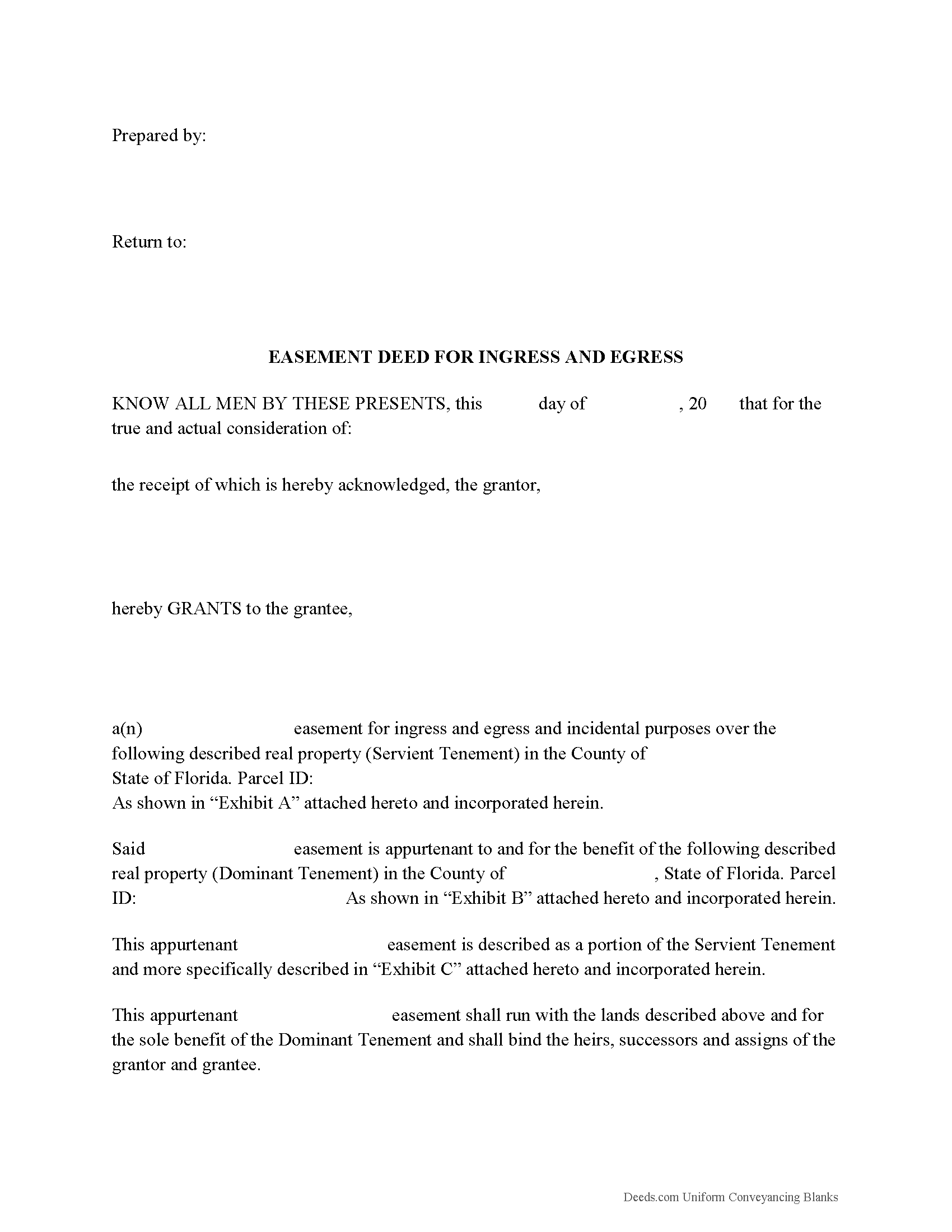
Monroe County Easement Deed Form
Fill in the blank Easement Deed form formatted to comply with all Florida recording and content requirements.
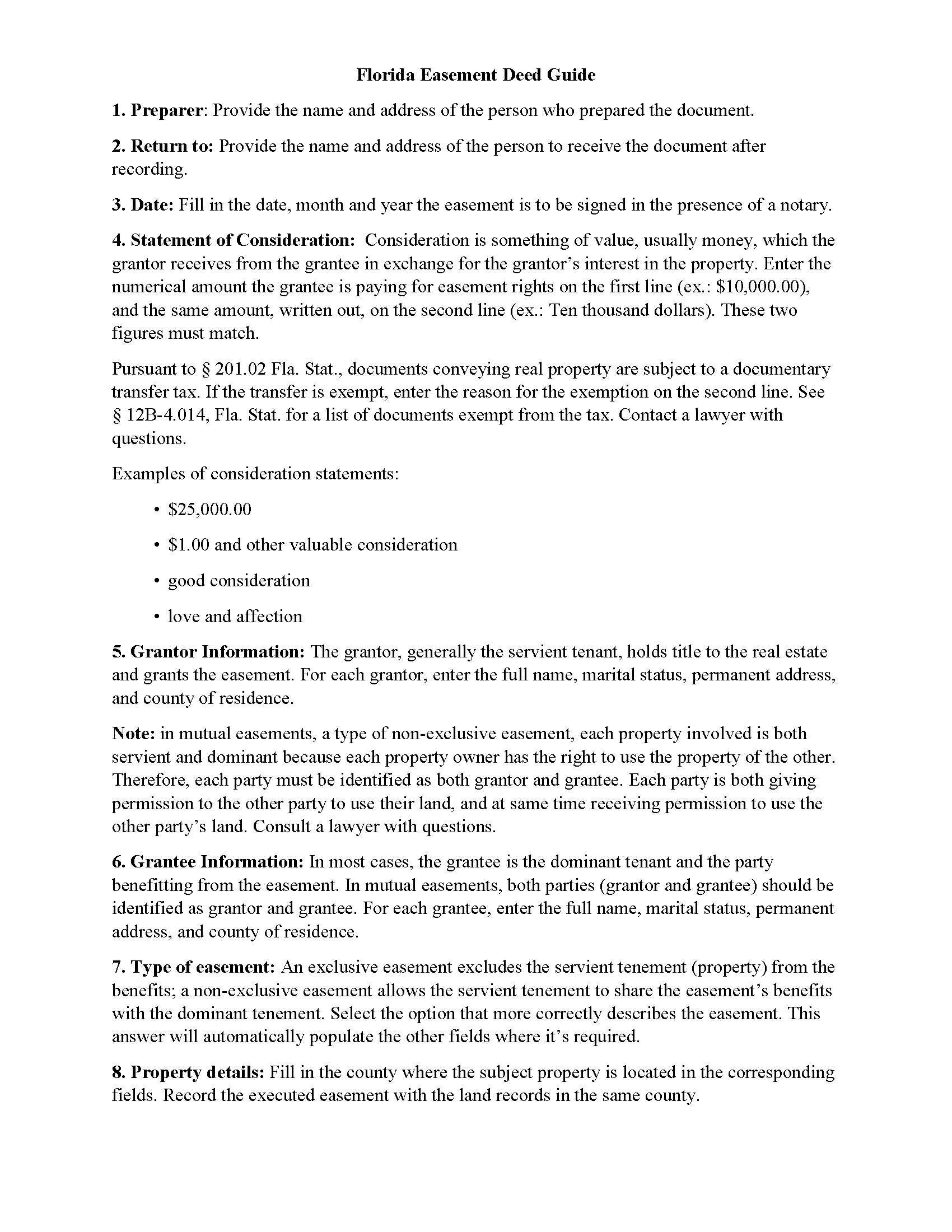
Monroe County Easement Deed Guide
Line by line guide explaining every blank on the Easement Deed form.
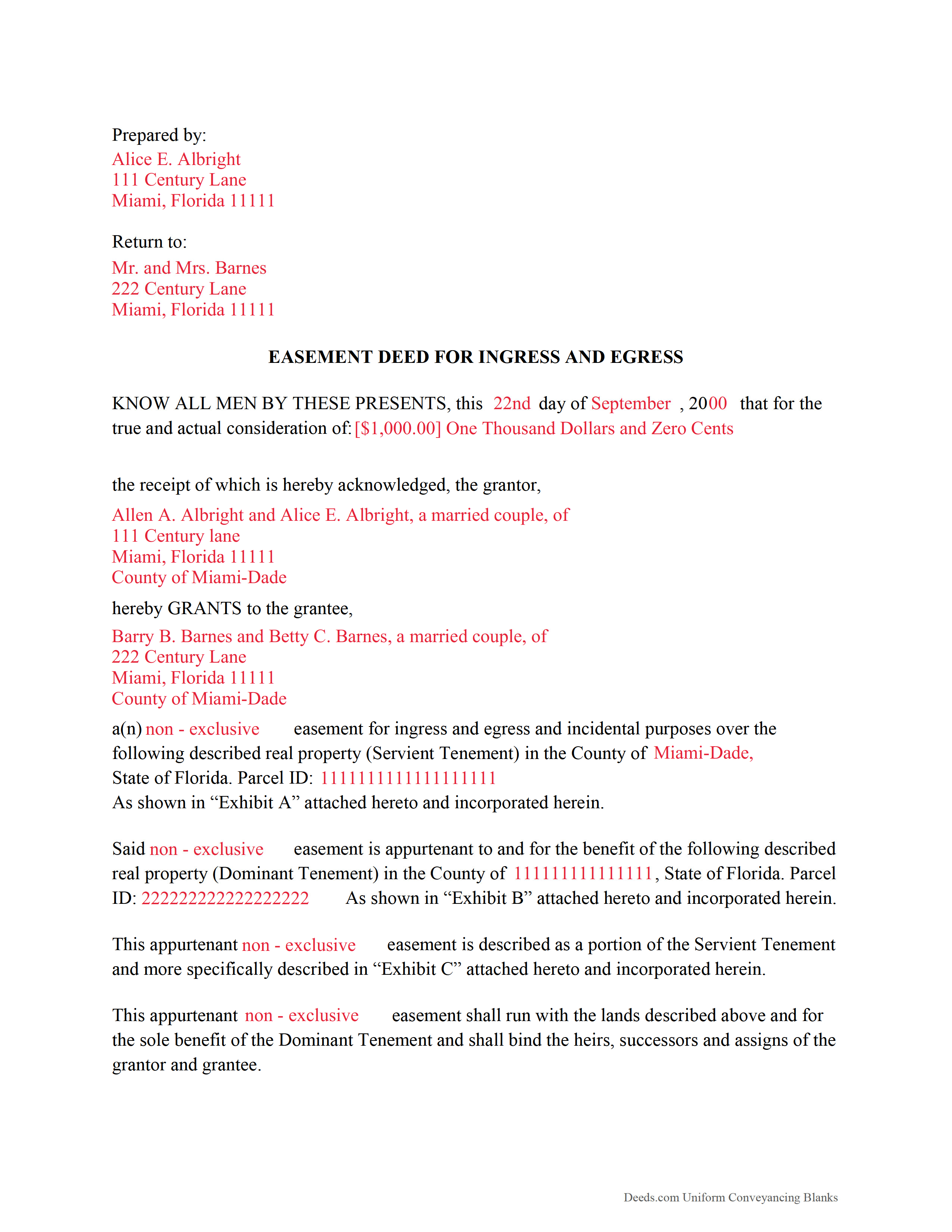
Monroe County Completed Example of the Easement Deed Document
Example of a properly completed Florida Easement Deed document for reference.
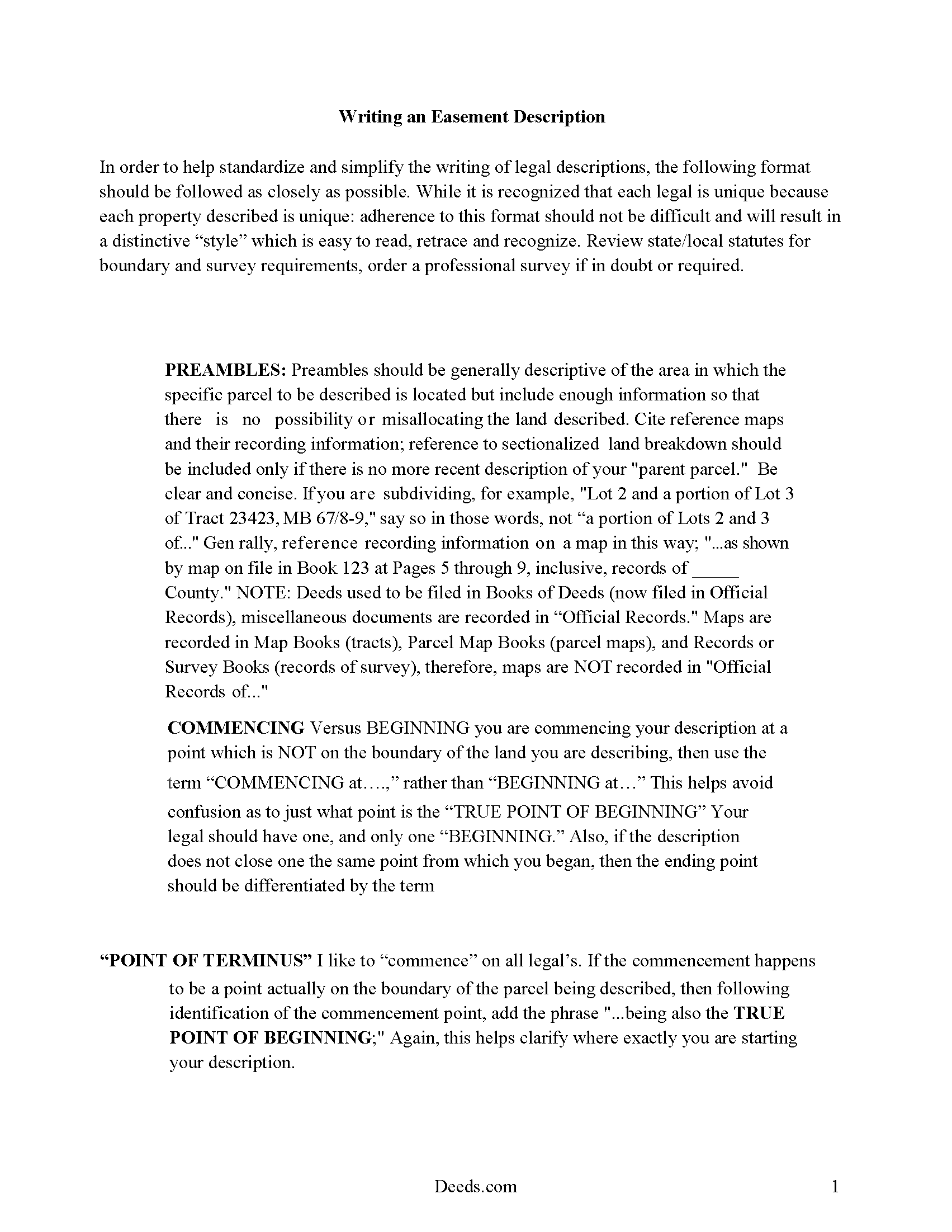
Monroe County Guide to Writing an Easement Description
A Description of the Easement will be required. This will show how to write an acceptable description for a Right of Way Easement, which gives access, to and from - point A to point B.
All 4 documents above included • One-time purchase • No recurring fees
Immediate Download • Secure Checkout
Additional Florida and Monroe County documents included at no extra charge:
Where to Record Your Documents
Clerk of the Court - Key West
Key West, Florida 33040
Hours: 8:30 to 5:00 M-F
Phone: (305) 294-4641
Marathon Office
Marathon, Florida 33050
Hours: 8:30 to 5:00 M-F
Phone: (305) 292-3540
Plantation Key Office 1
Plantation Key, Florida 33070
Hours: 8:30 to 5:00 M-F
Phone: (305) 852-7145
Plantation Key Office 2
Plantation Key, Florida 33070
Hours: 8:30 to 5:00 M-F
Phone: (305) 852-7145
Recording Tips for Monroe County:
- Bring your driver's license or state-issued photo ID
- Ensure all signatures are in blue or black ink
- Recorded documents become public record - avoid including SSNs
- Recording fees may differ from what's posted online - verify current rates
- Request a receipt showing your recording numbers
Cities and Jurisdictions in Monroe County
Properties in any of these areas use Monroe County forms:
- Big Pine Key
- Islamorada
- Key Colony Beach
- Key Largo
- Key West
- Long Key
- Marathon
- Marathon Shores
- Summerland Key
- Tavernier
Hours, fees, requirements, and more for Monroe County
How do I get my forms?
Forms are available for immediate download after payment. The Monroe County forms will be in your account ready to download to your computer. An account is created for you during checkout if you don't have one. Forms are NOT emailed.
Are these forms guaranteed to be recordable in Monroe County?
Yes. Our form blanks are guaranteed to meet or exceed the applicable formatting requirements used for recording in Monroe County, including margin requirements, font requirements, and other layout standards. This guarantee applies to formatting, not to the legal sufficiency of information entered by the user or the suitability of a form for a particular transaction.
Can I reuse these forms?
Yes. You can reuse the forms for your personal use. For example, if you have multiple properties in Monroe County you only need to order once.
What do I need to use these forms?
The forms are PDFs that you fill out on your computer. The free Adobe Acrobat Reader is recommended, and most PDF apps also work. You do NOT enter your property information online - you download the blank forms and complete them privately on your own computer.
Are there any recurring fees?
No. This is a one-time purchase. Nothing to cancel, no memberships, no recurring fees.
How much does it cost to record in Monroe County?
Recording fees in Monroe County vary. Contact the recorder's office at (305) 294-4641 for current fees.
Questions answered? Let's get started!
A Florida easement deed grants a non-possessory right to use another person's land for a specific purpose, and Florida's framework for these instruments is distinctive enough that forms drafted for other states routinely fail at the recorder's office. Florida is one of the few states that requires two subscribing witnesses to a grantor's signature on a deed conveying an interest in real property (Fla. Stat. § 689.01). Beyond the witness rule, Florida codifies several specific easement categories — statutory ways of necessity, conservation easements, and solar easements — each with its own mechanics under Chapter 704. Florida's constitutional homestead protections add a further layer when the burdened parcel is the grantor's primary residence. The Florida easement deed package on this page is drafted to satisfy these state-specific execution and recording requirements.
When a Florida easement deed is used
An easement deed is the instrument used to create or grant an express easement — a recorded right of use that runs with the land and binds future owners of the servient parcel. Common uses in Florida include driveway and access easements over a neighboring parcel, utility easements, drainage easements, ingress and egress easements for otherwise landlocked parcels, conservation easements protecting natural or scenic values, and solar easements preserving a property's exposure to sunlight for a solar energy device. Easements arising by implication, prescription, or statute (such as a statutory way of necessity under section 704.01) operate by separate legal mechanisms and are not created by this form.
Florida statutory framework: Chapter 704
Florida codifies easement law primarily in Chapter 704 of the Florida Statutes, and several provisions create easement categories that do not exist as statutory creatures in many other states.
Section 704.01(1) recognizes an implied grant of way of necessity where a grantor previously conveyed land that has no accessible right-of-way except over the grantor's remaining land. Section 704.01(2) creates a separate statutory way of necessity exclusive of common-law right when land used or intended for dwelling, agricultural, timber, or stock-raising purposes is shut off from the nearest practicable public road by surrounding lands, fences, or other improvements. The statutory remedy under 704.01(2) is distinct from the common-law implied easement and has its own procedural requirements.
Section 704.06 governs conservation easements held by a governmental body or a qualifying charitable organization whose purposes include retaining the natural, scenic, open-space, agricultural, or historic values of real property. A conservation easement runs with the land and binds successive owners of the servient estate. Recording a conservation easement also gives notice to the county property appraiser and tax collector of the conveyance.
Section 704.07 authorizes solar easements obtained for the purpose of maintaining the exposure of a solar energy device to sunlight. A solar easement must be in writing and is subject to the same recording and indexing rules as any other instrument affecting title to real property.
Execution requirements
Florida's execution rules are stricter than the national norm. Under section 689.01, a deed conveying an interest in real property must be signed by the grantor in the presence of two subscribing witnesses, each of whom signs the instrument. The grantor's signature must also be acknowledged before a notary public or other officer authorized to take acknowledgments under section 695.03. The notary may serve as one of the two witnesses, but if the notary signs in both capacities, the notary must sign the instrument twice — once on a witness line and once in the notarial block. The witness signatures and the acknowledgment certificate must both be present and properly completed for the clerk to record the instrument.
Section 695.26 separately requires that the name and post office address of the person who prepared the instrument appear on the face of the document. A clerk will refuse to record an easement deed that does not contain the preparer's name and address.
Florida-specific traps
Several Florida-specific issues cause easement deeds to be rejected at recording or to surface as defects in a later title examination.
- Homestead and spousal joinder. Article X, section 4 of the Florida Constitution protects homestead property and restricts its alienation. If the servient parcel is the grantor's homestead and the grantor is married, the non-owner spouse must join in conveying any easement that effectively alienates or materially burdens the homestead. This is true even when the spouse holds no record title to the land.
- Marital status recital. Because homestead status turns on marriage and residence, Florida deeds customarily include a recital of the grantor's marital status. Title examiners rely on this recital, and its absence can raise objections during a later title search even where homestead is not in fact involved.
- Documentary stamp tax. Chapter 201 imposes a documentary stamp tax on instruments conveying an interest in Florida real property when consideration is paid. The standard rate is $0.70 per $100 of consideration outside Miami-Dade County and $0.60 per $100 inside Miami-Dade. Whether stamps are due on a particular easement depends on whether consideration changed hands; the clerk computes and collects the tax at recording.
- Legal description and plat references. The easement area must be described with sufficient precision to be located on the ground. For parcels within a recorded subdivision, the plat book and page reference is customary; for metes-and-bounds parcels, a surveyed description of the easement area is generally needed. A vague or floating description is a frequent source of later boundary disputes.
- Conservation easement holder qualification. Section 704.06 limits who may hold a conservation easement to governmental bodies and charitable corporations or trusts whose stated purposes meet the statutory criteria. A conservation easement granted to a holder that does not qualify under 704.06 is not enforceable as a Florida conservation easement.
Recording the easement deed
Florida easement deeds are recorded with the clerk of the circuit court in the county where the affected real property is located. Recording places the instrument in the official records and provides constructive notice of its existence to subsequent purchasers, creditors, and other parties. Under section 695.01, an unrecorded conveyance is not effective in law or equity against creditors or subsequent purchasers for value without notice. Priority among recorded instruments is determined by the order and time of recording, so prompt recording protects the easement holder's position against later-recorded interests in the same land.
Included in the Florida easement deed package
- The Florida easement deed form, formatted to satisfy section 689.01 execution requirements and the section 695.26 preparer identification rule
- Line-by-line completion guidelines covering grantor and grantee identification, the legal description of the easement area, witness and notary blocks, and the marital status recital
- A completed example showing how a typical Florida easement deed reads when properly filled in
Important: Your property must be located in Monroe County to use these forms. Documents should be recorded at the county recording office listed above.
This Easement Deed meets all recording requirements specific to Monroe County.
Our Promise
The documents you receive here are guaranteed to meet or exceed the applicable Monroe County recording format requirements. If there is a rejection caused by our formatting, we will correct the issue or refund your payment. This guarantee applies to document formatting only and does not extend to information entered by the user, the selection of the form, or the legal effect of the completed document.
Save Time and Money
Get your Monroe County Easement Deed form done right the first time with Deeds.com Uniform Conveyancing Blanks. At Deeds.com, we understand that your time and money are valuable resources, and we don't want you to face a penalty fee or rejection imposed by a county recorder for submitting nonstandard documents. We constantly review and update our forms to meet rapidly changing state and county recording requirements for roughly 3,500 counties and local jurisdictions.
4.8 out of 5 - ( 4,819 Reviews )
Dina B. 5 out of 5 stars
The web cite is very easy to navigate through making a document process simple to obtain.
Thank you!
Candace K. 5 out of 5 stars
I was able to find the Certificate of Trust after a little searching. Once found, the remainder of the process was easy. My task was done in no time. It's a great site.
Thank you for your feedback. We really appreciate it. Have a great day!
Barb S. 5 out of 5 stars
if i could give this site ten stars i would
Thank you!
barbara s. 5 out of 5 stars
I was in a rush to record a quit claim deed, however due to covid 19 Miami dade county recorders office are not open to public. According to staff I would have to mail in the quit claim deed and wait approximately two weeks for the deed to get recorded. Thanks to Deeds.com I got my document recorded in less than one day. You guys are awesome, I will use this company anytime I need something like this again. Very reliable.
We appreciate your business and value your feedback. Thank you. Have a wonderful day!
David S. 5 out of 5 stars
The form was just what I needed for the Circuit Court and Land Records office. The additional information provided was very helpful as well.
We appreciate your business and value your feedback. Thank you. Have a wonderful day!
Michael W. 5 out of 5 stars
Excellent product. I am so happy I found Deeds.com!
Thank you for your feedback. We really appreciate it. Have a great day!
Delsina T. 5 out of 5 stars
So helpful. Thank you so much for making this a smooth process.
Thank you!
Melissa S. 5 out of 5 stars
As a person working in the title industry, I recommend this site to everyone needing a blank deed. Thank you for staying user friendly.
Thank you, Melissa! An endorsement from someone who works with these transactions every day carries real weight with us. We work hard to keep the whole process painless, so it's wonderful to hear it's landing that way. All the best to you!
DIANA S. 5 out of 5 stars
Five star rating. I requested a copy of the deed to my house and it arrived very quickly and for a fraction of the cost that it would have cost me on other sites. Great company. Will do business again. Five stars.
Thank you!
Alana G. 5 out of 5 stars
I was very pleased. It was the form I needed. I was getting discouraged by companies that wanted me to sign up for monthly payments just to get the one form I needed. I prefer your system of paying for what I get. Thank you so much!
Thank you for your feedback. We really appreciate it. Have a great day!
Sherry C. 5 out of 5 stars
more than 5 stars really! best company to do business with. I was helped and got everything I needed, then helped again by this company when I asked for a refund. their response was our office took care of it and you got your refund! what kind of professional company is this! they are very helpful!
Your review means a lot to us. Thank you for taking the time.
Dennis D. 5 out of 5 stars
Thanks for the efficient process and instructions.
Thank you for your feedback. We really appreciate it. Have a great day!
John T. 5 out of 5 stars
Amazing! Very helpful. Very specific.
Thank you for your feedback. We really appreciate it. Have a great day!
CAROLYN H. 5 out of 5 stars
Thanks. Was simple and easy to use.
Thank you!
Heidi G. 5 out of 5 stars
Very happy with the service that you offer. My office will use you again.
Great to hear Heidi, glad we could help. Have an amazing day!