Florida Enhanced Life Estate Special Warranty Deed
County Specific Legal Forms Validated as recently as October 12, 2026 by our Forms Development Team
About the Florida Enhanced Life Estate Special Warranty Deed
How to Use This Form
- Select your county from the list
- Download the county-specific form
- Fill in the required information
- Have the document notarized if required
- Record with your county recorder's office
What Others Like You Are Saying
"excellent and timely service."
"Was helpful"
"form was east to use...instructions came in handy."
"That was easy(I think). Hopefully they saved to my computer intact so I don't have to come back begg…"
"The website and information is fine. The proof in the pudding, of course, is whether the forms I use…"
4.8/5 from 4,825 reviews. Read all
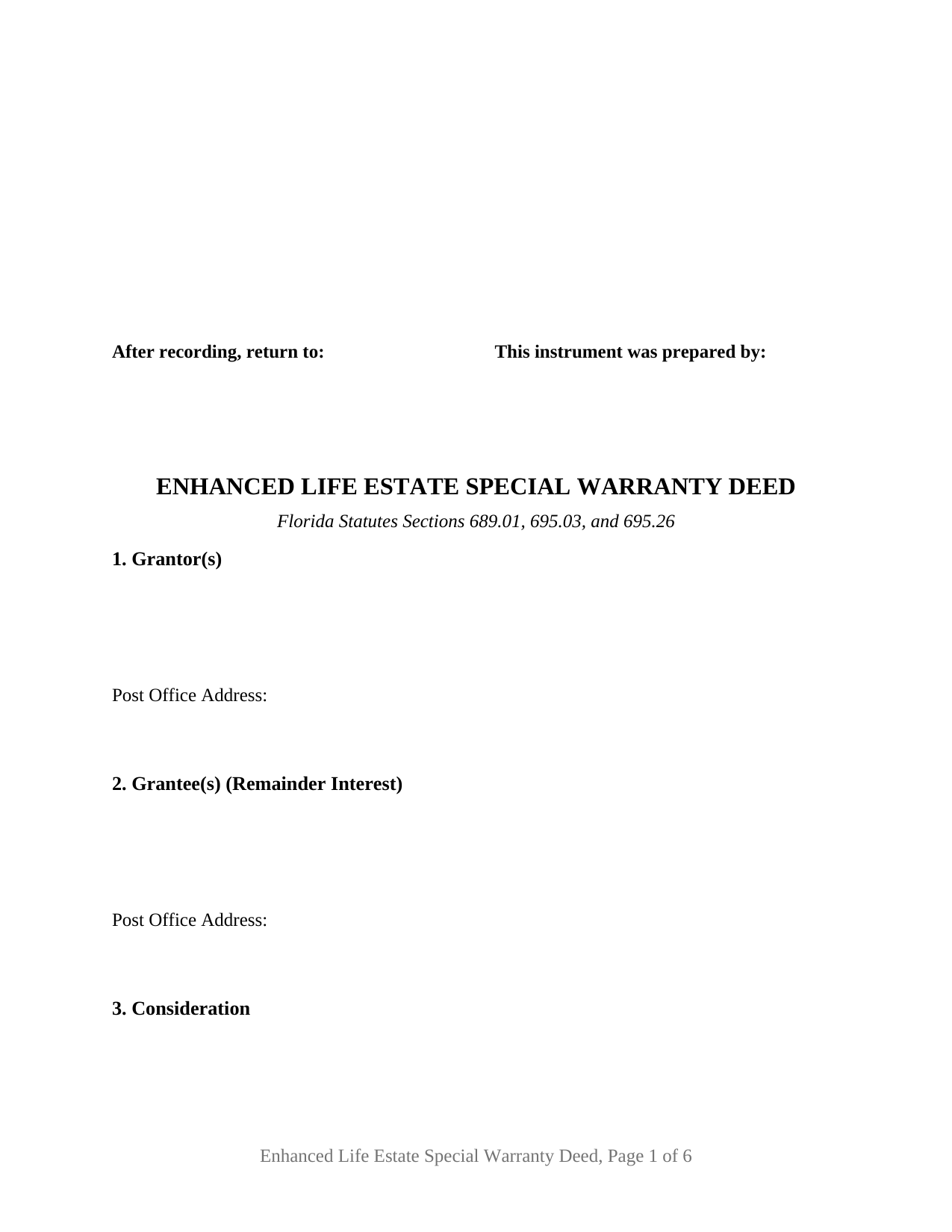
A Florida enhanced life estate special warranty deed, the instrument most people call a lady bird deed, puts the next owner of record in place today while the owner gives up nothing during life. The owner conveys the remainder interest and, in the same deed, reserves a life estate coupled with full power to sell, mortgage, lease, gift, revoke, and otherwise dispose of the property without the remainder holder's signature. At the owner's death, whatever was not disposed of vests in the named grantees without probate of that parcel, under a special warranty of title covering the owner's own period of ownership.
A deed with no statute behind it
Florida has no transfer on death deed statute and no statute creating the enhanced life estate deed. The instrument rests on common-law estate principles, Florida decisions, and title practice: the Florida Supreme Court upheld a deed reserving lifetime possession and a power of resale in 1917, and The Florida Bar's Uniform Title Standards 6.10 through 6.12, adopted in 2019, describe the instrument in non-homestead property, in homestead property, and for the remainderman at the life tenant's death. Because the standards' comments observe that the power to divest the remainderman is retained in the vesting deed itself, this form names that power expressly.
Control kept, remainder conveyed
Section 5 grants, bargains, sells, conveys, and confirms the property to the grantee in fee simple, subject to a reserved life estate carrying full power, without the joinder or consent of the grantee and without liability for waste, to dispose of the property in fee simple with or without consideration and to retain all proceeds. During the life estate the remainder is subject to complete divestment; on the grantor's death the property not previously disposed of vests in the grantee in fee simple. Where two grantors sign, the life estate and the powers belong to both during their joint lives and to the survivor afterward.
A special warranty that follows the reserved powers
Section 6 carries the Florida practice form of the covenant: the grantor warrants the title and will defend it against the lawful claims of all persons claiming by, through, or under the grantor, but against none other. That confines the warranty to the grantor's own ownership, the limit that distinguishes it from the statutory warranty deed of Florida Statutes Section 689.02, whose covenant runs against all persons whomsoever. One added sentence keeps the covenant consistent with the reserved powers: it does not reach interests the grantor later creates under Section 5.
The one-or-two-person configuration
This form is the base configuration for the deed type: natural persons signing in their own right, one or two on each side. The grantor and grantee blocks are free-form name blocks carrying whatever status recital and holding designation the signers supply, so a sole owner, spouses, two co-owners, and a married owner joined by a non-owner spouse for homestead purposes all present patterns the same deed recites, and two grantees may take the remainder as tenants in common, as joint tenants with right of survivorship, or, if married to each other, by the entirety. Nothing about status, vesting, or capacity is preprinted. The deed carries two grantor signature blocks, each with two subscribing witness blocks carrying the post-office addresses Section 695.26 requires, and a separate acknowledgment certificate for each grantor. A grantor signing in a representative capacity, an entity grantor, and three or more persons on either side are outside the configuration this deed recites.
Homestead, taxes, and the clerk
Article X, Section 4(c) of the Florida Constitution has the spouse join in an alienation of homestead by a married owner, and Uniform Title Standard 6.12 states that the remainderman in homestead property takes at the life tenant's death only when the constitutional restriction on devise of homestead is not violated. The Department of Revenue, in a 2020 letter ruling on an unencumbered property, concluded that an enhanced life estate deed transferred no present beneficial interest and was not subject to the documentary stamp tax, a ruling that binds the Department only as to the taxpayer who requested it. Section 196.041(2) keeps a person holding a beneficial interest for life within the homestead tax exemption.
The package includes the fillable form, a completed example filled in for a Pinellas County fact pattern, and the guide that walks through every section and the recording process. This description and the guide describe the form and the law in general terms; they are not legal advice.
Important: County-Specific Forms
Our enhanced life estate special warranty deed forms are specifically formatted for each of the 67 counties in Florida.
After selecting your county, you'll receive forms that meet all local recording requirements, ensuring your documents will be accepted without delays or rejection fees.