Florida Life Estate Warranty Deed (Unmarried Sole Owner Retaining the Life Estate)
County Specific Legal Forms Validated as recently as October 15, 2026 by our Forms Development Team
About the Florida Life Estate Warranty Deed (Unmarried Sole Owner Retaining the Life Estate)
How to Use This Form
- Select your county from the list
- Download the county-specific form
- Fill in the required information
- Have the document notarized if required
- Record with your county recorder's office
What Others Like You Are Saying
"This site was easy to use with full instructions on how to fill out and file forms very good"
"I find this site easy to use and every form I may need. Now to figure out how to fill in on line. :)"
"Super website. Easy to use and stuff is well organized."
"Super easy and quick. Love the service-"
"Easy and efficient way to get a deed copy."
4.8/5 from 4,828 reviews. Read all
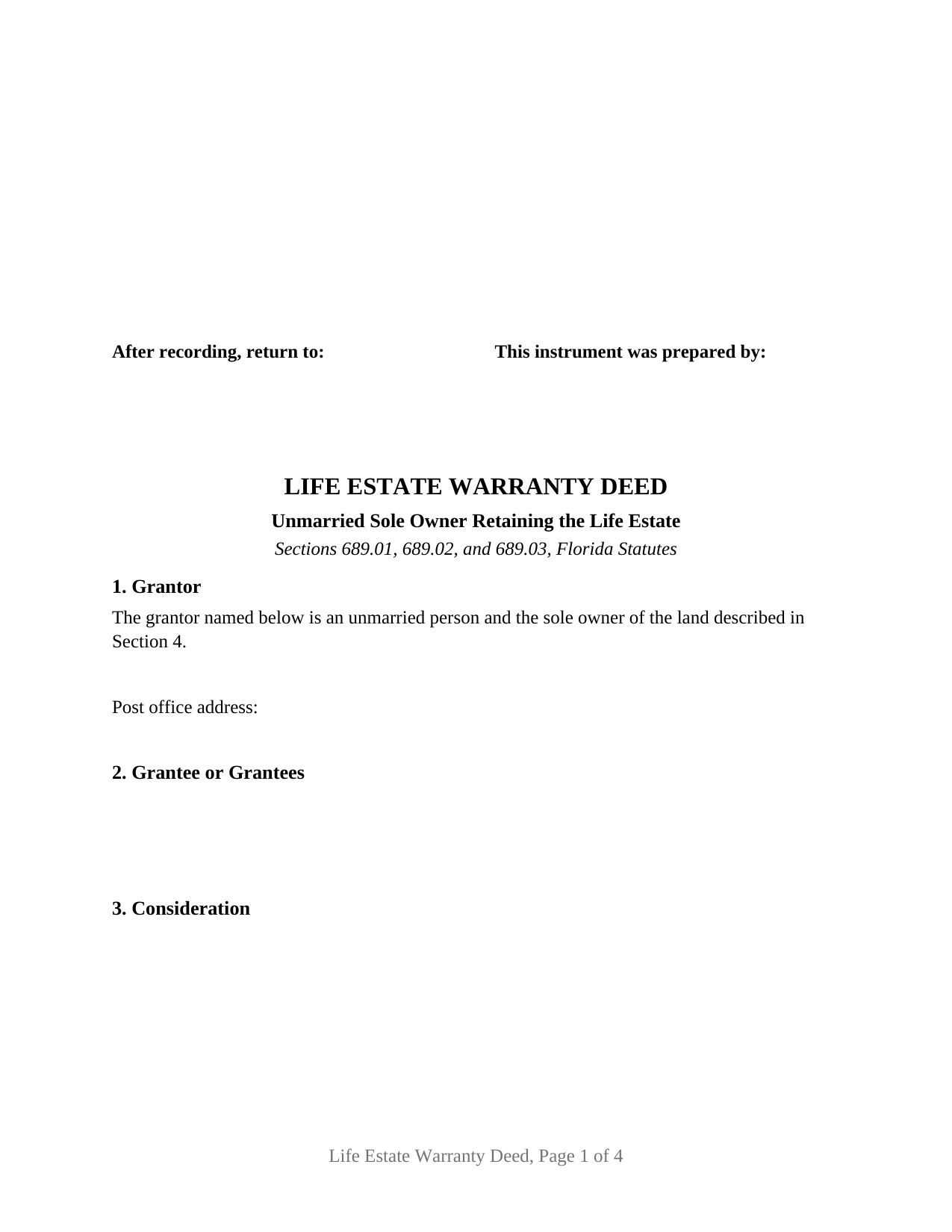
A single Florida owner with no spouse to join in a deed can give away the remainder in a house or a parcel of land in one signature, with the statutory warranty of title, and keep the right to live there for life. This form prepares a Florida life estate warranty deed for exactly that owner: one unmarried person who holds the land alone, conveying to one or two grantees and reserving the life estate to himself or herself.
One owner, one signature, one certificate
The deed's first section recites, as fixed text, that the grantor named there is an unmarried person and the sole owner of the land described in the property section. Nothing about marital status or existing title is left to a blank. Because one person conveys, the form carries one grantor signature block, the two subscribing-witness blocks Section 689.01 of the Florida Statutes calls for on a freehold conveyance, and one acknowledgment certificate; every block is used, and no block waits for a second grantor who never signs. The grantee section receives one or two grantees with their post-office addresses and, for two, the words that state how they hold the remainder, as the completed example shows.
An unmarried owner conveying the remainder in a lakefront lot to a niece and a nephew while keeping the seasonal rental income, and a divorced owner giving a sibling the remainder in the house where the owner continues to live, present the pattern this deed recites. The form is not set up as a deed by a married owner, whose homestead conveyance Article X, Section 4(c) of the Florida Constitution requires the spouse to join, as a deed by two owners, a trustee, a personal representative, or an attorney-in-fact, or as a deed in which the life estate goes to someone other than the grantor.
What stays with the grantor for life
The reservation names the estate the grantor keeps and states its content: the exclusive right to possess, occupy, and use the land and to receive its rents, issues, and profits for the grantor's natural life. Where the grantor keeps the land as a permanent residence, Section 196.041(2) declares a possessory right resting on an instrument that grants a beneficial interest for life to be equitable title for the property tax homestead exemption. The deed also says what the grantor does not keep: no power to sell, convey, mortgage, or otherwise divest the remainder without the joinder of the grantee. That one sentence separates this deed from the enhanced life estate, or lady bird deed, whose life tenant retains exactly those powers.
A remainder that is already given
The grantee takes a vested remainder in fee simple the moment the deed is delivered, with possession postponed until the life estate ends. The deed states that upon the death of the grantor the life estate ends and the grantee holds the land in fee simple absolute. The conveyance uses the words Section 689.02 prints, has granted, bargained and sold, and closes with the covenant that the grantor does hereby fully warrant the title to said land, and will defend the same against the lawful claims of all persons whomsoever, the covenant Section 689.03 treats as full common-law warranty. A matters-of-record section lists the recorded easements and restrictions the warranty excepts.
Recording in the county where the land lies
The clerk of the circuit court records the deed. Section 695.26 places on the instrument the printed names and post-office addresses of the grantor, the witnesses, and each grantee, the name and address of the natural person who prepared it, and a blank space at the top right of the first page for the clerk, and the form carries each of them. The acknowledgment sentence is the Section 695.25(1) statutory short form, with the physical presence or online notarization boxes the notary completes. Documentary stamp tax under Section 201.02 is paid at recording on the consideration; a deed of unencumbered land for nominal consideration carries the minimum tax, while a mortgage the land remains subject to is consideration under the Department of Revenue's rules.
Included in the package are the fillable deed form, with an instructions page that is not recorded, a completed example filled in for a Lake County fact pattern, and the guide that describes each section, the two-witness signing, the acknowledgment, and recording. This description and the guide describe the form and the Florida statutes that govern it in general terms and are not legal advice.
Important: County-Specific Forms
Our life estate warranty deed (unmarried sole owner retaining the life estate) forms are specifically formatted for each of the 67 counties in Florida.
After selecting your county, you'll receive forms that meet all local recording requirements, ensuring your documents will be accepted without delays or rejection fees.