Florida Release of Lis Pendens
County Specific Legal Forms Validated as recently as October 20, 2026 by our Forms Development Team
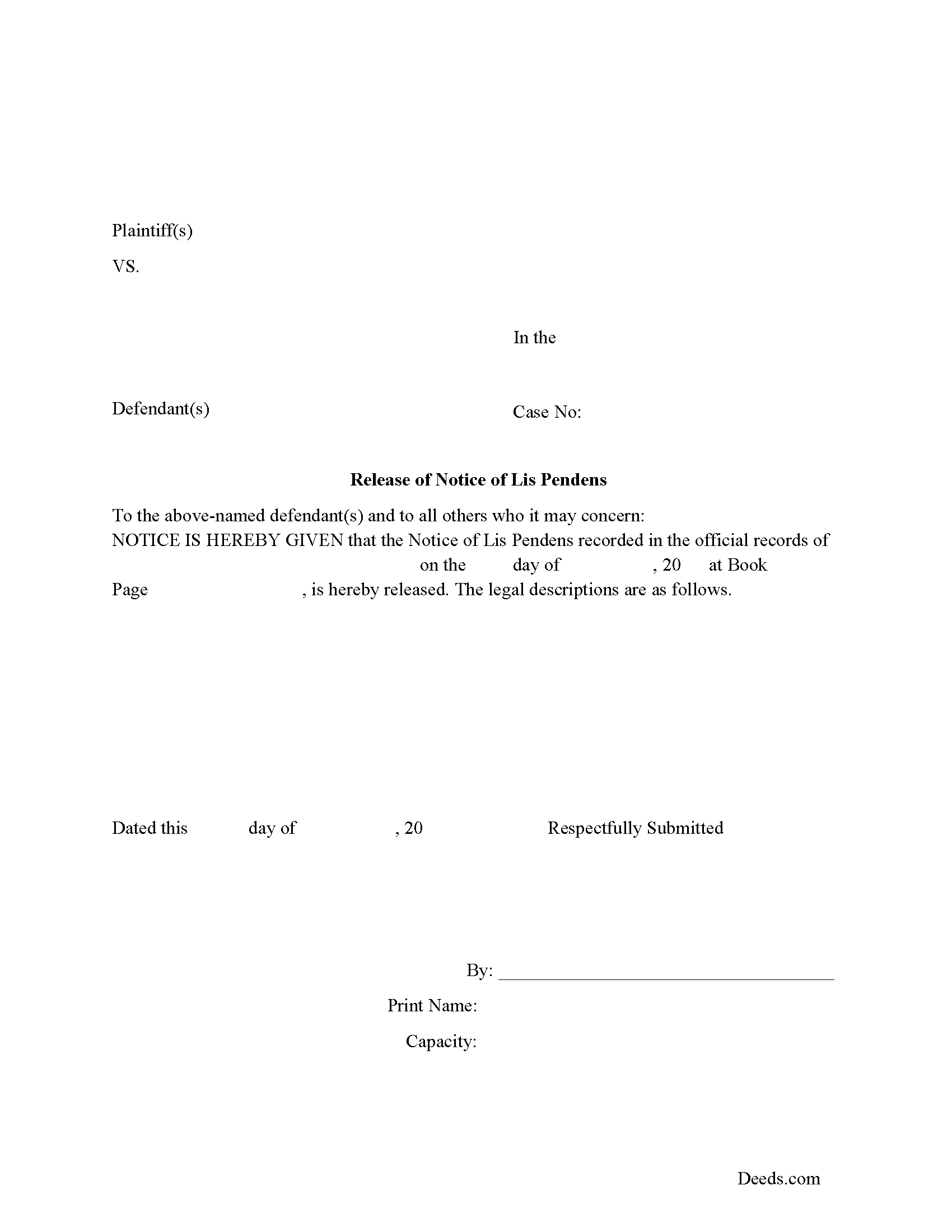
About the Florida Release of Lis Pendens
How to Use This Form
- Select your county from the list
- Download the county-specific form
- Fill in the required information
- Have the document notarized if required
- Record with your county recorder's office
What Others Like You Are Saying
"Easy steps to create an account, will recommend to anyone."
"I stand corrected. I received my report and it was exactly what I requested."
"I got what I asked for, almost instantly."
"Thanks, the documents were easy to follow and complete."
"Deeds.com did an excellent job in providing me the Real Estate documents I needed. You delivered the…"
4.8/5 from 4,836 reviews. Read all
A Florida Release of Lis Pendens removes the cloud on title that a recorded notice of pending action places on real property under Fla. Stat. § 48.23. Florida is one of the relatively few states with a statutory one-year expiration for a lis pendens, subject to limited exceptions and to court-ordered extensions, and even after that period the public record continues to show the encumbrance until a release is recorded. Title examiners pulling chain on the property will flag an unreleased lis pendens regardless of whether the underlying action has been dismissed, settled, or simply gone quiet, so the plaintiff or plaintiff's counsel typically files this release in the county's official records as soon as the matter concludes to keep title marketable.
When this form is used in Florida
This form is used by a plaintiff (or the plaintiff's attorney) who previously recorded a notice of lis pendens in connection with a Florida civil action and now needs to release that notice in the official records of the county where the property is located. Common triggers include voluntary dismissal, settlement, entry of a final judgment that does not require continuing notice to third parties, sale or transfer of the affected parcel pursuant to court order, or a determination that the action no longer affects the described real property.
Florida statutory framework
The substantive rules for lis pendens in Florida are set out in Fla. Stat. § 48.23. Two provisions in particular shape how releases are used in practice:
- Section 48.23(2) — A notice of lis pendens is not effectual for any purpose beyond one year from the commencement of the action unless the relief sought is founded on a duly recorded instrument or on a construction lien claimed under Chapter 713, or unless the court extends the time on a showing of good cause. Even where the notice has lapsed by operation of law, recording a formal release closes the gap on the public record.
- Section 48.23(3) — Where a lis pendens has been improperly filed, the court may control and discharge it on terms appropriate to the circumstances. A release recorded by the plaintiff after a court-ordered discharge or after voluntary withdrawal serves as the recording-office evidence that the cloud is gone.
Execution and acknowledgment
The release is signed by the plaintiff or by the plaintiff's attorney of record. Florida does not require two subscribing witnesses for a release of lis pendens — the two-witness rule under Fla. Stat. § 689.01 applies to conveyances of real property, and a release is not a conveyance. The signature must be acknowledged before a notary public in compliance with Fla. Stat. § 117.05, including the notary's seal, commission expiration date, and identification of the signer either by personal knowledge or by approved identification under § 117.05(5).
Florida-specific traps to avoid
A release that is substantively correct can still be rejected at the recording counter if it does not meet Florida's recording-format and indexing rules. The most frequent issues are:
- Preparer identification — Fla. Stat. § 695.26 requires every instrument affecting title or possession of real property to bear a statement showing the name and post-office address of the natural person who prepared it, typically rendered as "This instrument prepared by [name and address]."
- Three-inch top margin — Section 695.26 also requires a three-inch space at the top right corner of the first page for the recording stamp, with one-inch margins on the remaining sides. Out-of-state forms commonly fail this requirement.
- Names typed beneath signatures — The name of each person signing must be legibly printed, typewritten, or stamped immediately beneath the signature line under § 695.26(1)(b).
- Cross-reference to the original lis pendens — The release must identify the original notice by official records book and page number, or by instrument number, so the clerk can cross-index the release against the original entry. Without that reference, the release will not be linked in the index to the encumbrance it is meant to clear.
- Legal description and plat references — The legal description must match the original lis pendens. Where the parcel is described by reference to a recorded plat, the release should carry the same plat citation (e.g., "as recorded in Plat Book ___, Page ___, of the Public Records of [County] County, Florida") so that indexing matches across the two instruments.
- Documentary stamp tax — A release of lis pendens is not a conveyance and does not transfer an interest in real property, so documentary stamp tax under Fla. Stat. § 201.02 does not apply. Standard recording fees set by the clerk under Fla. Stat. § 28.24 still apply.
Recording the release
The release is recorded in the official records of the same Florida county where the original notice of lis pendens was recorded — the county where the real property is located. Recording is handled by the clerk of the circuit court or the comptroller's office, depending on the county, with fees set under Fla. Stat. § 28.24. Once recorded and indexed against the original lis pendens, the release becomes constructive notice to subsequent purchasers, lenders, and title insurers that the prior encumbrance has been removed.
What's included in the download package
The Florida Release of Lis Pendens package includes:
- The Florida Release of Lis Pendens form, formatted for recording under Fla. Stat. § 695.26
- Line-by-line completion guidelines
- A completed example showing how the release should be filled in for a typical post-dismissal filing
Files are provided in standard formats and are available immediately after purchase.
Important: County-Specific Forms
Our release of lis pendens forms are specifically formatted for each of the 67 counties in Florida.
After selecting your county, you'll receive forms that meet all local recording requirements, ensuring your documents will be accepted without delays or rejection fees.