Georgia Personal Representative Claim of Lien
County Specific Legal Forms Validated as recently as October 21, 2026 by our Forms Development Team
About the Georgia Personal Representative Claim of Lien
How to Use This Form
- Select your county from the list
- Download the county-specific form
- Fill in the required information
- Have the document notarized if required
- Record with your county recorder's office
What Others Like You Are Saying
"This was exactly what I needed. For $25-$30 it gave me the formatted document I needed and made it s…"
"All documents were site specific and up-to-date. Not recorded yet but have high hopes."
"Very concise and thorough website. Easily navigated and easily affordable."
"Easy to use, inexpensive, very helpful"
"Great process and very easy to complete"
4.8/5 from 4,829 reviews. Read all
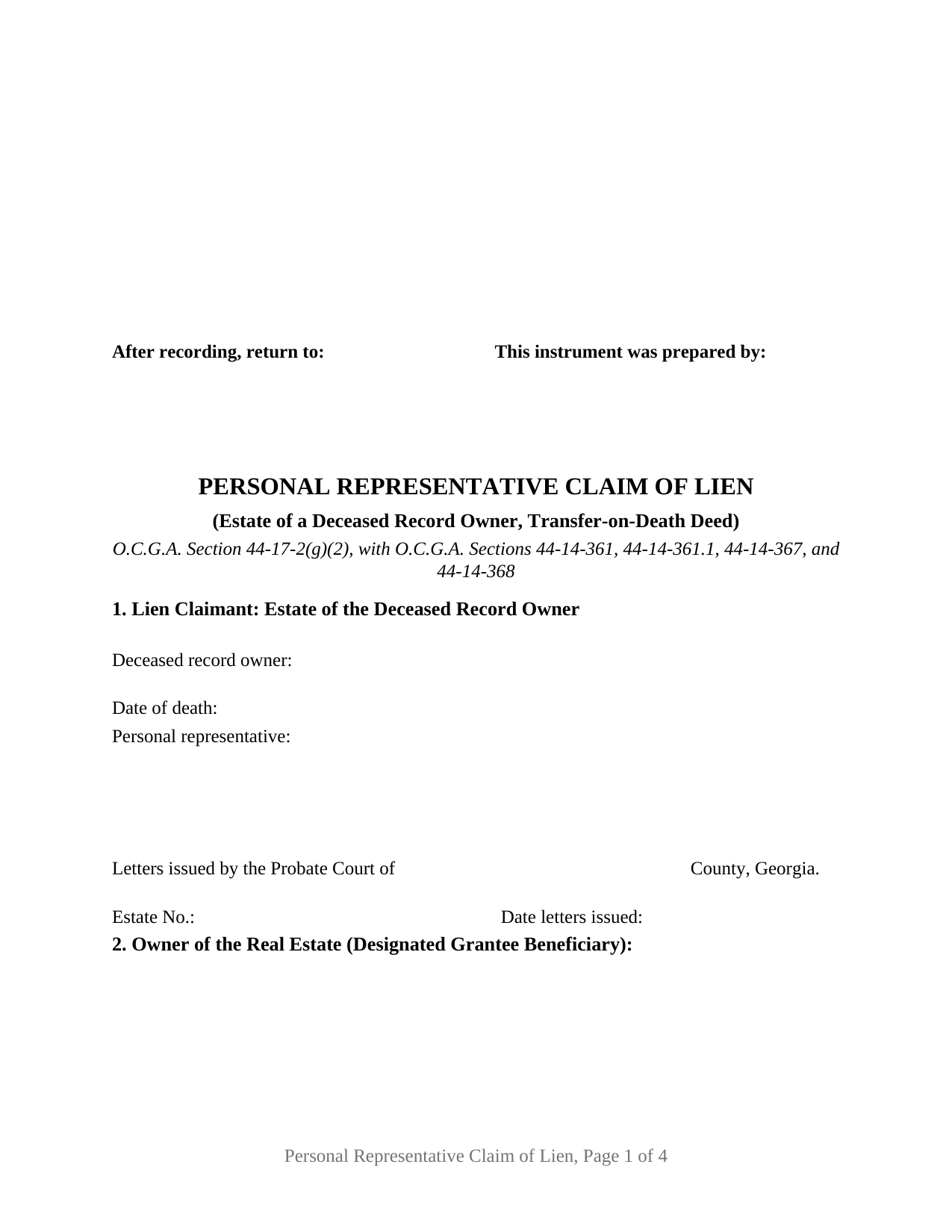
When Georgia real estate passes under a transfer-on-death deed, there is a gap between the record owner's death and the day the designated grantee beneficiary accepts the property, and someone keeps paying the mortgage, the taxes, and the roofer. The Georgia Personal Representative Claim of Lien is the recorded instrument by which the estate of the deceased record owner, through its executor or administrator, asserts the priority special lien that O.C.G.A. Section 44-17-2(g)(2) gives the estate for those payments when they are not repaid within one year after acceptance.
A lien for the year between death and acceptance
Georgia's 2026 amendments to its transfer-on-death deed chapter (Act 379, HB 413) made acceptance the moment of transfer: the beneficiary takes ownership only when the acceptance affidavit is executed and recorded after the record owner's death. Section 44-17-2(g)(2)(A) answers the question that timing raises. The personal representative of a solvent estate is authorized to incur expenses for mortgage payments, property taxes, and repairs that keep the property from imminent destruction until a beneficiary accepts; the estate is entitled to repayment and holds a priority special lien against the property for whatever is not repaid within one year after acceptance, behind property tax liens and previously recorded security deeds.
Thirty days to file, two business days to mail
The lien does not place itself of record. Under subparagraph (B), if the special lien has not been paid in full when the one-year period expires, the estate has 30 days to file a claim of lien with the clerk of superior court of the county where the property is located, and the lien then attaches for 365 days from the recording date. Under subparagraph (C), no later than two business days after filing, the estate sends a true and accurate copy to the owner by registered mail, certified mail, or statutory overnight delivery. The form's third section fixes the date of acceptance and the date the one-year period expired, and its second section carries the owner's mailing address, where the copy goes.
Borrowed enforcement rules and the 395 day statement
Chapter 17 prescribes no form for this claim of lien. It borrows the machinery of Georgia's mechanic's lien part instead: the lien attaches in the same manner as provided in Section 44-14-367, and the estate may foreclose it in the same manner as a mechanic's lien under Section 44-14-361. Section 44-14-367 requires a lien action within 365 days of filing and a notice of commencement of lien action within 395 days, and it requires every lien to carry on its face, in at least 12 point bold type, a statement that the claim expires and is void 395 days from filing if no notice of commencement of lien action is filed; a lien without that language cannot be filed. The form prints that statement in bold type, follows the substance of the Section 44-14-361.1 claim, and carries the notice to the owner of the right to contest the lien that Section 44-14-368 implements.
One fiduciary signer, one sworn certificate
The form recites exactly one lien claimant, the estate of the deceased record owner acting by and through the personal representative, and exactly one owner, the designated grantee beneficiary who accepted. It identifies the letters by probate court, estate number, and date, ties the claim to the recorded TOD deed and acceptance affidavit by deed book and page, describes the real estate, and itemizes the expenses with the total incurred, the amount repaid, and the amount claimed. The personal representative signs once under a sworn statement of authority and truth, and the form carries one verification certificate for the officer who administers the oath, the attestation that Section 44-2-14(a) makes a condition of recording. An insolvent estate follows a different path under Section 44-17-2(g)(3), and a claim by co-personal representatives or for expenses outside the three statutory categories presents a configuration this form does not recite.
The return block at the top of the first page satisfies Section 44-2-14(b), and a personal representative who files without a Georgia attorney is a self-filer who submits the claim through the GSCCCA electronic filing portal under Section 44-2-2. The package includes the fillable claim of lien, a completed example for a Gwinnett County estate, and the guide that walks through each section, the filing window, the mailing to the owner, and the enforcement timeline; this description and the guide describe the form and the governing statutes in general terms and are not legal advice.
Important: County-Specific Forms
Our personal representative claim of lien forms are specifically formatted for each of the 159 counties in Georgia.
After selecting your county, you'll receive forms that meet all local recording requirements, ensuring your documents will be accepted without delays or rejection fees.