Hawaii Affidavit of Death of Transferor (Transfer on Death)
County Specific Legal Forms Validated as recently as October 22, 2026 by our Forms Development Team
About the Hawaii Affidavit of Death of Transferor (Transfer on Death)
How to Use This Form
- Select your county from the list
- Download the county-specific form
- Fill in the required information
- Have the document notarized if required
- Record with your county recorder's office
What Others Like You Are Saying
"I thought your site was focused on my specific county, but it wasn't. Therefore, I did not complete …"
"The documents worked perfectly! Thanks"
"This service is very user-friendly and efficient."
"Efficient, helpful & easy! I highly recommend Deeds.com to anyone. Such a joy to use especially afte…"
"Easy to navigate site and download forms to PC!"
4.8/5 from 4,829 reviews. Read all
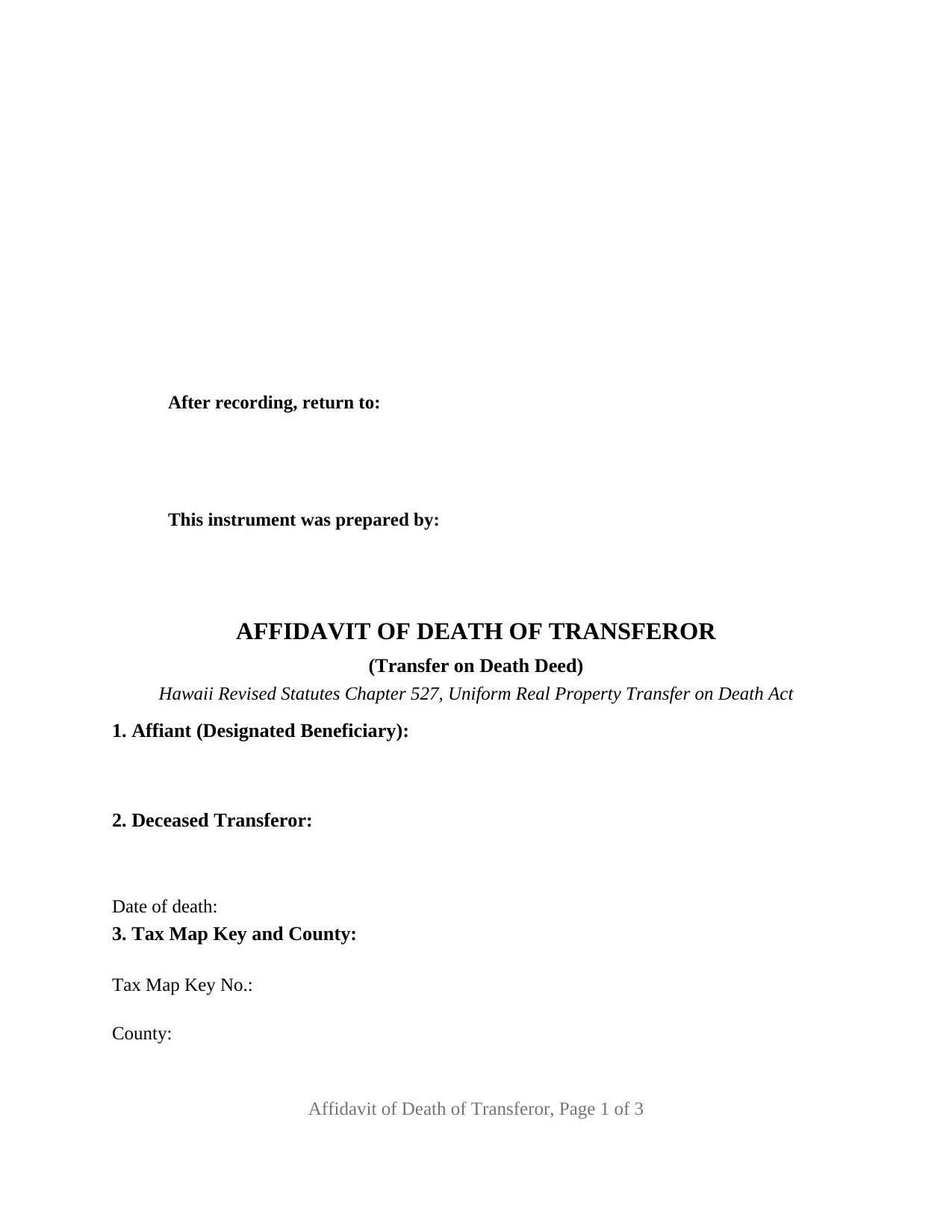
When the owner of Hawaii real property dies after recording a transfer on death deed, the deed has already done its work: under HRS Section 527-13, the owner's interest passed to the designated beneficiary at the moment of death, without probate and without any further conveyance. What the Bureau of Conveyances record does not yet show is that the death happened. This Hawaii Affidavit of Death of Transferor is the sworn statement a designated beneficiary records, with a certified copy of the death certificate attached, to put that fact into the Regular System record.
A transfer that happened at death, and a record that catches up
Hawaii adopted the Uniform Real Property Transfer on Death Act as HRS Chapter 527 in 2011. A transfer on death deed, also searched as a TOD deed or beneficiary deed, changes nothing while the owner lives and takes effect only if it was recorded with the Bureau of Conveyances, or filed with the assistant registrar of the Land Court, before the owner's death. At death, Section 527-13 transfers the owner's interest to the beneficiary named in the deed, subject to every mortgage, lien, and other interest then affecting the property. The chapter names no post-death filing for Regular System property; the affidavit is Hawaii conveyancing practice, the way title examiners, lenders, and the county real property tax office learn from the record that the transferor died and that the person now dealing with the property is the beneficiary the deed names.
What the affiant swears to
The affidavit identifies the transferor, the property by tax map key and legal description, and the deed by its recording data, then carries six sworn statements that track what Chapter 527 makes relevant. The affiant is a designated beneficiary named in the deed, which was recorded before the transferor's death. The transferor died, and the certified death certificate is attached as Exhibit A. The affiant survived the transferor by more than one hundred twenty hours, the measure HRS Section 560:2-702 supplies unless the deed itself expressly provides a different one. If the transferor held as a joint owner, the transferor was the last surviving joint owner, the condition Section 527-13(c) attaches before the deed takes effect. No instrument revoking the deed was recorded before the death, and the affiant knows of none; Section 527-11 recognizes revocation only by a later recorded instrument. The closing statement gives notice of the transfer under Section 527-13.
One affiant, one jurat, built for the Regular System
The form recites exactly one affiant, a natural person making the affidavit in that person's own right as a designated beneficiary, with one signature block and one jurat certificate that the notary completes. Hawaii prescribes no wording for a jurat; HRS Section 456-21 and the Attorney General's notary rules fix the certificate's contents, and the certificate carries each of them. A trust, an entity, an attorney in fact, or a personal representative making the statement follows a different pattern, as does a surviving joint tenant whose co-owner's death passed title by survivorship rather than under a transfer on death deed. Property of which any portion is registered in the Land Court takes the Section 527-13(a)(1) petition path to a new certificate of title, a filing prepared separately and not included in this package.
Formatted for the Bureau of Conveyances
Hawaii records centrally, and the Bureau's format rules shape the first page: the top three and one half inches are reserved for the registrars' recording information, the next inch carries the return address beginning one and one half inches from the left edge, and the names of the parties, the beneficiary's address, the document title, and the tax map key sit below that on page one, where HAR Section 13-16-4(c) places them. Pages are letter size and single sided, and the instructions cover page that ships with the form is removed before recording. The affidavit transfers nothing, so it is outside the conveyance tax Chapter 247 imposes on transferring documents; the Bureau is the source of its current intake practice for an affidavit presented without a P-64 form.
The package includes the fillable affidavit, a completed example filled in for a realistic Maui fact pattern, and the guide that walks through every section, the governing statutes, and the recording process. This description and the guide describe the form and Hawaii law in general terms; they are not legal advice.
Important: County-Specific Forms
Our affidavit of death of transferor (transfer on death) forms are specifically formatted for each of the 4 counties in Hawaii.
After selecting your county, you'll receive forms that meet all local recording requirements, ensuring your documents will be accepted without delays or rejection fees.