Hawaii Transfer on Death Revocation
County Specific Legal Forms Validated as recently as June 22, 2026 by our Forms Development Team
About the Hawaii Transfer on Death Revocation
How to Use This Form
- Select your county from the list on the left
- Download the county-specific form
- Fill in the required information
- Have the document notarized if required
- Record with your county recorder's office
What Others Like You Are Saying
"Easy to download. Hopefully easy to fill in. Just wish there was wording for a Beneficiary Deed for …"
"Excellent! Follow the prompts for easy access. Forms readily available. Thanks!"
"I was on several sites but this was the easiest and cost effective. No bait and switch like on sever…"
"It was very convenient to be able to purchase the forms that I needed and save an extra trip downtow…"
"It was very easy to get the documents which I needed."
In 2011, Hawaii enacted its version of the Uniform Real Property Transfer on Death Act (URPTODA), found at Chapter 527 of the Hawaii Revised Statutes.
Along with Hawaii, a growing number of states are choosing to adopt the provisions of the URPTODA. The new law allows landowners to direct the distribution of what is often their most significant asset, their real estate, with a correctly executed and recorded transfer on death deed (TODD).
Transfer on death deeds are nontestamentary, which means ownership of the property passes to the beneficiary without instructions in a will or the need for probate (5277). Unnecessary conflicts are likely to add confusion and expense, so property owners should ensure that their wills and TODDs contain the same instructions.
The named beneficiary gains no present rights to the property, only a potential future interest. Instead, the transferors retain absolute control during their lives. This includes the freedom to use the property in any lawful manner, to sell or transfer it to someone else, and to modify or revoke the intended transfer on death (52712). These details, along with the fact that TODDs only convey the property rights remaining, if any, at the owner's death, explain why they do not require notice to or consideration from the beneficiaries (52710).
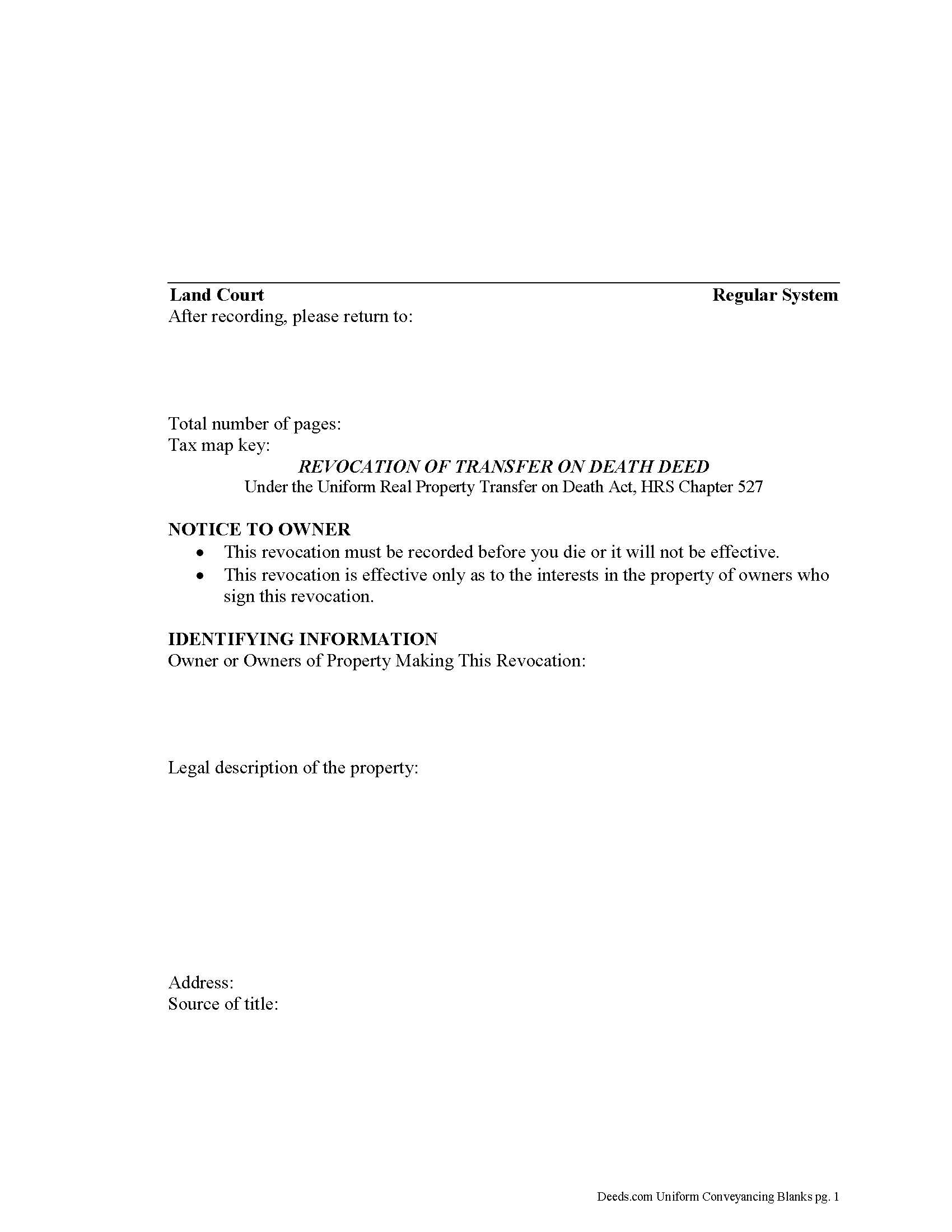
Revocation is an important feature of transfer on death deeds because it allows the owner to easily respond to a change in circumstances. At 52711, the statute outlines the three methods available for changing or revoking a recorded transfer on death deed, by executing and recording:
- a new TODD
- a revocation form
- a deed (example: warranty deed) that conveys title to someone else and expressly revokes all or part of the TODD
To preserve a clear chain of title, it makes sense to file a revocation form when changing a previously recorded transfer on death deed or selling the property outright. This extra step will add an end point for the potential transfer, simplifying future title searches prior to selling or mortgaging the property.
Since each circumstance is unique, contact an attorney with specific questions or for complex situations.
How to Use This Form
- Select your county from the list above
- Download the county-specific form
- Fill in the required information
- Have the document notarized if required
- Record with your county recorder's office
What Others Like You Are Saying
"Easy to download. Hopefully easy to fill in. Just wish there was wording for a Beneficiary Deed for …"
"Excellent! Follow the prompts for easy access. Forms readily available. Thanks!"
"I was on several sites but this was the easiest and cost effective. No bait and switch like on sever…"
"It was very convenient to be able to purchase the forms that I needed and save an extra trip downtow…"
"It was very easy to get the documents which I needed."
Common Uses for Transfer on Death Revocation
- Retain full control of your property during your lifetime
- Designate a beneficiary to receive property upon your death
- Ensure your property passes directly to heirs at death
- Designate a spouse as the beneficiary of your property
- Change a previously named property beneficiary
- Avoid probate costs and delays for your heirs
- Designate multiple beneficiaries for a property
Compare other Hawaii deed forms and documents
Important: County-Specific Forms
Our transfer on death revocation forms are specifically formatted for each county in Hawaii.
After selecting your county, you'll receive forms that meet all local recording requirements, ensuring your documents will be accepted without delays or rejection fees.