Minnesota Disclaimer of Interest (Transfer on Death Beneficiary)
County Specific Legal Forms Validated as recently as November 1, 2026 by our Forms Development Team
About the Minnesota Disclaimer of Interest (Transfer on Death Beneficiary)
How to Use This Form
- Select your county from the list
- Download the county-specific form
- Fill in the required information
- Have the document notarized if required
- Record with your county recorder's office
What Others Like You Are Saying
"Thank you for your helpful information."
"It was quick and easy."
"Deeds.com provides a valuable resource to efficiently file documents for recordation."
"Excellent software along with my other Will/Trust programs. I always use your program regarding deed…"
"This was so easy and seemless. I wish I had found deeds.com for eRecording sooner! I submitted my do…"
4.8/5 from 4,839 reviews. Read all
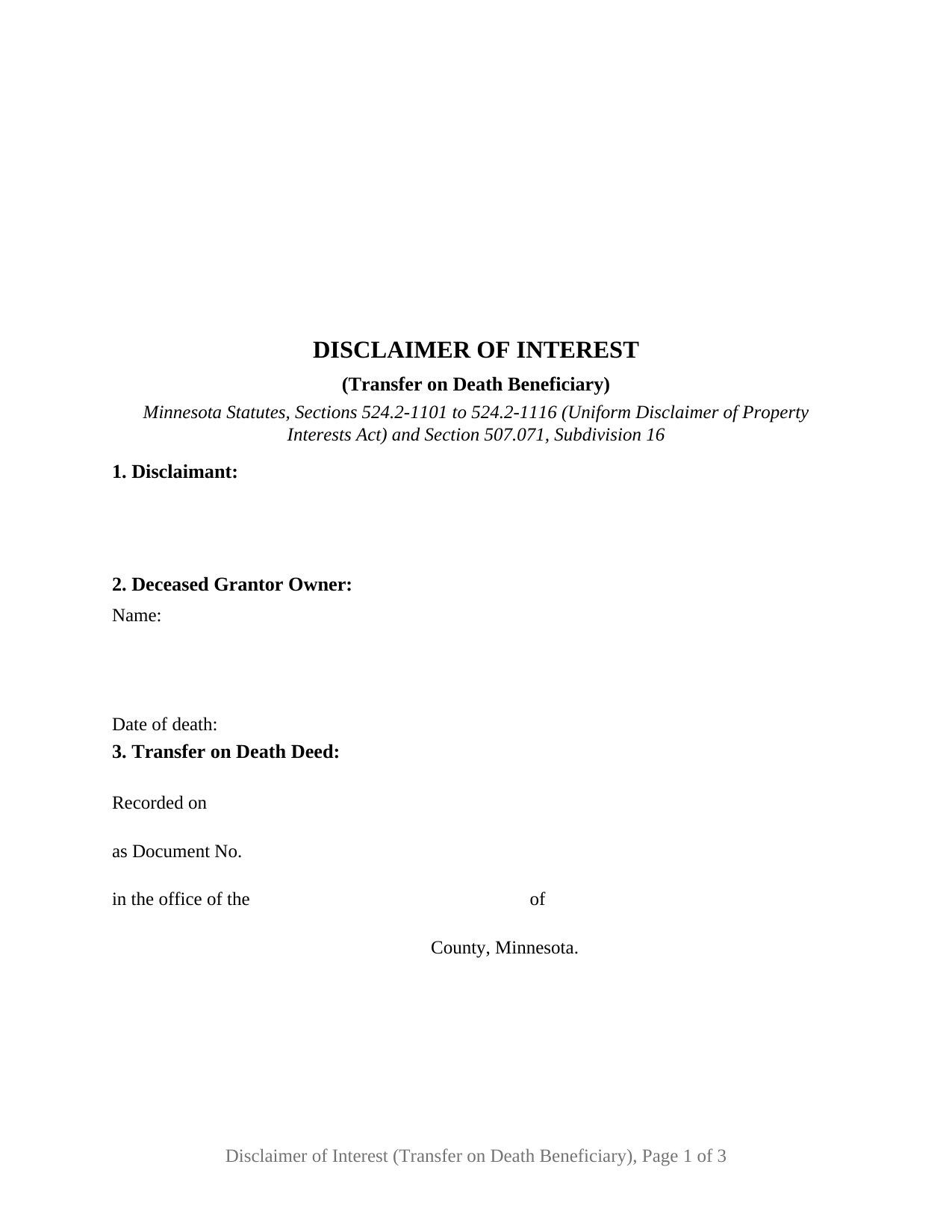
A person named as the grantee beneficiary in a Minnesota transfer on death deed does not have to take the property. This form prepares the disclaimer of interest by which one beneficiary refuses, in whole, the interest a recorded TOD deed would pass at the grantor owner's death, under Minnesota Statutes sections 524.2-1101 to 524.2-1116, the Uniform Disclaimer of Property Interests Act, and section 507.071, subdivision 16.
A refusal, not a transfer
Minnesota treats a disclaimer as the refusal to accept an interest, and the statute says plainly that a disclaimer made under the act is not a transfer, assignment, or release. The disclaimant deeds the property to no one and chooses no taker; the deed's own provisions, together with section 524.2-1108, decide where the disclaimed interest goes, generally as if the disclaimant had died immediately before the interest was created. Where the disclaimant is a grandparent or descendant of a grandparent of the grantor owner, the antilapse rule in section 507.071, subdivision 11, describes the result, and a court order determining the takers is then recorded separately, outside this package.
What Minnesota requires of the writing
Section 524.2-1107 asks for five things: a writing, a declaration that the writing is a disclaimer, a description of the interest disclaimed, the disclaimant's signature, and an acknowledgment taken the way a Minnesota deed is acknowledged. An original is then delivered or filed as section 524.2-1114 provides, and for real estate that section presumes delivery when the disclaimer is recorded where the land lies. Section 524.2-1115 adds the title record's condition: a recorded disclaimer gives constructive notice only if it contains a legal description. The form carries each element in fixed text or a labeled blank, with the legal description copied from the deed.
No deadline in the act, one set of bars
Minnesota sets no fixed period for a disclaimer. Section 524.2-1105 permits one at any time unless it is barred, and section 524.2-1106 lists the bars: a written waiver of the right to disclaim, acceptance of the interest, a voluntary assignment, conveyance, encumbrance, pledge, or transfer of it or a contract to do so, a judicial sale, or the disclaimant's insolvency when the disclaimer becomes irrevocable. The nine-month clock comes from section 2518 of the Internal Revenue Code and governs federal tax qualification, a separate question under section 524.2-1104. The instrument carries the disclaimant's own statements about the acceptance, transfer, and waiver bars.
One beneficiary, the whole interest, after the death
The form recites exactly one disclaimant, a natural person named as a grantee beneficiary or successor grantee beneficiary in the recorded deed, signing in that person's own right after the grantor owner's death and disclaiming the entire interest the deed would pass. It identifies the deceased grantor owner, the deed by its recording reference, and the property by legal description, then performs the disclaimer in fixed operative text with no drafting blanks, followed by one signature block and one acknowledgment certificate. Where a deed names several beneficiaries, each disclaimant signs a separate instrument. The form is not set up as a partial disclaimer of a fraction or percentage, a disclaimer by a fiduciary acting for someone else, a lifetime disclaimer delivered to a living grantor owner, or a trust or entity beneficiary's refusal; each of those follows a different statutory path.
Recording in the county where the land lies
The signed and acknowledged original goes to the county recorder for abstract property or the registrar of titles for Torrens property, in every county where part of the property sits. The instrument follows the section 507.093 document standards, with the top three inches of the first page left blank for recording information, and carries the drafter statement section 507.091 requires. Because a disclaimer transfers nothing, the deed tax, auditor transfer entry, and certificate of real estate value that accompany a conveyance are written for a different kind of instrument; the guide describes how those statutes read and notes that county intake practice varies. The affidavit of identity and survivorship and the medical assistance clearance certificate that section 507.071 describes after a TOD deed takes effect are prepared and recorded separately and are not included in this package.
The package includes the fillable disclaimer form, a completed example filled in for a realistic Dakota County fact pattern, and the guide that walks through every numbered section and the recording process. This description and the guide describe the form and the governing Minnesota statutes in general terms; they are not legal advice.
Important: County-Specific Forms
Our disclaimer of interest (transfer on death beneficiary) forms are specifically formatted for each of the 87 counties in Minnesota.
After selecting your county, you'll receive forms that meet all local recording requirements, ensuring your documents will be accepted without delays or rejection fees.