Nebraska Transfer on Death Deed
County Specific Legal Forms Validated as recently as July 20, 2026 by our Forms Development Team
About the Nebraska Transfer on Death Deed
How to Use This Form
- Select your county from the list on the left
- Download the county-specific form
- Fill in the required information
- Have the document notarized if required
- Record with your county recorder's office
What Others Like You Are Saying
"Great Help - very satisfied with the service - would recomend 100%"
"Actually, it was user friendly once I figured out where to go to get the forms. Thank you."
"Beware, you cannot save the information you typed and change it later. It will be a PDF upon saving.…"
"Applied for my Notice of Commencement to be recorded and it went very smoothly and fast. Will use ag…"
"This site was easy to use."
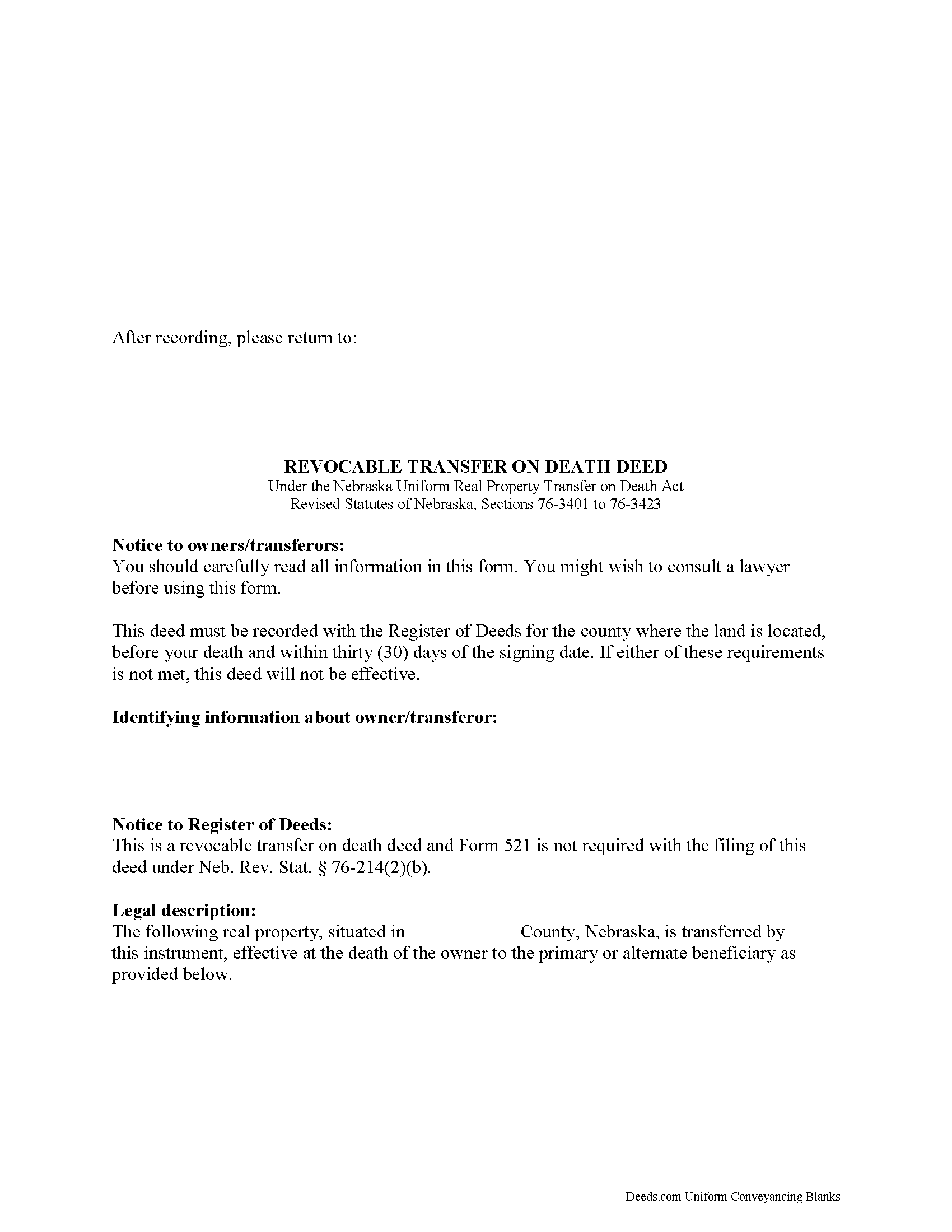
The Nebraska Uniform Real Property Transfer on Death Act is found at Sections 76-3401 to 76-3423 of the Nebraska Revised Statutes. This useful law provides an option for land owners to convey their real estate after their death, but without the need to include it in a will.
A transfer on death deed (TODD), when lawfully executed, allows property owners to retain absolute title to and control over their land during their lives ( 76-3414). The deeds are also revocable (76-3413). In part, these features are possible because unlike traditional deeds (warranty deeds, quitclaim deeds, etc.), TODDs do not require consideration from or notice to the beneficiary ( 76-3411).
In addition to meeting the content requirements of traditional deeds, people who use or revoke TODDs must meet the same competency standards as for creating a will (76-3408). The statute also demands the signatures of two disinterested witnesses (76-3409). Further, the document must contain specific warnings and must be recorded before the owner's death and within thirty days of signing ( 76-3410).
The rules for revoking a recorded TODD are set out at 76-3413. They include executing and recording a document that specifically revokes the TODD ( 76-3413(1)(B)); a new TODD that revokes the previous deed and changes the beneficiary or details about the transfer (76-3413(1)(A)); or transferring the real estate with a traditional deed (76-3413 (1)(C)).
When the owner dies, the beneficiary may accept the transfer by recording the appropriate documentation (76-3412, 76-3415) or disclaim the interest as provided by section 30-2352 (76-3416).
Overall, transfer on death deeds are flexible tools to consider as part of a comprehensive estate plan, but each circumstance is unique. Please contact an attorney for complex situations or with specific questions.
(Nebraska TOD Package includes form, guidelines, and completed example)
How to Use This Form
- Select your county from the list above
- Download the county-specific form
- Fill in the required information
- Have the document notarized if required
- Record with your county recorder's office
What Others Like You Are Saying
"Great Help - very satisfied with the service - would recomend 100%"
"Actually, it was user friendly once I figured out where to go to get the forms. Thank you."
"Beware, you cannot save the information you typed and change it later. It will be a PDF upon saving.…"
"Applied for my Notice of Commencement to be recorded and it went very smoothly and fast. Will use ag…"
"This site was easy to use."
Important: County-Specific Forms
Our transfer on death deed forms are specifically formatted for each county in Nebraska.
After selecting your county, you'll receive forms that meet all local recording requirements, ensuring your documents will be accepted without delays or rejection fees.