Nebraska Transfer on Death Revocation
County Specific Legal Forms Validated as recently as July 23, 2026 by our Forms Development Team
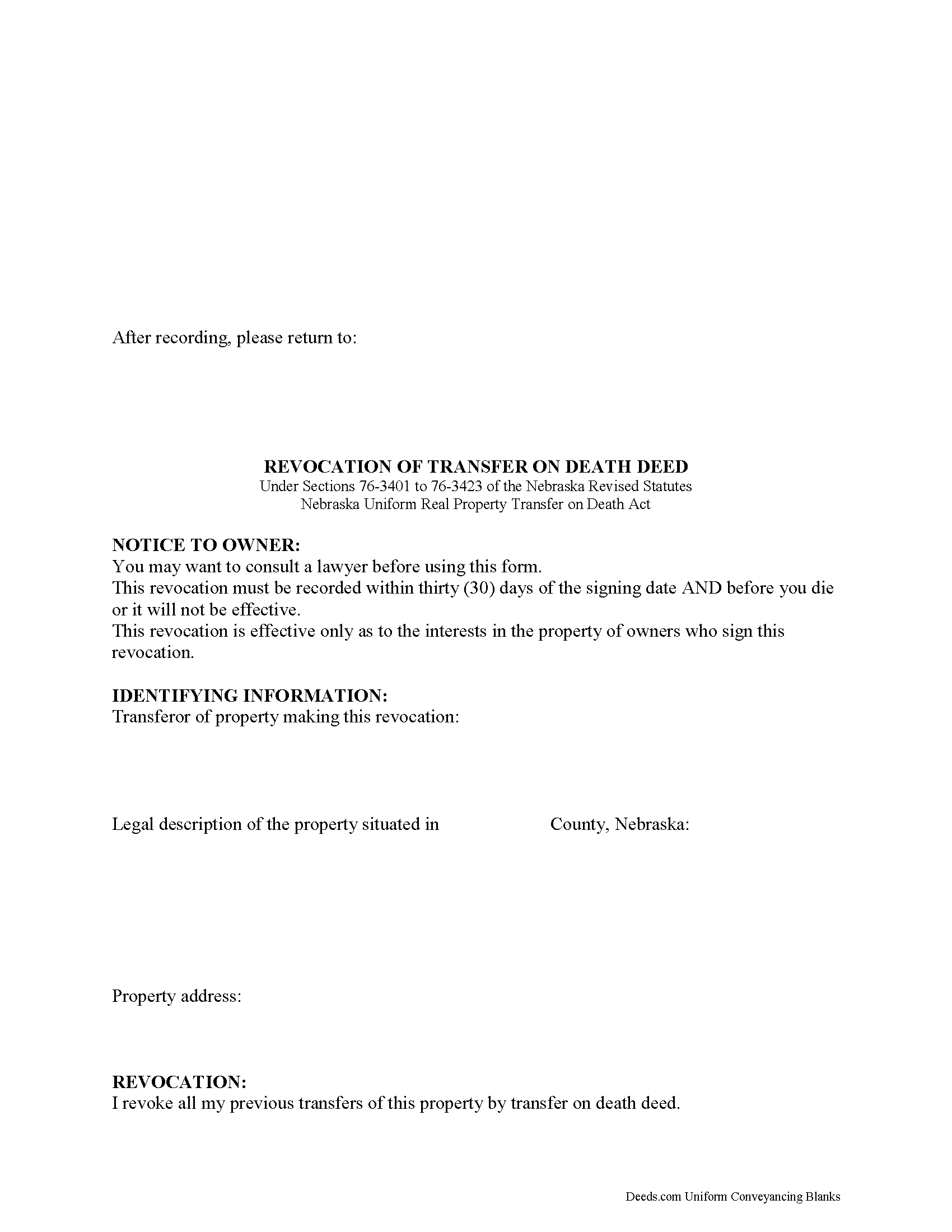
About the Nebraska Transfer on Death Revocation
How to Use This Form
- Select your county from the list on the left
- Download the county-specific form
- Fill in the required information
- Have the document notarized if required
- Record with your county recorder's office
What Others Like You Are Saying
"This site was awesome And received what I wanted the same day."
"Easy to understand and download!"
"Found the service useful and straightforward. The only recommendation would be to send an e-mail not…"
"Forms were spot on and able to save over $100 by not going to an attorney to complete the same docum…"
"Straightforward and pretty easy to use. The only downside is that there is no way to contact them di…"
Revoking a Nebraska Transfer on Death Deed
The Nebraska Uniform Real Property Transfer on Death Act is found at Sections 76-3401 to 76-3423 of the Nebraska Revised Statutes. This useful law provides an option for land owners to convey their real estate after their death, but without the need to include it in a will.
A transfer on death deed (TODD), when lawfully executed, allows property owners to retain absolute title to and control over their land during their lives ( 76-3414). The deeds are also revocable (76-3413). In part, these features are possible because unlike traditional deeds (warranty deeds, quitclaim deeds, etc.), TODDs do not require consideration from or notice to the beneficiary ( 76-3411).
Revocability is a valuable feature of transfer on death deeds. With it, land owners can quickly and easily respond to changes in their lives or the lives of their beneficiaries, and redirect any future transfer toward a more appropriate outcome.
The options for revoking a recorded TODD are set out at 76-3413. They include executing and recording one or more of the following: a document that specifically revokes the TODD ( 76-3413(1)(B)); a new TODD that revokes the previous deed and changes the beneficiary or details about the transfer (76-3413(1)(A)); or transferring the real estate with a traditional deed (76-3413 (1)(C)).
Because there is more than one way to revoke a TODD, an instrument of revocation can also provide an endpoint for a recorded (but cancelled) transfer on death deed. Executing and recording such a document before selling the property or simply transferring it to another beneficiary ensures that future title searches will not show the potential for claims against the title from the earlier TODD. The resulting clear chain of title (ownership history) should help to simplify future transactions involving the same real estate.
Overall, transfer on death deeds are flexible tools to consider as part of a comprehensive estate plan, but each circumstance is unique. Please contact an attorney for complex situations or with specific questions.
(Nebraska TOD Revocation Package includes form, guidelines, and completed example)
How to Use This Form
- Select your county from the list above
- Download the county-specific form
- Fill in the required information
- Have the document notarized if required
- Record with your county recorder's office
What Others Like You Are Saying
"This site was awesome And received what I wanted the same day."
"Easy to understand and download!"
"Found the service useful and straightforward. The only recommendation would be to send an e-mail not…"
"Forms were spot on and able to save over $100 by not going to an attorney to complete the same docum…"
"Straightforward and pretty easy to use. The only downside is that there is no way to contact them di…"
Important: County-Specific Forms
Our transfer on death revocation forms are specifically formatted for each county in Nebraska.
After selecting your county, you'll receive forms that meet all local recording requirements, ensuring your documents will be accepted without delays or rejection fees.