New York Transfer on Death Revocation
County Specific Legal Forms Validated as recently as November 19, 2026 by our Forms Development Team
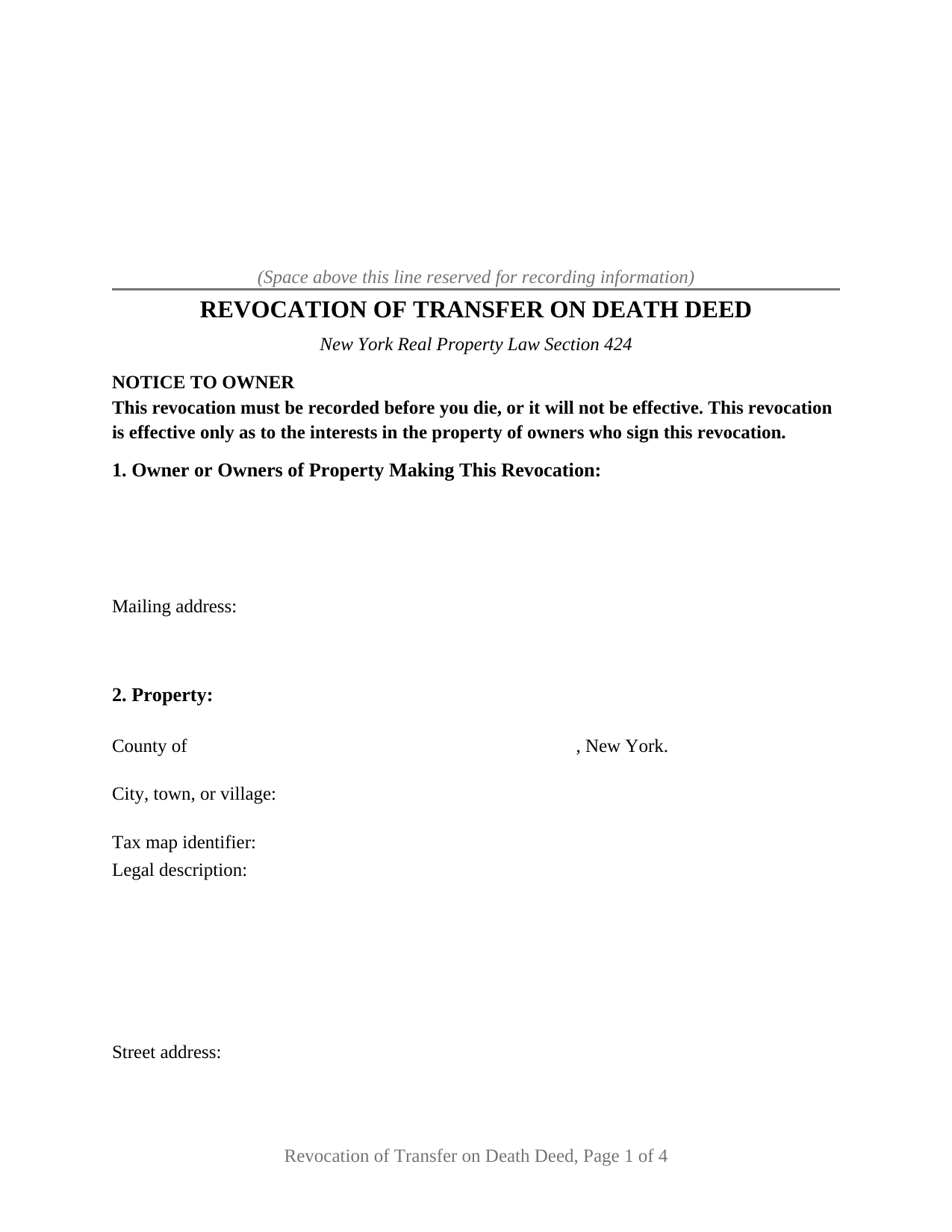
About the New York Transfer on Death Revocation
How to Use This Form
- Select your county from the list
- Download the county-specific form
- Fill in the required information
- Have the document notarized if required
- Record with your county recorder's office
What Others Like You Are Saying
"The site delivered just what it promised - I needed a specific deed formatted for a specific county/…"
"Super easy to order and save a document!"
"I recently needed an affidavit of death. The form and help tools made it easy to fill out and file. …"
"Quick easy and reliable. Thank you"
"After some initial general confusion -- (we sold a small piece of land privately and therefore do no…"
4.8/5 from 4,861 reviews. Read all
A New York transfer on death deed stays revocable for the owner's whole life, but undoing it takes a recorded instrument, not a will and not a line drawn through the deed. This form prepares the instrument of revocation that Real Property Law Section 424(9) describes, for one or two owners who made a recorded New York transfer on death deed and now revoke it.
A revocation that turns on two dates
Section 424(9)(a)(2) makes an instrument of revocation effective only if it is acknowledged by the transferor after the acknowledgment of the deed being revoked, and recorded before the transferor's death in the county clerk's office of the county where that deed is recorded. Both dates matter. The notary's certificate on the revocation carries a date later than the certificate on the transfer on death deed, and the revocation is of record while the owner is living. A revocation that is signed and acknowledged but sits unrecorded at the owner's death revokes nothing; the transfer on death deed then operates exactly as written. The form states both conditions on its face in capital letters, directly above the signature blocks, and carries the Notice to Owner from the statutory form, which warns that the revocation must be recorded before the owner's death or it will not be effective.
One sentence that reaches every earlier designation
Section 424(16) prints an optional statutory form titled Revocation of Transfer on Death Deed, and its operative sentence is short: the owner revokes all previous transfers of the property by transfer on death deed. This form carries that sentence word for word. The sentence is deliberately broad; it reaches every transfer on death deed of the described property the signer ever made, so an earlier deed that a later deed had already displaced by inconsistency is swept up with it. The form then goes one step further than the statutory page and identifies the recorded deed being revoked by its acknowledgment date, its recording date, its instrument number or liber and page, and the county clerk's office that recorded it, and expressly revokes that deed in its entirety as to each signing owner's interest. That identification is what a title examiner reading the county index uses to connect the revocation to the deed it undoes.
What recording accomplishes, and what it does not
Recording is the effectiveness act for this instrument, and the office is fixed by the deed it revokes: the county clerk's office where the transfer on death deed is of record, which under Section 424(7)(e) is the county where the property is located. In Manhattan, the Bronx, Brooklyn, and Queens that office is the City Register, reached through ACRIS. Recording the revocation does not pull the transfer on death deed out of the record. The deed stays where it was recorded, the revocation is recorded after it, and the two are read together. Section 424(9)(c) is the reason the recorded instrument is the only route: once a transfer on death deed is recorded, it is not revoked by any revocatory act on the deed itself, so tearing up, marking, or destroying the original changes nothing.
The revocation transfers no interest in the property. The New York Department of Taxation and Finance's published answers on Form RP-5217 state that transfer on death deeds do not need to be accompanied by Form RP-5217 or Form TP-584 when recorded; the guide included with this package describes that statement, the statewide page and type size standards of CPLR Section 8019, the county fee schedules under CPLR Section 8021, and the recording and endorsement pages the New York City Register and the Suffolk County Clerk add to their intake.
One or two owners, nothing preprinted
The form recites one or two natural persons who made the transfer on death deed as its transferors and who revoke it in their own capacity. The owner block is free-form: it takes the name or names as they appear on the transfer on death deed, together with any status recital that deed carried after them, and nothing about marital status, how title is held, or capacity is preprinted anywhere on the instrument. The form carries two owner signature blocks, headed OWNER and SECOND OWNER (if applicable), and a separate New York acknowledgment certificate for each, so two owners can acknowledge on different dates or before different notaries. Where one owner revokes, the second block and its certificate are left blank. A sole owner revoking a deed made alone, and two spouses who made one deed together as tenants by the entirety and revoke it together, both present the pattern this form recites. The form is not set up as a revocation by an entity, a trustee, an agent under a power of attorney, or three or more owners.
Who signs is tied to whose interest the revocation reaches. Under Section 424(9)(b), revocation by one transferor does not affect the deed as to the interest of another transferor, and a deed made by joint owners, a term the section defines to include tenants by the entirety and joint tenants, is revoked only by all of the living joint owners. The Notice to Owner on the form says the same thing from the signer's side: the revocation is effective only as to the interests in the property of owners who sign it.
The certificate the clerk expects
Each acknowledgment certificate is the New York short form of Real Property Law Section 309-a(1), with the venue printed as State of New York, one blank for the day, month, and year, the name of the person appearing, and the statutory sentence that the person was personally known to the notary or proved on satisfactory evidence to be the individual whose name is subscribed to the instrument. Beneath the notary's signature, the certificate carries the printed name, state, county of qualification, registration number, and commission expiration lines that Executive Law Section 137 describes. An owner who signs outside New York acknowledges before an officer of that place under Sections 299 and 299-a, using that officer's own certificate, and the guide walks through that path and the electronic notarization path of Executive Law Section 135-c.
The package includes the fillable transfer on death revocation form, a completed example filled in for a realistic Onondaga County fact pattern, and the guide that walks through every numbered section, the signing and acknowledgment rules, and the recording process. This description and the guide describe the form and the governing New York statutes in general terms; they are not legal advice.
Important: County-Specific Forms
Our transfer on death revocation forms are specifically formatted for each of the 62 counties in New York.
After selecting your county, you'll receive forms that meet all local recording requirements, ensuring your documents will be accepted without delays or rejection fees.