Ohio Land Contract for Deed
County Specific Legal Forms Validated as recently as November 4, 2026 by our Forms Development Team
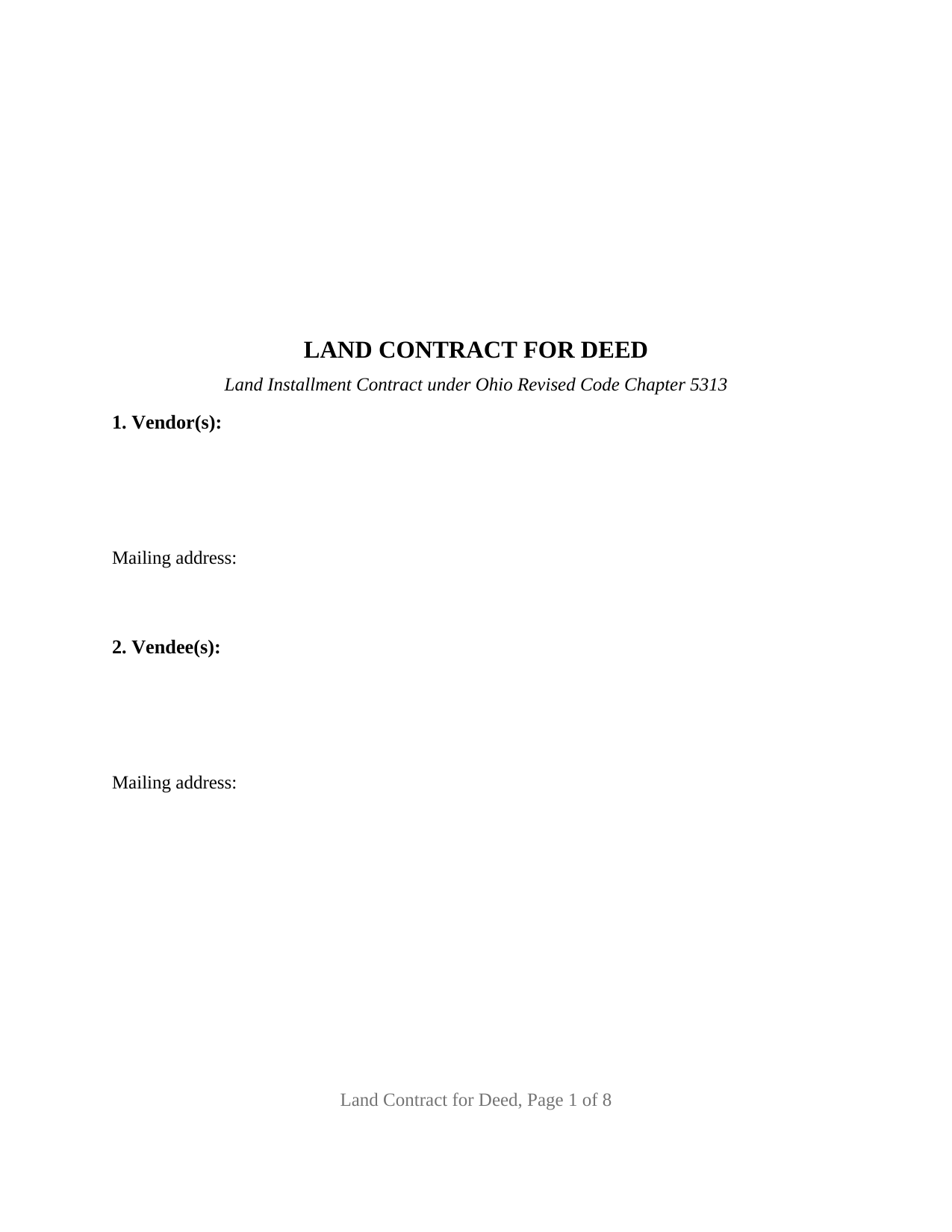
About the Ohio Land Contract for Deed
How to Use This Form
- Select your county from the list
- Download the county-specific form
- Fill in the required information
- Have the document notarized if required
- Record with your county recorder's office
What Others Like You Are Saying
"Easy to understand and use!"
"Excellent service. Pay your fee, download the form and fill out according to specific instructions. …"
"Very easy to use and very fast. I was very happy with your service and will definitely use it again …"
"The Executor's Guide needs more info about what to put for grantee (estate of deceased or my name as…"
"Site was super easy to use. After frustrating search for the item I needed I found it here!"
4.8/5 from 4,843 reviews. Read all
An Ohio land contract for deed, the land installment contract of Chapter 5313 of the Ohio Revised Code, is a sale in which the seller keeps the deed until the price is paid: the vendor agrees to convey title on completion, the vendee agrees to pay the price in installments, and the vendor retains title as security meanwhile. This form prepares that contract for Ohio real property improved by a dwelling, with one or two natural-person vendors selling to one or two natural-person vendees.
A contract the statute writes most of
Ohio does not leave the contents of a land contract to the parties. Section 5313.02(A) lists sixteen provisions every land installment contract contains, from the parties' names and mailing addresses through the price, down payment, principal balance, installments, interest, encumbrances, and any pending public agency order, and the form carries each as a blank inside a complete provision. The vendor's covenants the chapter requires appear as fixed text: a general warranty deed on completion, or another available deed where the vendor is legally unable to deliver one; evidence of title by the prevailing local custom; the vendee's right to pay on the vendor's mortgage and take credit; recording; and the vendee's responsibility for taxes and assessments from the contract date, with the mortgaging limits of Section 5313.02(B) and the annual statement duty of Section 5313.03.
Title stays with the vendor, possession goes to the vendee
The contract conveys nothing when it is signed. The vendor remains the record owner, the vendee takes possession, and the deed that completes the sale is a separate instrument delivered when the last installment is paid. The form's vendee section records how that deed will name the purchaser: two purchasers can enter the survivorship words of Section 5302.17, for their joint lives, remainder to the survivor of them, or enter their names alone and take as tenants in common under Section 5302.19.
Thirty days, five years, twenty percent
The chapter supplies the default rules. Under Section 5313.05, forfeiture of a vendee's interest can be enforced only after thirty days from a payment default, and a vendee who brings the account current within that period avoids it; Section 5313.06 then prescribes a written notice giving ten days to perform. Where the vendee has paid for five years or more, or twenty percent or more of the price, Section 5313.07 limits the vendor to a foreclosure and judicial sale; otherwise Section 5313.08 allows an action for forfeiture and restitution. The contract states that the vendor's remedies are those the chapter provides, and adds no acceleration clause, late charge, or forfeiture language of its own.
Recorded within twenty days
Section 5313.02(C) requires the vendor, within twenty days after both parties have signed, to record a copy of the contract with the county recorder where the property lies and to deliver a copy to the county auditor; until recorded, the contract is fraudulent as to a later bona fide purchaser without knowledge of it under Section 5301.25. Under Section 5301.01 the vendor's signature is acknowledged before a notary or other authorized officer, and a metes and bounds description is reviewed and approved by the county engineer on the contract itself. The form is laid out to Section 317.114, with the three-inch blank top margin on the first page reserved for county certifications.
One or two vendors, one or two vendees
The form carries two vendor signature blocks and two vendee signature blocks, each followed by its own acknowledgment certificate, and preprints nothing about marital status, ownership, or vesting; the names, status recitals, and any vesting designation are entries the parties supply. A single owner selling to a couple, a married couple selling to one purchaser, and two co-owners selling to two purchasers present the patterns the blocks carry; on a fill with one vendor or one vendee, the second block of that side and its certificate stay blank. The form is not set up as an entity or trustee vendor, a vendor signing through an attorney in fact, or three or more parties on either side.
The package includes the fillable land contract for deed, a completed example filled in for a realistic Franklin County fact pattern, and the guide that walks through every section, the signing and dower rules, and the recording process. This description and the guide describe the form and the governing Ohio statutes in general terms; they are not legal advice.
Important: County-Specific Forms
Our land contract for deed forms are specifically formatted for each of the 88 counties in Ohio.
After selecting your county, you'll receive forms that meet all local recording requirements, ensuring your documents will be accepted without delays or rejection fees.