Ohio Mortgage
County Specific Legal Forms Validated as recently as November 6, 2026 by our Forms Development Team
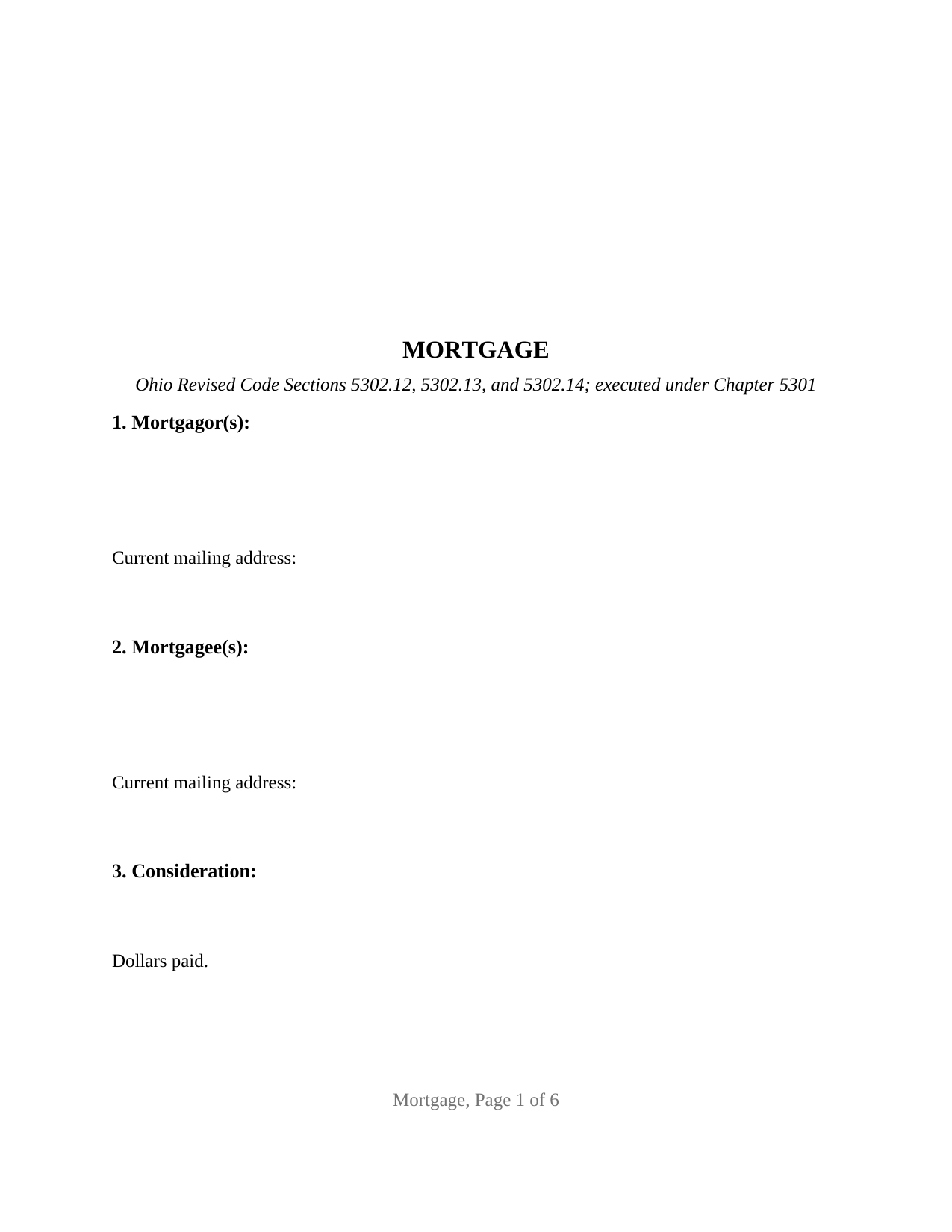
About the Ohio Mortgage
How to Use This Form
- Select your county from the list
- Download the county-specific form
- Fill in the required information
- Have the document notarized if required
- Record with your county recorder's office
What Others Like You Are Saying
"Once I found this site the rest was easy. I read through the guide but the example really helped the…"
"Look great and I thought my daughter wanted me to buy, but she had already bought the package so did…"
"So far so good, I did not know the convenience I would have from my seat to file a legal document! A…"
"Thomas hopefully these are the correct forms I need wish me luck"
"The process was easy and efficient. I will definitely be using this service!"
4.8/5 from 4,867 reviews. Read all
Ohio Mortgage in the Statutory Form
This download supplies an Ohio mortgage prepared in substance in the statutory form of Ohio Revised Code Section 5302.12. By this instrument one or two individual mortgagors grant Ohio real property to one or two mortgagees, with mortgage covenants and upon the statutory condition, as security for payment of a stated number of dollars with interest as provided in a promissory note of the same date. The form follows the statute in substance while arranging its elements in numbered sections for the parties, consideration, property, grant, secured obligation, release of dower, and signatures.
A mortgage secures a debt it does not itself create, and this form states no interest rate, payment schedule, or maturity date. Those terms belong to the note, so the package also includes an Ohio Promissory Note component for the debt the mortgage secures. Each instrument is supplied as a fillable blank form with its own guide and completed example. The mortgage guide refers to the note as a separate document; the note component in this download supplies it.
What the Download Contains
Six PDFs are delivered as one statewide set, the same files for every Ohio county:
- Mortgage Form – a fillable blank of six recorded pages behind a removable instructions page.
- Mortgage Guide – an explanation of the form, its statutory basis, signing and acknowledgment, recording, and the form’s limits.
- Completed Example of the Mortgage – the same form filled in for a fictional Franklin County loan.
- Promissory Note Form – a fillable blank of five pages behind a removable instructions page.
- Promissory Note Guide – an explanation of the note and its relationship to the mortgage.
- Promissory Note Completed Example – the note filled in for the same fictional loan.
How the Mortgage Form Works
The form relies on the two phrases Chapter 5302 defines. The grant is made “with mortgage covenants,” the words that under Section 5302.13 carry the mortgagor’s covenants of lawful seisin in fee simple, freedom from encumbrances, good right to convey, and warranty against the lawful claims of all persons. The mortgage is given “upon the statutory condition,” which under Section 5302.14 means, except as otherwise specifically stated in the mortgage, that the mortgage becomes void once the secured principal and interest are paid and the other conditions the statute lists, including payment of taxes and assessments, insurance for the mortgagee’s benefit, and no waste or breach of covenant, are performed. The form prints the statutory form’s own general summary of that condition beside the secured-amount entry.
The form carries three signature blocks: Mortgagor, Second Mortgagor (if applicable), and Spouse of Mortgagor (if applicable). The mortgagee does not sign. Each signer has a separate acknowledgment certificate in the Ohio statutory short form of Section 147.55(A) for an individual acting in the individual’s own right, so the signers can acknowledge on different dates, before different officers, or in different states. The guide notes that this separate-certificate layout is the form’s design rather than an Ohio legal requirement.
Ohio dower remains in force under Section 2103.02, and the statutory mortgage form includes a sentence by which the mortgagor’s spouse releases all rights of dower in the described property. This form prints that sentence as Section 7 with a name entry, paired with the Spouse of Mortgagor signature block and its certificate. The form carries one such release, serving a single mortgagor’s spouse who is not also a mortgagor. Where two mortgagors each have a spouse who is not a mortgagor, the form provides a release for only one of them; a second non-mortgagor spouse’s release is a separate instrument outside this package.
The mortgage is built to the Section 317.114 standard format for recorded instruments and the instructions page states that it prints at actual size. It carries the current mailing address entry for the mortgagee that Section 5301.23(B) calls for in a mortgage presented for record, together with a prior instrument reference, a prepared-by block, and an after-recording return block. Ohio mortgages are recorded with the county recorder of the county in which the property is situated.
The Included Promissory Note
The Ohio Promissory Note states the economic terms the mortgage leaves to the note: the borrowers and lenders with current mailing addresses, the date and principal amount, a promise to pay to the order of the lender, an annual interest rate computed as simple interest, a monthly installment amount with first due date and maturity date, prepayment without penalty, a late charge, default and acceleration after written notice, a description of the securing mortgage of the same date with the property’s street address and county, and a closing section on the joint and several liability of two borrowers, waivers, and Ohio governing law, followed by signature blocks for a borrower and a second borrower.
The note is signed by the borrowers only; the lender does not sign, and the note carries no acknowledgment or notary certificate. It is not recorded with the county recorder; the mortgage is the acknowledged and recorded instrument. The note guide’s section on the relationship to the mortgage describes which entries on the two forms describe the same facts (the parties, date, principal amount, and property) and which belong to one document only: the rate, installments, and maturity on the note, and the dower release and acknowledgments on the mortgage. A person who is a mortgagor but not a borrower, or a borrower but not a mortgagor, is outside both forms as built.
| Feature | Mortgage | Promissory Note |
|---|---|---|
| Role | Security instrument on the real property | Evidence of the debt and its payment terms |
| Rate, installments, maturity | Not stated | Stated |
| Dower release | Section 7 with spouse block | None |
| Acknowledgment | Three individual certificates | None |
| Recording | Recorded instrument | Not recorded |
Guides and Completed Examples
Each guide explains the form it accompanies in general terms: the statutory framework the form rests on, the parties and configurations the form describes, each numbered section with the entry that appears in the completed example, signing and acknowledgment (including dower on the mortgage and the absence of a notary certificate on the note), recording and non-recording, and what each form does not do. The note guide adds a section on how the note and the mortgage correspond.
Both completed examples are filled in for one fictional Franklin County loan between two mortgagors, one married and one unmarried, and two private lenders. Read together, they show every entry on both instruments completed for a single transaction, how the corresponding entries on the mortgage and note match, all three signature blocks and notary certificates completed on the mortgage, and the married mortgagor’s spouse releasing dower on the mortgage while not signing the note. The note guide works through the example’s interest and amortization figures for its monthly schedule.
Limits of the Supplied Forms
The mortgage form’s mortgagor block receives one or two natural persons signing in their own right. It is not set up as a mortgage by a corporation, limited liability company, partnership, or trust; by a mortgagor signing through an attorney in fact; by a mortgagor acting as executor, administrator, guardian, or other fiduciary; or by three or more mortgagors on one instrument, since those configurations carry different recitals and acknowledgment certificates.
This is not an open-end mortgage under Section 5301.232: it does not state an intent to secure future advances, a maximum amount, or the words “OPEN-END MORTGAGE,” and it secures the amount stated in Section 6. It incorporates no master mortgage form and adds no agreement or condition beyond the statutory form. The form states no power of sale; under Section 2323.07, when an Ohio mortgage is foreclosed, the sale is ordered by the court having jurisdiction.
The note fixes a single payment structure, monthly installments of principal and interest to a maturity date, and offers no selection among structures; a note payable on demand, in a single payment, in other installment intervals, at a variable rate, or with a prepayment penalty is a different drafting. It carries no warrant of attorney to confess judgment (it is not a cognovit note), no commitment by the borrower to pay the holder’s attorney fees, no default interest rate above the note rate, and no future-advance provision, and it is not set up for an entity borrower, a representative signer, a guarantor or accommodation party, or three or more borrowers. The forms print no interest-rate ceiling; both guides describe the Ohio interest limits of Section 1343.01 in general terms only.
The forms, guides, and examples in this download describe Ohio instruments and statutes as general information. They are not legal advice.
Important: County-Specific Forms
Our mortgage forms are specifically formatted for each of the 88 counties in Ohio.
After selecting your county, you'll receive forms that meet all local recording requirements, ensuring your documents will be accepted without delays or rejection fees.