Dewey County Quitclaim Deed (Married Grantor with Non-Owner Spouse Joinder) Form
Last validated September 18, 2026 by our Forms Development TeamFormatted for recording in Dewey County, for property anywhere in the county: rural and unincorporated areas as well as Eagle Butte, Glencross, Isabel, Lantry, Ridgeview, Timber Lake, Whitehorse.
- 3 documents included
- Immediate PDF download
- Formatting guarantee
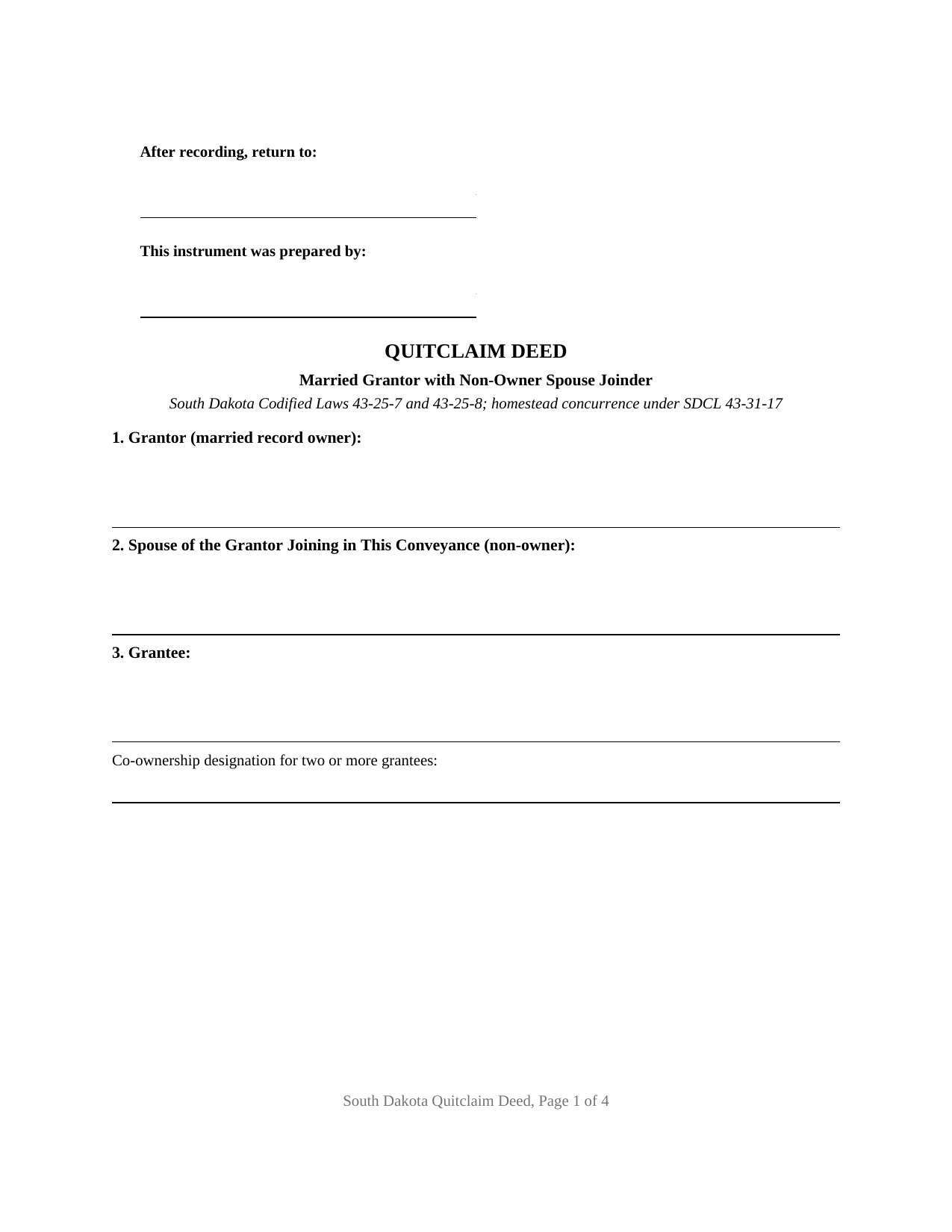
Dewey County Quitclaim Deed (Married Grantor with Non-Owner Spouse Joinder) Form
Fill in the blank Quitclaim Deed (Married Grantor with Non-Owner Spouse Joinder) form formatted to comply with all South Dakota recording and content requirements.
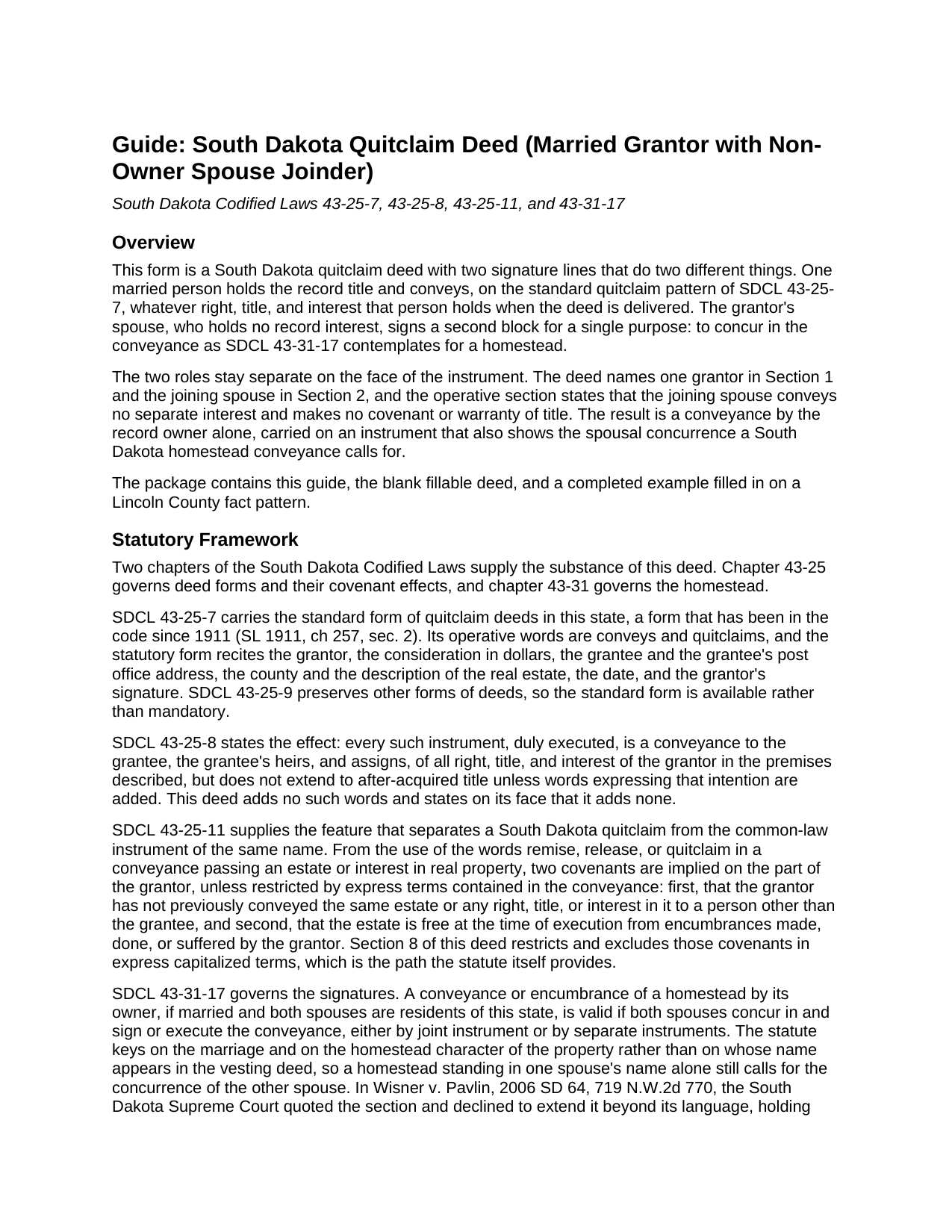
Dewey County Quitclaim Deed (Married Grantor with Non-Owner Spouse Joinder) Guide
Line by line guide explaining every blank on the Quitclaim Deed (Married Grantor with Non-Owner Spouse Joinder) form.
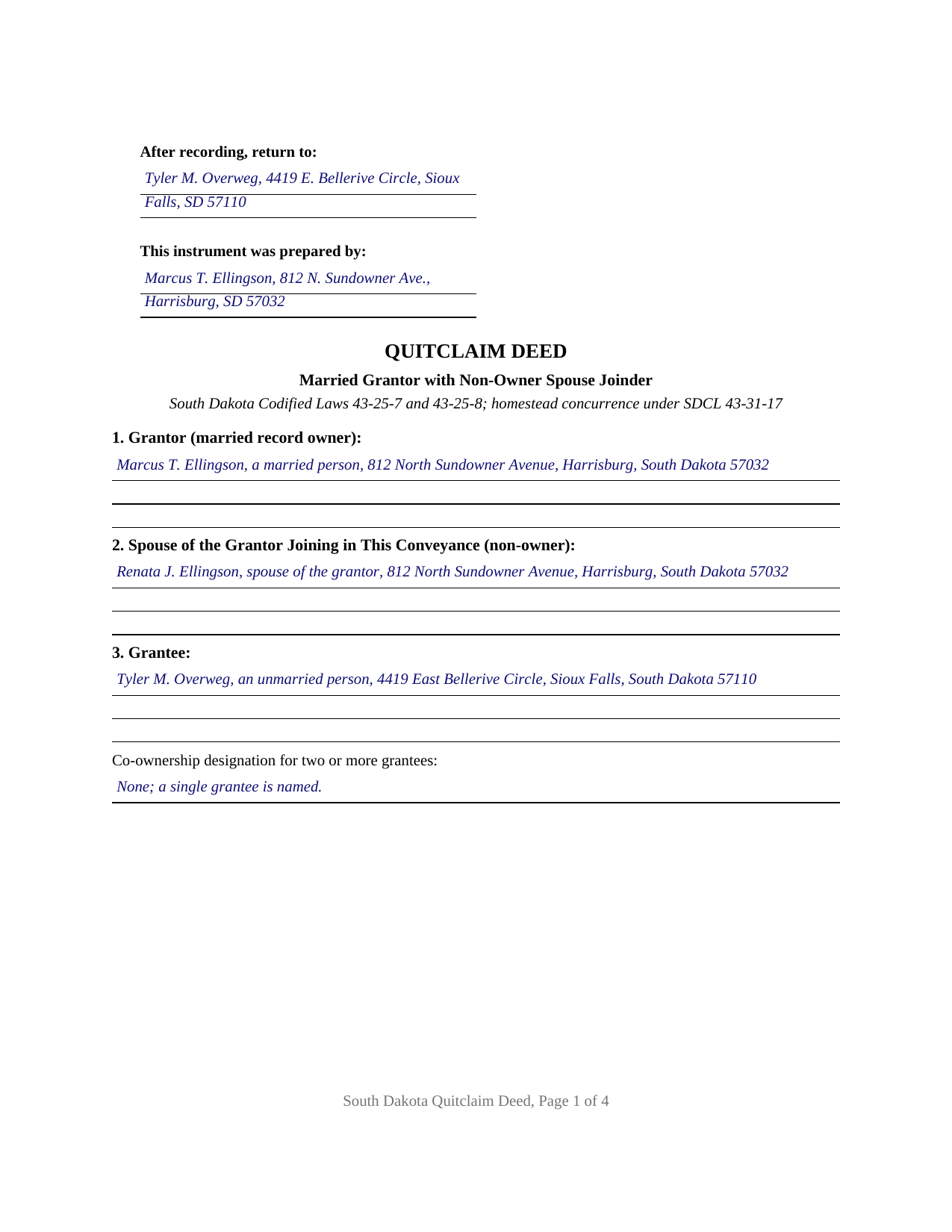
Dewey County Completed Example of the Quitclaim Deed (Married Grantor with Non-Owner Spouse Joinder) Document
Example of a properly completed South Dakota Quitclaim Deed (Married Grantor with Non-Owner Spouse Joinder) document for reference.
All 3 documents above included • One-time purchase • No recurring fees
Immediate Download • Secure Checkout
Additional South Dakota and Dewey County documents included at no extra charge:
Where to Record Your Documents
Dewey County Register of Deeds
Timber Lake, South Dakota 57656-0117
Hours: 8:00am to 4:30pm.M-F
Phone: (605) 865-3661
Recording Tips for Dewey County:
- Bring your driver's license or state-issued photo ID
- Ensure all signatures are in blue or black ink
- Ask about accepted payment methods when you call ahead
- Ask for certified copies if you need them for other transactions
- Ask if they accept credit cards - many offices are cash/check only
Cities and Jurisdictions in Dewey County
Properties in any of these areas use Dewey County forms:
- Eagle Butte
- Glencross
- Isabel
- Lantry
- Ridgeview
- Timber Lake
- Whitehorse
Hours, fees, requirements, and more for Dewey County
How do I get my forms?
Forms are available for immediate download after payment. The Dewey County forms will be in your account ready to download to your computer. An account is created for you during checkout if you don't have one. Forms are NOT emailed.
Are these forms guaranteed to be recordable in Dewey County?
Yes. Our form blanks are guaranteed to meet or exceed the applicable formatting requirements used for recording in Dewey County, including margin requirements, font requirements, and other layout standards. This guarantee applies to formatting, not to the legal sufficiency of information entered by the user or the suitability of a form for a particular transaction.
Can I reuse these forms?
Yes. You can reuse the forms for your personal use. For example, if you have multiple properties in Dewey County you only need to order once.
What do I need to use these forms?
The forms are PDFs that you fill out on your computer. The free Adobe Acrobat Reader is recommended, and most PDF apps also work. You do NOT enter your property information online - you download the blank forms and complete them privately on your own computer.
Are there any recurring fees?
No. This is a one-time purchase. Nothing to cancel, no memberships, no recurring fees.
How much does it cost to record in Dewey County?
Recording fees in Dewey County vary. Contact the recorder's office at (605) 865-3661 for current fees.
Questions answered? Let's get started!
One name on the grantor line, two signatures at the bottom. This fillable South Dakota quitclaim deed is built for a married person holding record title alone: the owner conveys whatever interest the owner holds, and the owner's spouse signs a separate block that transfers nothing and promises nothing, concurring as SDCL 43-31-17 contemplates for a homestead.
A signature that concurs instead of conveying
Most deeds treat every signature as a conveyance; this one does not. Section 1 names the grantor, the person shown on the recorded vesting deed, and Section 2 names that person's spouse, who holds no interest of record. Section 8, the operative section, states that the spouse named in Section 2 is not a grantor, signs solely to concur under SDCL 43-31-17, transfers no separate interest, and gives no covenant or warranty of title. The chain of title still runs through the record owner alone.
Why South Dakota looks at the marriage, not the vesting deed
SDCL 43-31-17 provides that a conveyance or encumbrance of a homestead by its owner, if married and both spouses are residents of this state, is valid if both spouses concur in and sign or execute the conveyance, by joint instrument or by separate instruments. Two features shape this product: the statute asks about the marriage and the homestead, not whose name the vesting deed carries, and it accepts one joint instrument, which is what this deed is. In Wisner v. Pavlin, 2006 SD 64, 719 N.W.2d 770, the South Dakota Supreme Court held the section to its language, declining to extend the requirement to co-owners who were never married. Away from the homestead, SDCL 25-2-4 leaves either spouse free to convey separate property alone.
What a South Dakota quit claim deed passes, and what it withholds
The instrument follows the SDCL 43-25-7 standard quitclaim form, whose operative words are conveys and quitclaims. SDCL 43-25-8 fixes the reach: the instrument conveys all right, title, and interest of the grantor in the premises described and stops there, picking up no title acquired afterward unless words expressing that intention are added. This form adds none and says so. One wrinkle separates a South Dakota quitclaim from the common-law instrument: under SDCL 43-25-11, quitclaim words imply two covenants unless the deed restricts them by express terms, one against an earlier conveyance of the same estate, one against encumbrances the grantor made, did, or suffered. Section 8 takes the statute's express-terms route in capital letters, so what reaches the grantee is interest, with no title promises attached.
One grantor block, one joinder block, two certificates
The form recites exactly one grantor, entered with name, marital status, and mailing address, and one joining spouse, entered with name, address, and relationship to the grantor. Both signature blocks carry a printed-name line, which SDCL 43-28-23 makes recording content beneath a signature, and each signer has a certificate of acknowledgment, a layout choice letting the two appear before different officers or on different days. Ownership patterns presenting this architecture include a residence one spouse owned before the marriage and never retitled, and an inherited homestead where the record is meant to show one grantor conveying and a spouse concurring without warranting anything. An unmarried sole owner, spouses who both convey interests of their own, three or more owners, and trustee or entity grantors each print a different configuration. The grantee side stays open to one grantee or several, with a blank for the co-ownership designation the guide covers beside the SDCL 43-2-12 default.
Recording in the county where the land lies
The signed deed goes to the register of deeds where the property sits, and SDCL 7-9-15 sets a statewide thirty dollar charge for a deed's first fifty pages. The realty transfer fee of SDCL 43-4-21 runs fifty cents per five hundred dollars of value; the example's seventy-five thousand dollar consideration yields seventy-five dollars. A transfer claiming a SDCL 43-4-22 exemption instead states the exemption and its subdivision on the deed's face, which Section 7 receives, and the SDCL 7-9-7 certificate of real estate value travels with the deed either way. Format is statutory under SDCL 43-28-23, and a nonconforming deed is surcharged under SDCL 43-28-24 rather than refused.
The package holds three files: the blank deed as a fillable PDF, a completed example built on a Lincoln County fact pattern, and a guide walking blank by blank through the sections, the signing mechanics, and what the register of deeds collects. The materials are informational and are not legal advice.
Important: Your property must be located in Dewey County to use these forms. Documents should be recorded at the county recording office listed above.
This Quitclaim Deed (Married Grantor with Non-Owner Spouse Joinder) meets all recording requirements specific to Dewey County.
Our Promise
The documents you receive here are guaranteed to meet or exceed the applicable Dewey County recording format requirements. If there is a rejection caused by our formatting, we will correct the issue or refund your payment. This guarantee applies to document formatting only and does not extend to information entered by the user, the selection of the form, or the legal effect of the completed document.
Save Time and Money
Get your Dewey County Quitclaim Deed (Married Grantor with Non-Owner Spouse Joinder) form done right the first time with Deeds.com Uniform Conveyancing Blanks. At Deeds.com, we understand that your time and money are valuable resources, and we don't want you to face a penalty fee or rejection imposed by a county recorder for submitting nonstandard documents. We constantly review and update our forms to meet rapidly changing state and county recording requirements for roughly 3,500 counties and local jurisdictions.
4.8 out of 5 - ( 4,829 Reviews )
LISA B. 5 out of 5 stars
GOT WHAT I NEEDED FORMS WORKED FINE.
Thank you!
Marilyn S. 5 out of 5 stars
I was pleased with the service and product.
Thank you!
David S. 5 out of 5 stars
Very good website. All government should be that clear and efficient.
Thank you!
Karen H. 5 out of 5 stars
Saves a trip to the Recorders Office!
It was a pleasure serving you. Thank you for the positive feedback!
CHARLES H. 5 out of 5 stars
Easy to fill-in forms, easy instructions, worth purchasing
Thank you!
Cindy A. 5 out of 5 stars
Needed a deed and the form provided with example and guide were of the most help. Thank you
Thank you, Cindy! We’re so glad the form, example, and guide were helpful in getting your deed taken care of. We appreciate your feedback!
Carol F. 5 out of 5 stars
Instructions were easy to follow and it was reasonable
Thank you for your feedback. We really appreciate it. Have a great day!
Jaynell B. 5 out of 5 stars
This website was most helpful and easy to use. Glad the information I needed was available
Thank you!
David H. 5 out of 5 stars
Thank You the form is easy to use.
Thank you!
Frank C. 3 out of 5 stars
Great experience and online account service
Thank you for your feedback. We really appreciate it. Have a great day!
Christine R. 4 out of 5 stars
Ordering and directions were easy. The only thing missing in the instructions was how to record by mail. Thanks!
Thank you Christine. We'll work on making it more clear that one can find mailing information in our recording section. Have a great day!
James A. 5 out of 5 stars
Good.
Thank you!
Amanda W. 5 out of 5 stars
Very helpful.
Thank you!
Matthew F. 4 out of 5 stars
Experience was very positive. It's very easy to use and I like the chat/feedback feature. It almost doubles the recording fees that is a little expensive but otherwise it works great.
We truly value your business and appreciate your review.
Kathyren O. 5 out of 5 stars
Very helpful and I will be using your services in the near future. Thank you Kathyren Oleary
Thanks Kathyren, we really appreciate your feedback.