Texas Homestead Affidavit as Release of Judgment Lien
County Specific Legal Forms Validated as recently as November 26, 2026 by our Forms Development Team
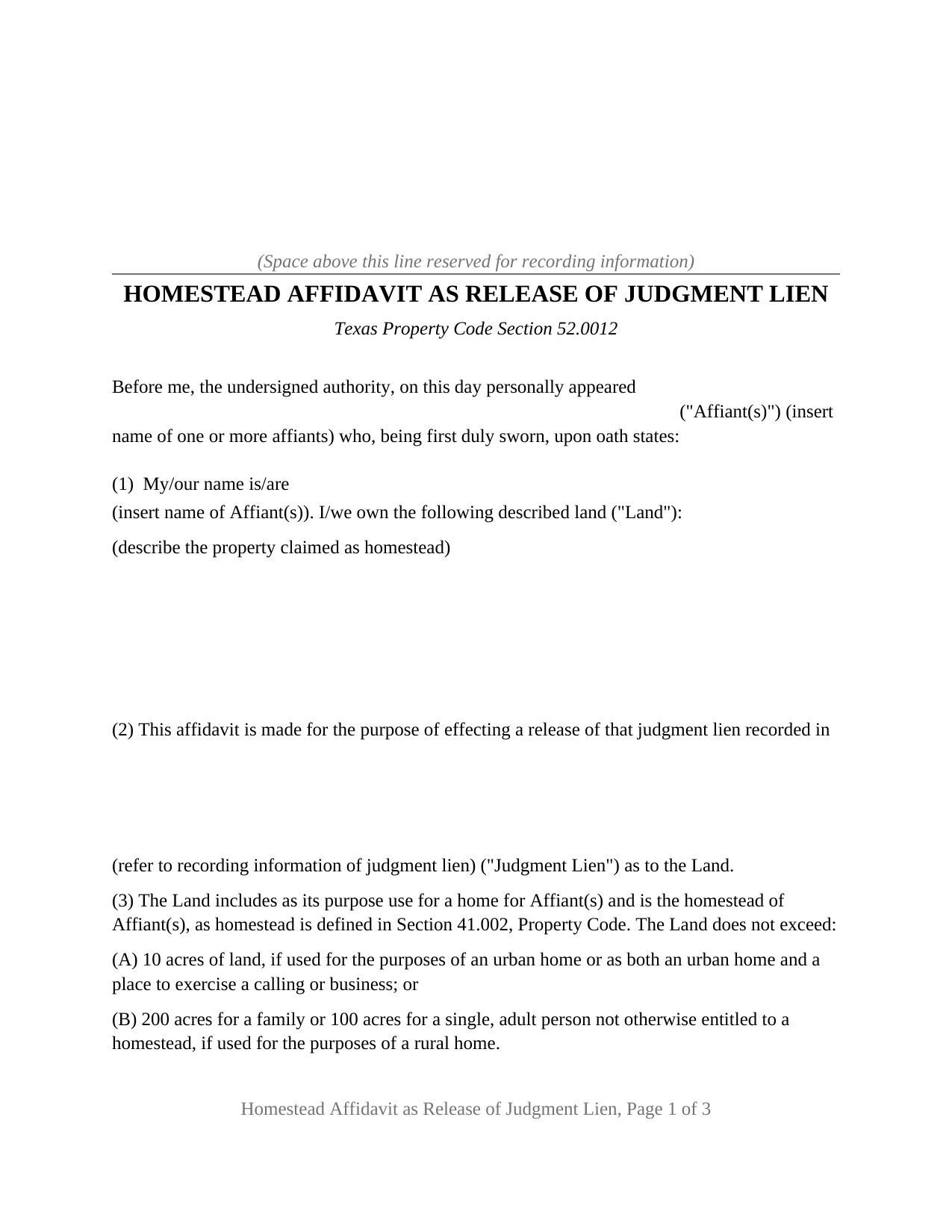
About the Texas Homestead Affidavit as Release of Judgment Lien
How to Use This Form
- Select your county from the list
- Download the county-specific form
- Fill in the required information
- Have the document notarized if required
- Record with your county recorder's office
What Others Like You Are Saying
"The process of obtaining the forms that I wanted was very easy and the cost reasonable. The site is …"
"Pleasant experiences. Look forward to future contacts"
"Simple way to complete documents with very detailed instructions. And to be able to e-file them is g…"
"This process was so easy."
"Really a great service for a reasonable price. Will definitely use again."
4.8/5 from 4,865 reviews. Read all
This Texas statewide download supplies the two recorded instruments of the Property Code Section 52.0012 procedure: the Homestead Affidavit as Release of Judgment Lien and the Certificate of Mailing of Homestead Affidavit as Release of Judgment Lien. Each arrives as its own fill-in-the-blank form, completed example, and line-by-line guide. The affidavit is the primary document. Under Section 52.0012, a judgment debtor may file it in the real property records of the county where the homestead is located, and, subject to the conditions the statute attaches, a filed affidavit serves as a release of record of a Chapter 52 judgment lien (a recorded abstract of judgment) as to the homestead land it describes. The certificate is recorded afterward and documents the creditor notice the statute requires. The two instruments are not alternatives; no county-specific versions exist for this product, and no other documents are included.
| Instrument | Role in the procedure | Supplied as |
|---|---|---|
| Homestead Affidavit as Release of Judgment Lien | Primary recorded document; carries the text of the Section 52.0012(f) statutory form and, once filed and subject to the statute's conditions, serves as the release of record as to the described homestead | Fillable form, completed example, guide |
| Certificate of Mailing of Homestead Affidavit | Second recorded document; refers back to the recorded affidavit and attaches the creditor notice letter and proof of mailing | Fillable form, completed example, guide |
The affidavit and who it is written for
The supplied affidavit carries the text of the statutory form in Subsection (f): the title, the appearance paragraph, and the four numbered statements. Statement (3) is fixed text reciting the Section 41.002 homestead definition, with the land described as not exceeding 10 acres for an urban homestead in one or more contiguous lots with improvements, or 200 acres for a family or 100 acres for a single adult not otherwise entitled to a homestead for a rural homestead in one or more parcels with improvements. The signature blocks, jurat captions, and notary close follow the product's own layout rather than reproducing the statutory form's signature sentence and jurat word for word.
Both forms are written for one or two affiants, each a judgment debtor who owns the land and claims it as homestead; the guides' two-affiant illustration is a married couple named together in the judgment and the abstract. The judgment creditor does not sign. Each form carries a separate jurat for each affiant, a sworn statement before an officer authorized to administer oaths rather than an acknowledgment, as the statutory form prints. The forms are not set up for an entity judgment debtor, for three or more affiants on one instrument, or for an affiant signing through an attorney-in-fact.
The certificate of mailing and the statutory clocks
Section 52.0012(b-1) requires a judgment debtor who files the affidavit to send the judgment creditor a letter notifying of the filing, with a copy of the filed affidavit, by registered or certified mail, return receipt requested, to the creditor and attorney addresses the statute lists. The statute prints no form for that letter; the guides describe it, but the package does not draft or supply it. The Certificate of Mailing is the recorded record of that notice. It is written for the stage after the affidavit has been recorded and the letter sent: its statement (2) carries the recorded affidavit's recording information, it is filed in the same county, and it attaches a true copy of the letter and the proof of mailing behind labeled Exhibit A and Exhibit B divider pages.
Two statutory periods run from the certificate's filing date, not the affidavit's. The judgment creditor has until the 30th day after the certificate is filed to record a contradicting affidavit asserting that the affidavit or certificate is untrue or that another reason exists why the lien attaches; if that happens, the affidavit does not serve as a release of record with respect to a purchaser or mortgagee that acquires its interest from the judgment debtor, and Section 52.0012 supplies no further procedure for resolving the disagreement over homestead status, nor does this package. If no contradicting affidavit is filed, a 90-day period beginning on the 31st day after the certificate is filed runs during which a bona fide purchaser or mortgagee for value, or a successor or assign, may rely conclusively on the affidavit. An affidavit recorded without a filed certificate carries no conclusive-reliance period, and the certificate on its own does not release the judgment lien.
What the release leaves in place
The affidavit does not pay, satisfy, or release the judgment itself. The abstract of judgment continues to constitute a lien on the judgment debtor's nonexempt real property in the county under Section 52.001; the release the affidavit effects is a release of record only as to the homestead land it describes and reaches no other parcel. The affidavit is written for the judgment lien of Property Code Chapter 52. According to the guides, it does not reach a child support lien (which has its own Family Code Section 157.3171 procedure), a federal lien, any lien not established under Chapter 52, or an encumbrance Section 41.001(b) permits to attach to a homestead, such as purchase money or taxes on the property. It is not a voluntary designation of homestead under Section 41.005 and not an application for a property-tax residence homestead exemption.
How the guides and examples work together
Both guides walk through each numbered statement using one fictional Travis County fact pattern, and the two completed examples share the same affiants, homestead, abstract of judgment, and notary, with dates in statutory order. Read together, they show how a completed affidavit identifies the homestead and the recorded abstract, and how the later certificate's entries refer back to that recorded affidavit and its mailing. The example certificate's exhibit pages are placeholders; no letter or postal receipt is drawn, and the package does not supply the letter or postal records the certificate attaches. This description and the guides are general information about the forms and the statute they follow, not legal advice; the materials do not determine whether particular land qualifies as a homestead or how a particular judgment lien is affected.
Important: County-Specific Forms
Our homestead affidavit as release of judgment lien forms are specifically formatted for each of the 254 counties in Texas.
After selecting your county, you'll receive forms that meet all local recording requirements, ensuring your documents will be accepted without delays or rejection fees.