Texas Transfer on Death Revocation
County Specific Legal Forms Validated as recently as May 26, 2026 by our Forms Development Team
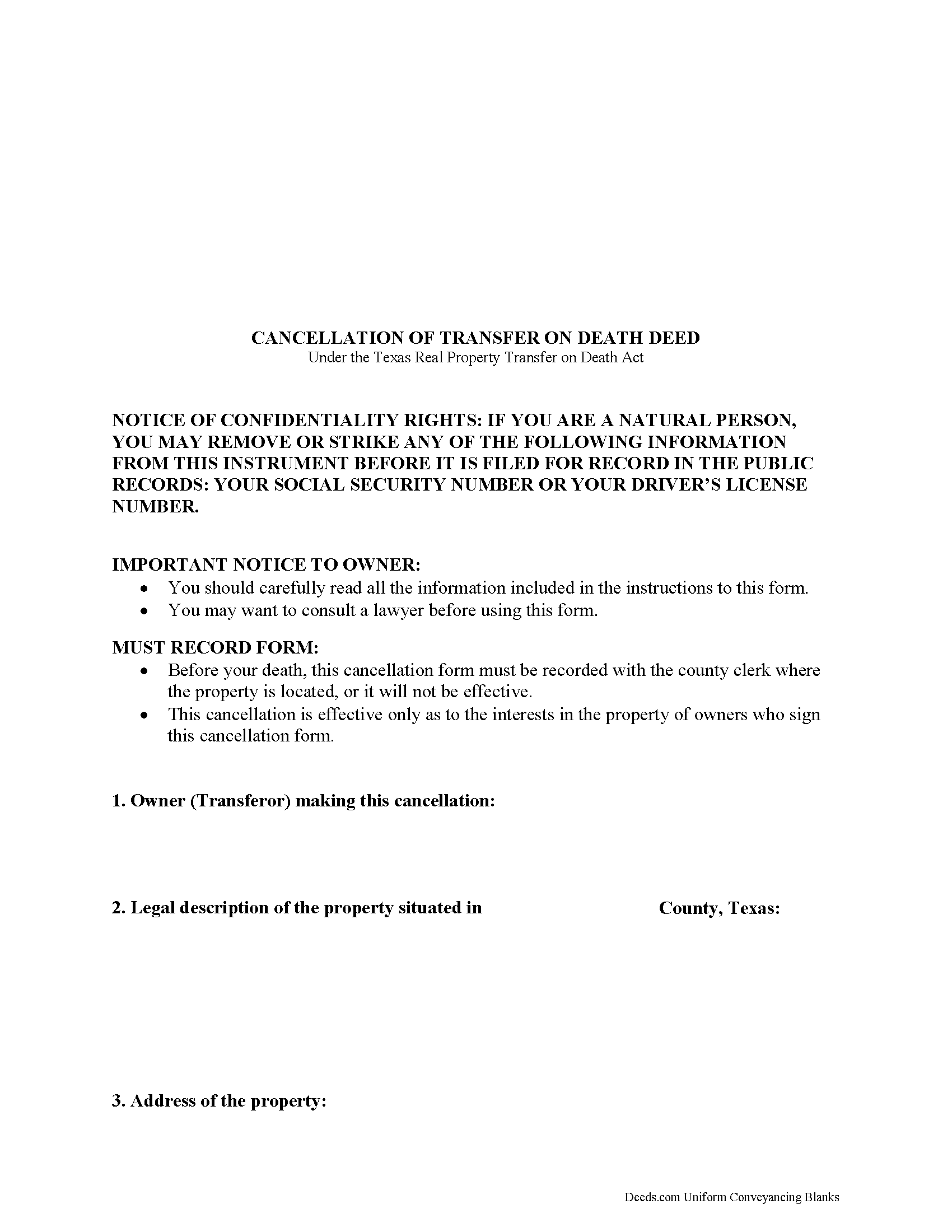
About the Texas Transfer on Death Revocation
How to Use This Form
- Select your county from the list on the left
- Download the county-specific form
- Fill in the required information
- Have the document notarized if required
- Record with your county recorder's office
What Others Like You Are Saying
"Forms were very easy to use using the completed form as an example."
"Using Deeds.com could not have been easier. The examples and line-by-line instructions helped a lot!…"
"Hi! Is there a setting that I can click on that will make sure I'm notified via email when an update…"
"I was happy to find a way to file my title without having to send original. Although I found it hard…"
"I ordered the wrong forms at first because I'm an idiot and didn't do my research. When I told the c…"
Revoking Transfer on Death Deeds in Texas
On September 1, 2015, owners of real property in Texas gained access to a useful estate planning tool: the statutory transfer on death deed (TODD). Modeled after the Uniform Real Property Transfer on Death Act and located at Chapter 14 of the Texas Estates Code, the Texas Real Property Transfer on Death Act governs the use of transfer on death deeds in the State of Texas.
IMPORTANT: TRANSFER ON DEATH DEEDS AND ASSOCIATED REVOCATIONS MUST BE RECORDED WHILE THE OWNER IS ALIVE OR THEY HAVE NO EFFECT.
Transfer on death deeds are nontestamentary instruments (not using a will). They allow transferors/owners to retain absolute ownership of and control over their land during their lives -- they may sell, mortgage, rent, or otherwise use the real estate as they desire, with no penalty for waste or obligation to notify the beneficiaries (114.101).
By recording the executed TODD, property owners may also take advantage of one of the most unique aspects of these instruments: revocability (114.052). Revocability is possible for two primary reasons: there is no obligation to notify the beneficiaries about the potential future interest they stand to gain when the owner dies; and these conveyances do not generally involve consideration (something of value given in exchange for the property) (114.056).
The statute provides several methods for revoking a transfer on death deed. The owner may execute and record a new TODD, cancelling the prior deed and designating a different beneficiary. The owner may also sell the real estate to someone else using a standard inter vivos conveyance such as a warranty deed or a quitclaim deed that contains a comment revoking the TODD. A third option uses a revocation form, which, after recording, cancels all previously recorded TODDs (114.057).
While the first two options are effective, it makes sense to file an instrument of revocation, because it provides a start and end point to a recorded TODD, which should reduce confusion in future title searches. For additional clarity, best practices dictate that an efficient estate plan does not contain conflicting directions, so make sure that wills, etc., reflect the most current information and the related documents can work together to reinforce the owner's intent.
Before revoking a transfer on death deed, consider the effect it will have on the comprehensive estate. Each situation is unique, so for complex circumstances or additional questions, contact a local attorney.
How to Use This Form
- Select your county from the list above
- Download the county-specific form
- Fill in the required information
- Have the document notarized if required
- Record with your county recorder's office
What Others Like You Are Saying
"Forms were very easy to use using the completed form as an example."
"Using Deeds.com could not have been easier. The examples and line-by-line instructions helped a lot!…"
"Hi! Is there a setting that I can click on that will make sure I'm notified via email when an update…"
"I was happy to find a way to file my title without having to send original. Although I found it hard…"
"I ordered the wrong forms at first because I'm an idiot and didn't do my research. When I told the c…"
Common Uses for Transfer on Death Revocation
- Transfer property automatically at death without probate
- Designate a beneficiary to receive property upon your death
- Revoke a prior transfer on death or beneficiary designation
- Name your children as beneficiaries of your real estate
Compare other Texas deed forms and documents
Important: County-Specific Forms
Our transfer on death revocation forms are specifically formatted for each county in Texas.
After selecting your county, you'll receive forms that meet all local recording requirements, ensuring your documents will be accepted without delays or rejection fees.