Utah Notice of Completion
County Specific Legal Forms Validated as recently as October 2, 2026 by our Forms Development Team
About the Utah Notice of Completion
How to Use This Form
- Select your county from the list
- Download the county-specific form
- Fill in the required information
- Have the document notarized if required
- Record with your county recorder's office
What Others Like You Are Saying
"Super easy to download and Deeds dot com had the documents I was looking for and set up in a manner …"
"Great products, quick downloads, the "guides" are extremely helpful. Overall 5 stars!"
"No fuss-No muss. Very easy!"
"Your website is very easy to use. No problem downloading the forms."
"Wonderful forms, been coming here for years (since 2012) for my deed forms and they have never faile…"
4.8/5 from 4,815 reviews. Read all
In Utah, mechanic's liens are governed under Title 38, Chapter 1A of the Utah Code.
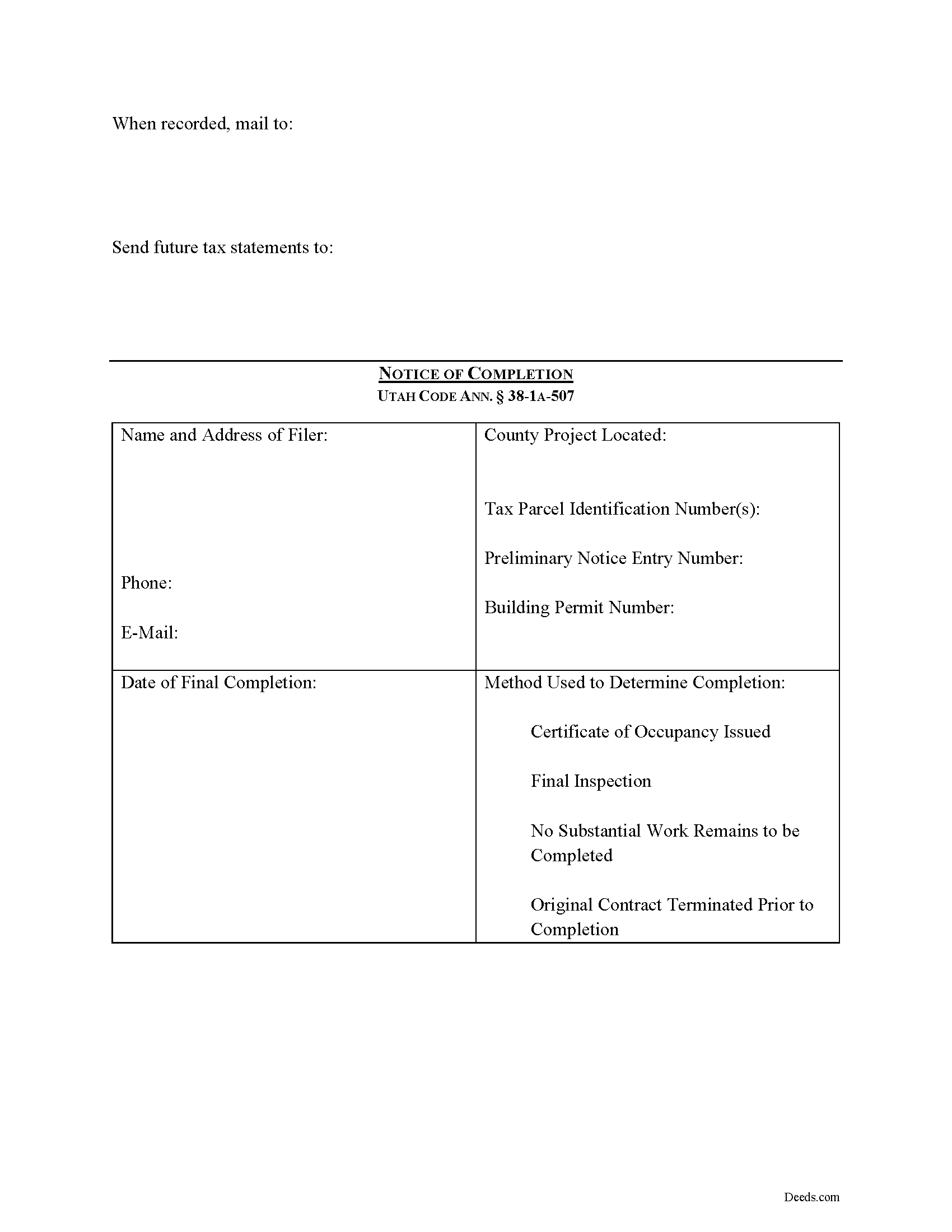
A Notice of Completion is a document completed by a property owner or other interested party and uploaded the construction registry. Its purpose is to publicize the completion date of a work of improvement on real property which in turn shortens the time during which any potential lien claimant can file for a mechanic's lien against the owner's ownership interest in the estate. Notice must then be provided to all possible claimants who have given the owner notice that they may have lien rights.
Upon final completion of a construction project, a notice of completion may be filed with the registry by: (i) an owner; (ii) an original contractor for construction work; (iii) a lender that has provided financing for the construction project; (iv) a surety that has provided bonding for the construction project; or (v) a title company issuing a title insurance policy on the construction project. UTAH CODE ANN. 38-1A-507(1)(a).
The Notice of Completion document includes the following: (1) the name, address, telephone number, and email address of the person filing the notice of completion; (2) the name of the county in which the project property is located; (3) for a private project, the tax parcel identification number of each parcel included in the project property and the entry number of a preliminary notice on the same project that includes the tax parcel identification number of each parcel included in the project property; or the entry number of the building permit issued for the project; (4) for a government project, the government project-identifying information; (5) the date on which final completion is alleged to have occurred; and (6) the method used to determine final completion. 38-1A-507(1)(b).
Final completion is determined by the first of the following to occur:
a) the date of issuance of a permanent certificate of occupancy, (if a permanent certificate of occupancy is required);
b)the date of the final inspection of the construction work by the local government entity having jurisdiction over the construction project, if an inspection is required under a state-adopted building code applicable to the construction work, but no certificate of occupancy is required;
c) unless the owner is holding payment to ensure completion of construction work, the date on which there remains no substantial work to be completed to finish the construction work under the original contract, if a certificate of occupancy is not required and a final inspection is not required under an applicable state-adopted building code; or
d) the last date on which substantial work was performed under the original contract, if, because the original contract is terminated before completion of the construction work defined by the original contract, the local government entity having jurisdiction over the construction project does not issue a certificate of occupancy or perform a final inspection. 38-1A-102(17).
Finally, ensure the notice is correctly prepared and all the information contained is accurate. A person filing a notice of completion by alternate means is responsible for verifying and changing any incorrect information in the notice of completion before the expiration of the time period during which the notice is required to be filed. 38-1A-507(2)(a).
Utah lien laws have specific requirements, which can be complicated to navigate. Please contact an attorney with questions about the Notice of Completion or any other issues related to construction liens in Utah.
Important: County-Specific Forms
Our notice of completion forms are specifically formatted for each of the 29 counties in Utah.
After selecting your county, you'll receive forms that meet all local recording requirements, ensuring your documents will be accepted without delays or rejection fees.