Utah Warranty Deed (Two Grantors)
County Specific Legal Forms Validated as recently as October 19, 2026 by our Forms Development Team
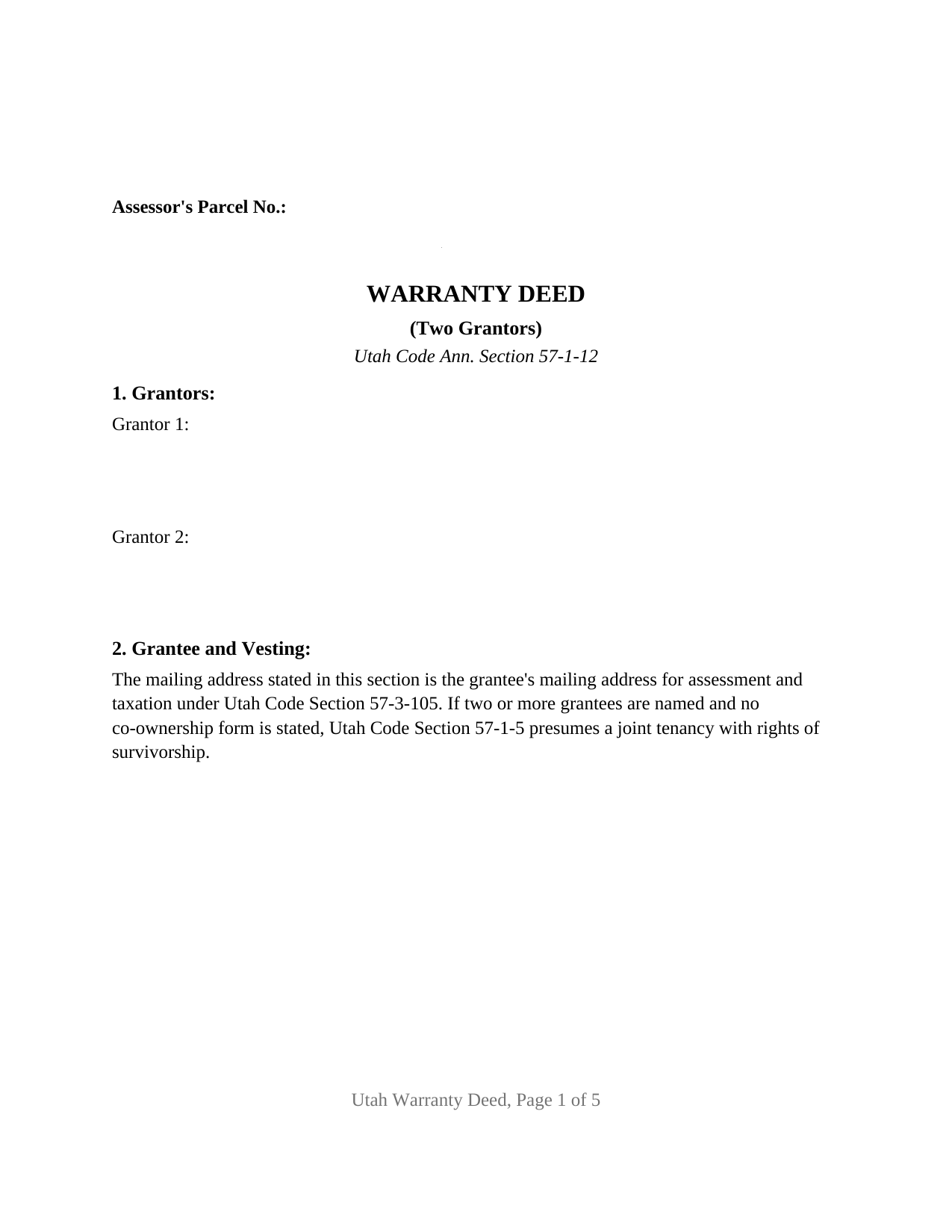
About the Utah Warranty Deed (Two Grantors)
How to Use This Form
- Select your county from the list
- Download the county-specific form
- Fill in the required information
- Have the document notarized if required
- Record with your county recorder's office
What Others Like You Are Saying
"Excellent and timely responses. Do you offer an annual rate? Thank you."
"cost effective and quick!"
"Simple and quick -- just what we needed!"
"Good so far could use more examples for each section of info. needed. ex. (parcel and alt.ID info wh…"
"My experience was great! Thank you, ejb"
4.8/5 from 4,829 reviews. Read all
This Utah warranty deed carries two grantors on one instrument. Both co-owners join in a single conveyance, each signs on a labeled line of the grantor's own and acknowledges on a separate notary certificate, and together they pass the entire title with the full covenants Utah Code Section 57-1-12 attaches to a warranty deed. The first page recites both grantors by name and mailing address, a grantee entry that carries the mailing address for assessment and taxation Utah recording law requires, and the statutory conveys-and-warrants language spoken by both owners at once.
Why co-owned title takes both signatures
Utah rewrote its co-ownership default in 2024: under Utah Code Section 57-1-5, an interest granted to two or more persons in their own right on or after May 1, 2024 is presumed to be a joint tenancy with rights of survivorship unless the deed expressly declares otherwise, and older Utah titles carry survivorship wording of their own. Survivorship title has a sharp edge on the selling side. A conveyance signed by one joint tenant severs only that tenant's interest, turning it into a tenancy in common share, while the whole parcel passes only when every record owner joins. This deed is built for that joinder: two grantors, each conveying in an individual capacity, so one instrument moves the complete fee whether the pair held as joint tenants or as tenants in common. A married couple selling the home they hold together, two siblings conveying inherited acreage, and co-owning partners passing a rental house to its buyer present the two-grantor pattern this deed recites.
Two acknowledgment certificates on one deed
The signature architecture follows the ownership. The form ends with a signature line, printed-name line, and date entry for each grantor, satisfying the typed-name-under-signature rule in Utah Code Section 17-71-403, and then an acknowledgment certificate for each signer. The certificate wording tracks Utah's Statutory Short Form of Acknowledgment in Section 57-2a-7, and carrying one certificate per grantor means the two owners may appear before different notaries, in different counties, on different dates; a co-owner who has moved out of state signs in front of a local notary there, and the deed still assembles into one recordable instrument. Remote online notarization through a certified Utah remote notary is also part of current Utah law.
Full covenants, stated exceptions
The deed delivers the complete statutory covenant package: seisin, right to convey, quiet possession, freedom from encumbrances, and a promise to warrant and defend against all lawful claims, backed by both grantors. The form's exceptions section sits directly after the legal description, the placement Section 57-1-12(3) prescribes, so recorded easements, restrictions, and the current year's taxes can be carved out of the covenants in the grantors' own words. Utah's after-acquired title rule rides along as well: title a grantor picks up later passes automatically under a deed purporting to convey fee simple.
Ready for the Utah recorder
The layout answers the recording statutes on its face: a first-page title, the grantee's mailing address for assessment and taxation, a legal description entry sized for platted land, a parcel number line in the margin position Utah Code Section 17-71-402(5) permits, and a first page whose upper right stays clear for the recorder's 2.5 by 4.5 inch stamp space. Utah records deeds at a statewide base fee of 40 dollars, with 45 dollars published by several county recorders after the 2026 fee amendments, and collects no transfer tax on an ordinary conveyance.
What the download contains
Buyers searching for this instrument also call it a general warranty deed or a full covenant deed made by joint sellers; in the Utah Code the label is simply warranty deed, and this package prepares the two-grantor version of it. The download contains the warranty deed as a fillable PDF, a completed example showing every entry on a Utah County fact pattern, and a plain language guide that walks through each numbered section, both notarizations, and the recording steps. The materials are informational and are not legal advice.
Important: County-Specific Forms
Our warranty deed (two grantors) forms are specifically formatted for each of the 29 counties in Utah.
After selecting your county, you'll receive forms that meet all local recording requirements, ensuring your documents will be accepted without delays or rejection fees.