Vermont Grant Deed
County Specific Legal Forms Validated as recently as July 7, 2026 by our Forms Development Team
About the Vermont Grant Deed
How to Use This Form
- Select your county from the list on the left
- Download the county-specific form
- Fill in the required information
- Have the document notarized if required
- Record with your county recorder's office
What Others Like You Are Saying
"Fast efficient, just what I needed."
"I highly recommend this website. It was quick and easy with very helpful guides and examples! I am s…"
"Customer service was excellent!"
"Quick and friendly answers. So Easy!"
"I was very pleased with the service I received. I sent a Quit Claim deed to be filed and received a …"
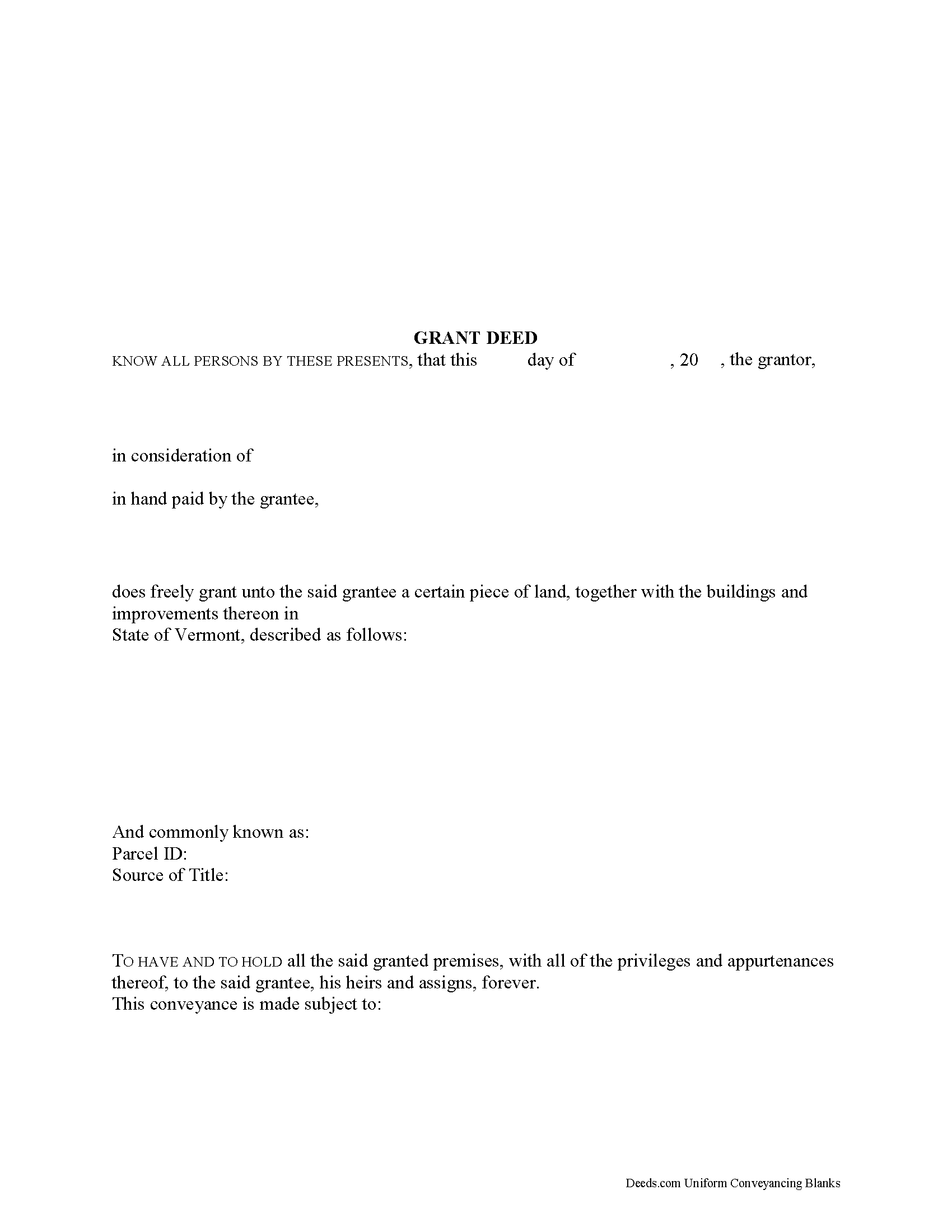
In Vermont, title to real property can be transferred from one party to another by executing a grant deed. Use a grant deed to transfer a fee simple interest with limited covenants of title. The word "grant" in the conveyancing clause typically signifies a grant deed, but it is not a statutory form in Vermont.
Grant deeds give the grantee more protection against claims on the property than quitclaim deeds, but less than warranty deeds. Quitclaim deeds offer no warranty of title, and only convey the grantor's interest, if any, in the subject real estate. Grant deeds guarantee, through implied covenants, that, to the grantor's knowledge, the title is free of any encumbrances (except for those stated in the deed) and that the grantor holds an interest in the property and is free to convey that interest. A warranty deed provides the highest level of protection for the grantee because, unlike the grant deed, it requires the grantor to defend against all claims on the title.
A lawful grant deed includes the grantor's full name, mailing address, and marital status; the consideration given for the transfer; and the grantee's full name, mailing address, marital status, and vesting. Vesting describes how the grantee holds title to the property. Generally, real property is owned in either sole ownership or in co-ownership. For Vermont residential property, the primary methods for holding title are tenancy in common, joint tenancy, and tenancy by the entirety. A conveyance of real estate to two or more unmarried persons creates a tenancy in common, unless a joint interest is declared. A conveyance to a married couple vests as tenancy by the entirety, unless declared otherwise (27 V.S.A. 2).
As with any conveyance of realty, a grant deed requires a complete legal description of the parcel. Recite the prior deed reference to maintain a clear chain of title, and detail any restrictions associated with the property. The completed deed must be acknowledged by the grantor (and his or her spouse, if applicable) in the presence of a notary.
Record the original completed deed, along with any additional materials, at the clerk's office of the city or town where the property is located. Note that a few unincorporated towns and gores still record properties at the county level. Contact the local clerk's office to confirm the recording location and to verify recording fees and accepted forms of payment.
File a Vermont Property Transfer Tax Return with all deeds conveying an interest in real estate. Send tax payments, if necessary, directly to the Vermont Department of Taxes, along with a payment voucher (Form PT-173). If the transfer is exempt from the transfer tax, state the reason for the exemption on the face of the deed. A list of exemptions can be found at 32 V.S.A. 9603.
This article is provided for informational purposes only and is not a substitute for the advice of an attorney. Contact a Vermont lawyer with any questions related to the transfer of real property.
(Vermont Grant Deed Package includes form, guidelines, and completed example)
How to Use This Form
- Select your county from the list above
- Download the county-specific form
- Fill in the required information
- Have the document notarized if required
- Record with your county recorder's office
What Others Like You Are Saying
"Fast efficient, just what I needed."
"I highly recommend this website. It was quick and easy with very helpful guides and examples! I am s…"
"Customer service was excellent!"
"Quick and friendly answers. So Easy!"
"I was very pleased with the service I received. I sent a Quit Claim deed to be filed and received a …"
Other versions of this form
Compare with related Vermont forms
Important: County-Specific Forms
Our grant deed forms are specifically formatted for each county in Vermont.
After selecting your county, you'll receive forms that meet all local recording requirements, ensuring your documents will be accepted without delays or rejection fees.