Wisconsin Memorandum of Contract (Husband and Wife)
County Specific Legal Forms Validated as recently as November 25, 2026 by our Forms Development Team
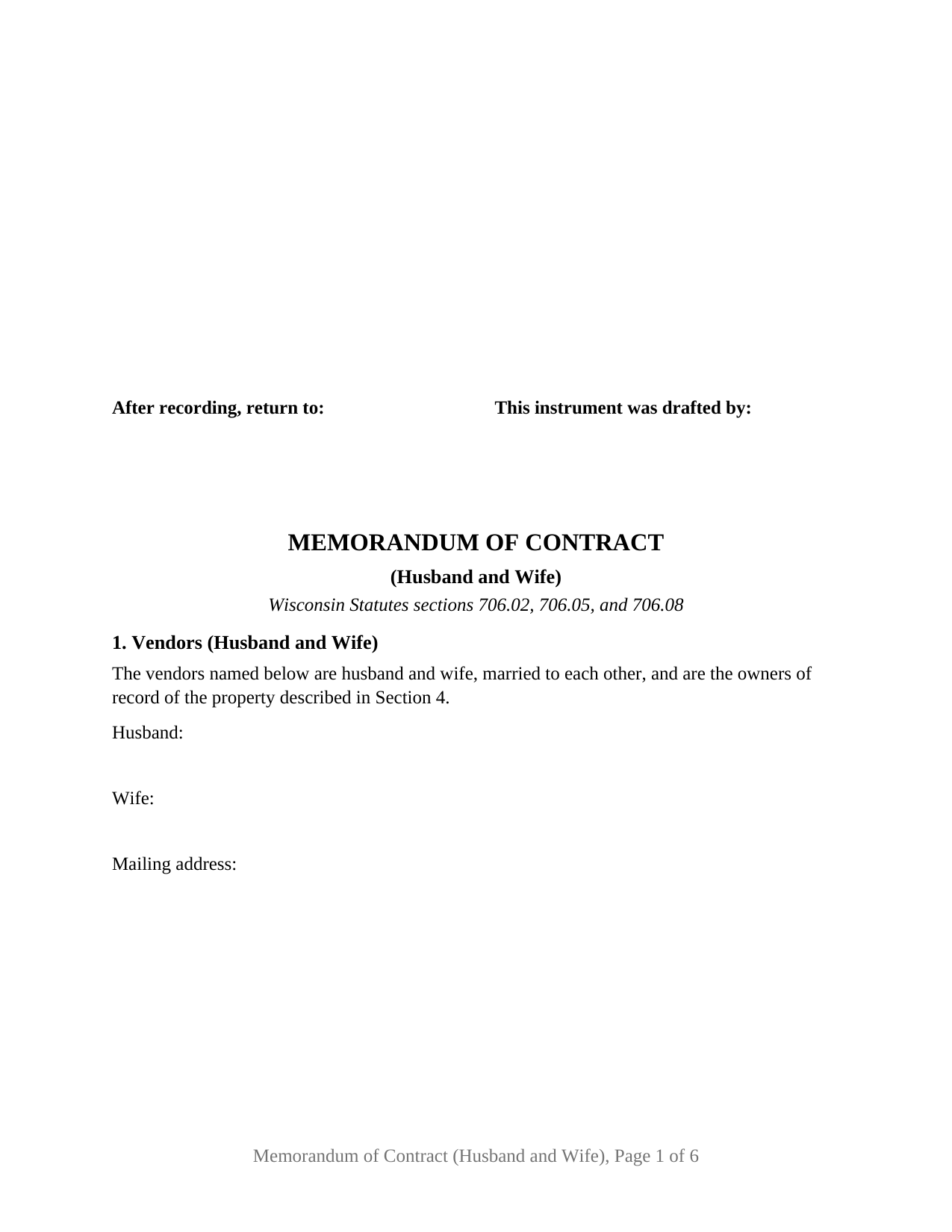
About the Wisconsin Memorandum of Contract (Husband and Wife)
How to Use This Form
- Select your county from the list
- Download the county-specific form
- Fill in the required information
- Have the document notarized if required
- Record with your county recorder's office
What Others Like You Are Saying
"Looks good and provides lots of instruction."
"So easy and documents downloaded in a flash. Highly recommended. Just gotta fill out and submit done…"
"It was easy to find the forms I was looking for and the guided steps and examples of how to use the …"
"The form itself was very good and easy to use. The only problem I had was the Sample they provided. …"
"Very easy to use and understand. Thank you."
4.8/5 from 4,864 reviews. Read all
When a married couple sells Wisconsin real estate on a land contract, the contract itself often stays in a drawer while the purchaser moves in and starts paying. This Wisconsin Memorandum of Contract (Husband and Wife) is the short recorded instrument that puts that contract on the public record: it names the two spouses as the vendors, names the purchaser, identifies the contract by date and title, describes the property, and states that the contract is in effect, without disclosing the price or the payment schedule. Both spouses sign it and acknowledge it, and so does each purchaser.
Two spouses, two signatures, one recorded notice
The defining feature of this configuration is the pair of vendor signature blocks. The form recites that the vendors are husband and wife, married to each other, and the owners of record, and it carries a separate signature block and acknowledgment certificate for each of them. That pattern tracks two Wisconsin rules. Wisconsin Statutes section 706.02(1)(f) requires a conveyance that alienates any interest of a married person in a homestead to be signed by each spouse, except a conveyance between spouses. Section 766.51(2) provides that marital property held in the names of both spouses, other than in the alternative, is managed and controlled only by both spouses acting together. A memorandum signed by one spouse alone would leave the record silent about the other; this one does not.
The recital states the spouses' status and nothing more about the title. It does not fix whether they hold as marital property, survivorship marital property, joint tenants, or tenants in common, and it does not change how they hold. The vendors' recorded deed answers that question; the memorandum simply gives notice of what the two of them agreed to sell.
Why the purchaser signs too
A memorandum of a land contract is the record evidence of a contract to convey, and section 706.02(1)(e) makes such a contract valid only if it is signed by or on behalf of all parties. The form therefore carries a purchaser signature block and a second purchaser block for a couple or any two buyers, each with its own acknowledgment certificate. Where one purchaser contracted to buy, the second block is left blank. Four certificates let the spouses and the purchasers sign on different days, before different notarial officers, and in different states; the certificate sentence is the Wisconsin short form of section 140.16(1), This record was acknowledged before me on.
Notice without the terms
Section 706.05(1) entitles every instrument which affects title to Wisconsin land to record in the county where the land lies, and section 706.02(2)(a) lets a conveyance satisfy its formal requisites by specific reference to an extrinsic writing in existence when it is signed. The memorandum uses that mechanism: it incorporates the contract by reference, states that the contract controls where the two differ, and states that it conveys no title. The price, the down payment, the interest rate, and the installment schedule stay in the contract. What the public record gains is the fact of the contract and the purchaser's interest under it, which is what the race-notice rule of section 706.08(1)(a) protects against a later purchaser who records first.
The form collects what the recording statutes ask of a document that affects a land contract: the full legal description copied from the vendors' deed, the parcel identification number where the county uses one, and the document number of the contract where the contract itself was recorded, the item section 706.05(2m)(a) names. Where the contract was never recorded, that entry reads None and the memorandum becomes the first recorded instrument evidencing it.
The transfer return rides with it
Wisconsin treats a land contract as a conveyance for transfer fee purposes. Section 77.21(1) defines a conveyance to include contracts for the passage of ownership interests in real estate, and Wisconsin Administrative Code section Tax 15.04(1) provides that any instrument evidencing the existence of a land contract requires the submission of a real estate transfer return as a condition to recording. The return is filed electronically through the Department of Revenue's eRETR system, and where the memorandum is the first recorded evidence of the contract, the fee under section 77.22(1) is computed on the total principal amount the purchaser agreed to pay. Section 6 of the form carries the face-of-document exemption statement section 77.22(1) requires where an exemption under section 77.25 is claimed, and the guide walks through the return, the fee, and the later exemption under section 77.25(17) for the deed in fulfillment.
Built to the Wisconsin standard document format
The memorandum is laid out to section 59.43(2m)(a): a blank 3 inch by 3 inch recording area in the upper right corner of the first page, the document name within the first 6 inches of that page, return information on the first page, the drafter's name on the document, and margins and type that reproduce legibly. The statewide recording fee is $30 per document under section 59.43(2)(ag), and the form's six recordable pages do not change it. The register of deeds may refuse a document that does not substantially comply with the format, so the geometry is part of the product rather than an afterthought.
What this configuration is and is not
The form recites exactly two vendors, husband and wife, and one or two natural-person purchasers. Spouses selling a home or a parcel they bought together under a land contract, and a couple carrying the financing for a buyer who takes possession now and the deed later, present the pattern this memorandum recites. It is not set up as a memorandum signed by one vendor, by co-owners who are not married to each other, by a trust, trustee, company, or personal representative as vendor, by a party acting through an attorney-in-fact, or by three or more vendors or purchasers. It is not the land contract, not an assignment of the vendee's interest, not an amendment, and not the deed in fulfillment; each of those is prepared and recorded separately and is not included in this package.
The package includes the fillable memorandum of contract, a completed example filled in for a realistic Dane County fact pattern, and the guide that walks through every section, the signing and notarization, and the recording process. This description and the guide describe the form and the governing Wisconsin statutes in general terms; they are not legal advice.
Important: County-Specific Forms
Our memorandum of contract (husband and wife) forms are specifically formatted for each of the 72 counties in Wisconsin.
After selecting your county, you'll receive forms that meet all local recording requirements, ensuring your documents will be accepted without delays or rejection fees.