Wisconsin Mineral Deed (Quitclaim)
County Specific Legal Forms Validated as recently as November 24, 2026 by our Forms Development Team
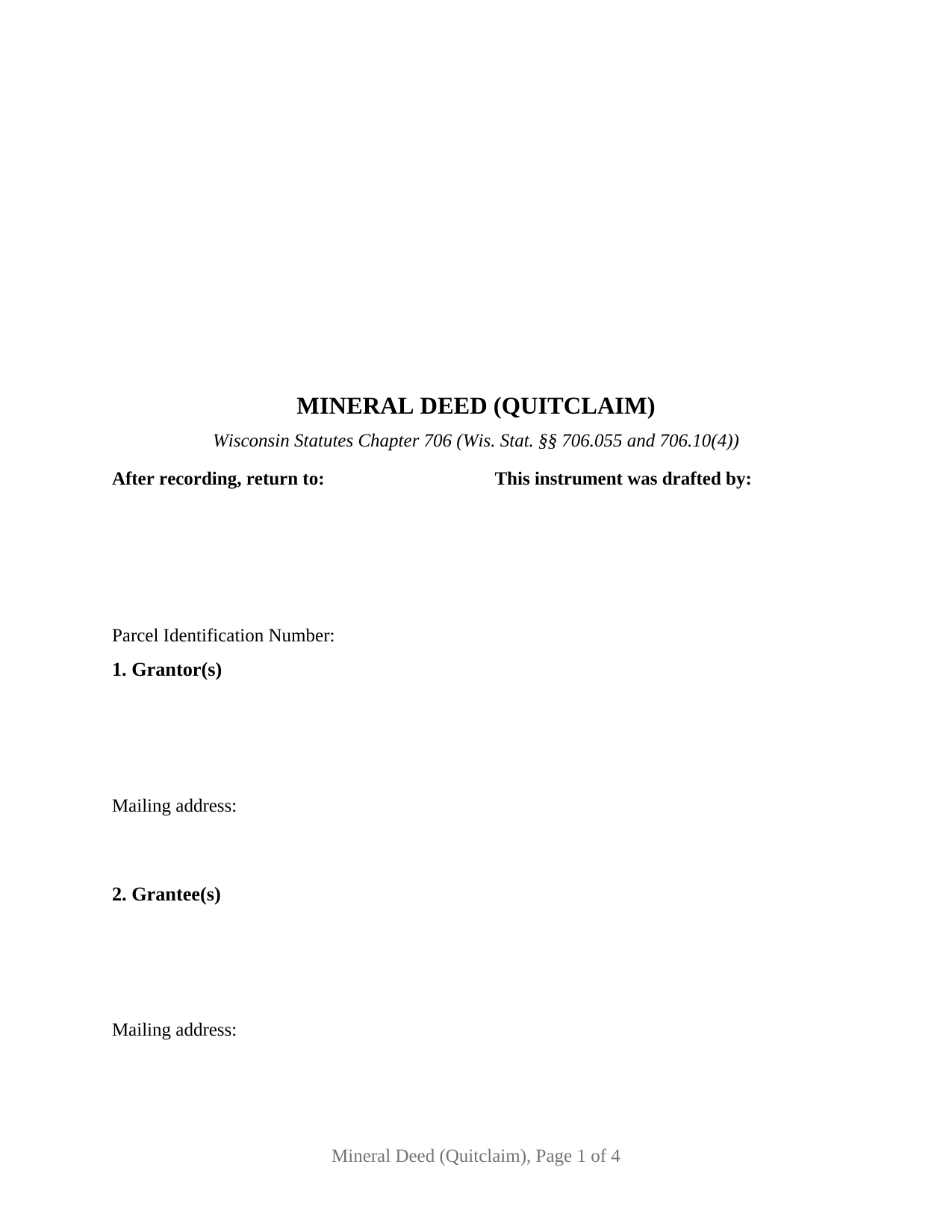
About the Wisconsin Mineral Deed (Quitclaim)
How to Use This Form
- Select your county from the list
- Download the county-specific form
- Fill in the required information
- Have the document notarized if required
- Record with your county recorder's office
What Others Like You Are Saying
"I am a WA State Attorney and just made my first purchase. The experience was flawless, and I appreci…"
"a lil pricey but i was able to knock out what needed to be done within 2 hours and not all day."
"This is my fourth try, and I hope my form is complete and acceptable."
"Great forms, exactly what I needed. Easy to understand. No problems recording. Thanks!"
"I am very impressed with Deeds.com. They provided the form with instructions that I needed. Also, th…"
4.8/5 from 4,864 reviews. Read all
A Wisconsin mineral deed in quitclaim form conveys the grantor's interest in the oil, gas, and other minerals under a described tract of Wisconsin land, and nothing more than that interest. This form prepares that deed for one or two grantors conveying to one or two grantees, in the quitclaim form Wisconsin Statutes section 706.10(4) describes, and it carries the first-page elements and the mineral-interest recording rule that Wisconsin registers of deeds apply.
A deed that carries the minerals and leaves the surface
Wisconsin treats the minerals under land as real estate that can be owned apart from the surface, and Wisconsin Statutes section 706.01(7m) names that separate fee simple interest, created by an instrument transferring, granting, assigning, or reserving the minerals, an interest in minerals. A mineral deed is the instrument that makes or passes along that separation: a landowner who keeps the farm or the forty but conveys the minerals, or a person who already holds a severed mineral interest and sells or gives it to someone else, uses a mineral deed. The deed on this form defines the Minerals as all oil, gas, and other minerals of every kind and character, metallic and nonmetallic, in, on, and under the described land, and it conveys the undivided interest in those Minerals that the grantor writes into the deed, whether that is the whole of the grantor's interest or a stated fraction. The surface is not conveyed; the deed carries only the access rights it describes, the right of ingress and egress for exploring, developing, producing, and removing the Minerals, to the extent the grantor holds that right. The grantor's interest under any existing mineral lease, including the rents and royalties accruing under it, passes with the mineral interest.
Quitclaim means no warranty
The deed is a quitclaim. Under Wisconsin Statutes section 706.10(4), a quitclaim deed passes all of the grantor's interest in the land and appurtenant interests that the grantor could lawfully convey, and it implies no warranty and no representation that any interest exists, or about the quantity or quality of any interest. The deed states that rule in its own text, so a reader of the recorded instrument sees exactly what the grantee received: whatever interest in the Minerals the grantor held, with no covenant behind it. That is the ordinary shape of a mineral conveyance where the grantor's interest came down through old reservations and partial conveyances and the grantor is not in a position to warrant it. The deed also uses Wisconsin's own quitclaim words, remises, releases, and quitclaims, so the register and a later title examiner read it as the conveyance Chapter 706 preserves under the forms in common use.
Why recording a Wisconsin mineral deed matters twice
Recording a deed gives it priority and constructive notice under the recording act, Wisconsin Statutes sections 706.08 and 706.09, as it does for any conveyance. A mineral deed is recorded for a second reason. Wisconsin Statutes section 706.057 provides that an interest in minerals owned separately from the surface lapses if it is not used during the previous 20 years, and the section counts the recording of a conveyance by which the interest is aliened as a use. Recording this deed therefore starts a new 20-year period for the interest it conveys, and the grantee keeps the interest alive afterward by mining, by recording a later conveyance, by paying property taxes on a separately assessed interest, or by recording the statement of claim the section describes. Section 706.055 sends conveyances of mineral interests, as the chapter defines them, to the index the register keeps under section 59.43(9), the same index in which every recorded deed is found by grantor, grantee, document number, and, in a county with a tract index, by parcel. The guide walks through the lapse rule, the three-year grace period the Wisconsin Court of Appeals construed in 2021, and the statement of claim that cures or forecloses a lapse.
Built to the Wisconsin standard document format
The first page of the deed carries the blank 3 inch by 3 inch recording area in its upper right corner, the document name within the band the statute places it in, the return address, the drafter's name, and a parcel identification number line, the items the standard document format of Wisconsin Statutes section 59.43(2m) names and the register may refuse a document for lacking. The recording fee is $30 statewide regardless of page count. Section 7 of the deed carries the transfer-fee exemption line that section 77.22(1) requires on the face of an exempt conveyance; a mineral deed for value pays the real estate transfer fee of 30 cents per $100 of value through the Department of Revenue's electronic real estate transfer return, whose receipt accompanies the deed to the register, and the guide describes the family and spousal exemptions of section 77.25 that commonly reach a mineral deed given for nominal or no consideration.
One or two grantors, nothing preprinted about who they are
The form recites nothing about the grantors' marital status, the form in which they hold the mineral interest, or the capacity in which they sign; the grantor block receives one or two names with whatever status recital the grantors write in, and the grantee block receives one or two names with the Wisconsin ownership designation the grantees choose, as tenants in common, as joint tenants, as marital property, or as survivorship marital property, which the guide describes form by form with the statutes that give each its effect. The deed carries two grantor signature blocks and two acknowledgment certificates, one for each grantor, so two grantors may acknowledge on different dates or before different notarial officers; a single grantor uses the first block and leaves the second blank. A married grantor conveying minerals under the family homestead is described in the guide against Wisconsin Statutes section 706.02(1)(f), under which each spouse signs or joins a conveyance that alienates a married person's interest in a homestead, and the second signature block is where a joining spouse signs. The form is not set up as a conveyance by a trustee, a personal representative, an attorney-in-fact, or an entity, for three or more grantors or grantees, or with warranty covenants. Each certificate opens with the acknowledgment sentence of Wisconsin Statutes section 140.16(1), and no witnesses are required for a Wisconsin deed.
The package includes the fillable mineral deed form, a completed example filled in for a realistic Iron County fact pattern, and the guide that walks through every numbered section, the signing formalities, the lapse statute, and the recording process. This description and the guide describe the form and the governing Wisconsin statutes in general terms; they are not legal advice.
Important: County-Specific Forms
Our mineral deed (quitclaim) forms are specifically formatted for each of the 72 counties in Wisconsin.
After selecting your county, you'll receive forms that meet all local recording requirements, ensuring your documents will be accepted without delays or rejection fees.