Wisconsin Quitclaim Deed
County Specific Legal Forms Validated as recently as October 6, 2026 by our Forms Development Team
About the Wisconsin Quitclaim Deed
How to Use This Form
- Select your county from the list
- Download the county-specific form
- Fill in the required information
- Have the document notarized if required
- Record with your county recorder's office
What Others Like You Are Saying
"Very easy to complete Quitclaim Deed"
"Great system"
"More expensive that I would have thought."
"This company is a super time saver for our firm and our client! Their website was easy to use and th…"
"Worked well for me to create a deed for a house I inherited. It was very thorough and easy to use. I…"
4.8/5 from 4,832 reviews. Read all
Wisconsin never adopted a statutory deed form. Wis. Stat. § 706.10(1) keeps the terms and forms of conveyance that were authorized by law or in common use here on July 1, 1971, and in the same breath permits other, different, or more concise forms conforming to ch. 706. No Wisconsin statute tells a deed what to look like. What the statutes supply instead is the covenant arithmetic, and that is where one Wisconsin deed parts company with another.
A deed defined by what it leaves out
Two adjacent subsections do the sorting. Wis. Stat. § 706.10(5) loads a warranty deed with covenants of seisin, right to convey, freedom from encumbrance, and defense of title. Wis. Stat. § 706.10(4) does the reverse for the instrument prepared here. A quitclaim deed carries across whatever interest in the land, or appurtenant to it, the grantor was lawfully able to convey, and it makes no warranty and implies none about whether that interest exists, how large it is, or how sound. The grantee takes the grantor's position exactly as it stood at delivery, so a mortgage, judgment, easement, or restriction of record rides through untouched. Section 10 states that character in the instrument's own words rather than leaving it to the document's title, which is why Wisconsin records carry the instrument under both spellings, quitclaim deed and quit claim deed, with no difference in effect.
Blanks that carry the parties' own words
This is the general configuration, and its design decision is restraint: no marital status, capacity, or co-ownership language is printed on the instrument. Section 1 takes one or two grantor names with whatever status those parties write after them, Section 3 takes one or two grantee names with whatever co-ownership designation the grantees write, and Section 10 makes both entries part of the deed by its own terms. Four count patterns fit that shape: one name to one, one to two, two to one, and two to two. The signature section holds a block for each grantor with an acknowledgment certificate under each, in the Wis. Stat. § 140.16(1) short form wording, so two signers may appear before different notarial officers on different days; on a single-signer fill the second block and its certificate stay empty. That second block is also where a spouse signing under Wis. Stat. § 706.02(1)(f) lands. The form is not drawn for a corporation, a limited liability company, a partnership, a trustee, or an agent under a power of attorney, each of which signs through a different execution pattern, and not for three or more owners on either side.
An exemption stated, not decided, at the counter
Wisconsin puts the transfer fee on the grantor at 30 cents for each $100 of value under Wis. Stat. § 77.22(1), and the same subsection settles who judges a claim of exemption. A conveyance owing nothing names its exempting subsection of Wis. Stat. § 77.25 on the instrument's own face, and the register of deeds is given no duty to weigh either the value reported or the exemption claimed. Section 6 is that labeled line. Review comes afterward from the Department of Revenue, which under Wis. Stat. § 77.26(8) may assess $25 or 25 percent of the additional fee, whichever is greater.
Refusal rather than a surcharge
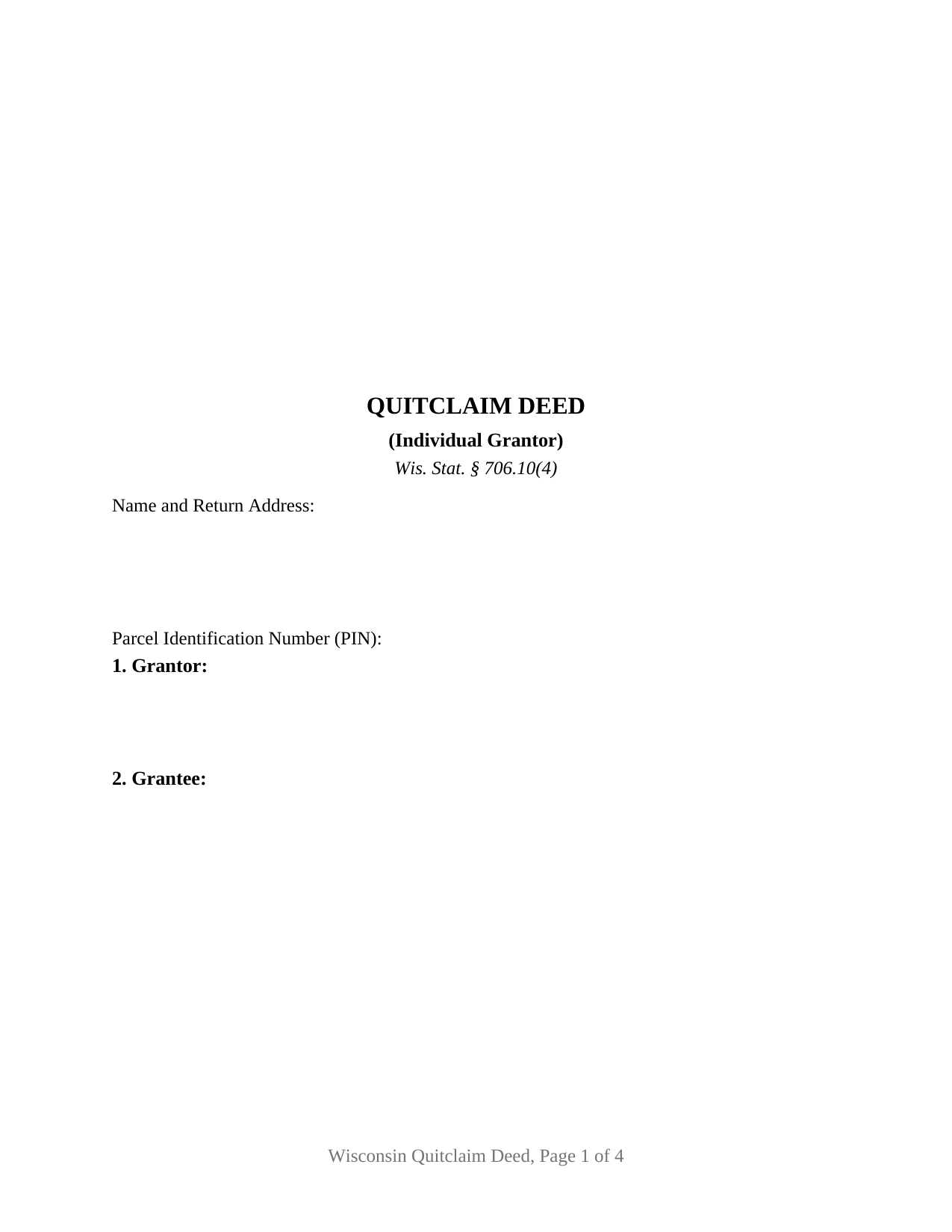
Many states price a nonconforming page. Wisconsin declines it. The recording fee is one flat number, $30 per document regardless of page count, under Wis. Stat. § 59.43(2)(ag)1, and the grounds for turning a document away are listed in Wis. Stat. § 59.43(2s), from a missing current legal description to correction fluid on the page. A document lacking the three inch by three inch blank square in the upper right of page one may not be recorded at all. This form answers that standard: the square left empty, the document name high on page one, first page return information, a parcel number line for counties that use one, and the drafting statement of Wis. Stat. § 59.43(5)(a). Once a document is accepted and properly indexed, Wis. Stat. § 59.43(6)(b) treats it as recorded even if a format failure surfaces later.
The download holds the Wisconsin quitclaim deed as a fillable PDF, a completed example filled in for an Outagamie County conveyance in Appleton, and a plain language guide covering every blank, the execution rules, and recording. These materials describe Wisconsin law in general terms for information and are not legal advice.
Important: County-Specific Forms
Our quitclaim deed forms are specifically formatted for each of the 72 counties in Wisconsin.
After selecting your county, you'll receive forms that meet all local recording requirements, ensuring your documents will be accepted without delays or rejection fees.