Wyoming Mineral Deed (Individual Grantor)
County Specific Legal Forms Validated as recently as November 12, 2026 by our Forms Development Team
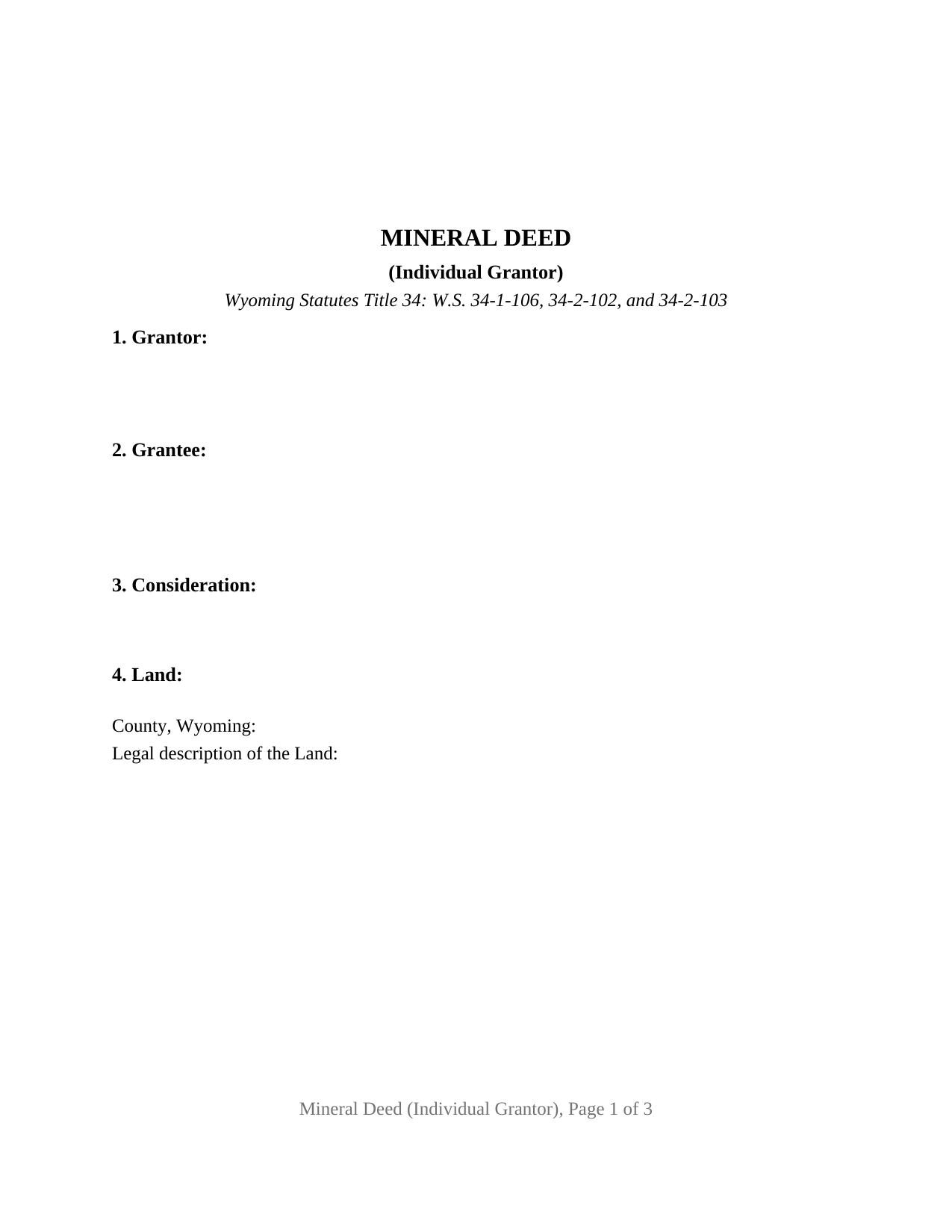
About the Wyoming Mineral Deed (Individual Grantor)
How to Use This Form
- Select your county from the list
- Download the county-specific form
- Fill in the required information
- Have the document notarized if required
- Record with your county recorder's office
What Others Like You Are Saying
"Found the forms I needed with no problem and easy to fill out thanks to the guide that is with it. B…"
"Thank you! This is very helpful"
"Very easy to use"
"Look great and I thought my daughter wanted me to buy, but she had already bought the package so did…"
"A coworker recommended this service to me and I was hesitant to try it. Turned out to be a life save…"
4.8/5 from 4,850 reviews. Read all
A Wyoming mineral deed for one individual grantor conveys a stated share of the oil, gas, and other minerals under described Wyoming land to the grantee named in it, with the grantor signing once, in the grantor's own right, and acknowledging once before a notarial officer. This form prepares that deed: one grantor block, one signature line, one acknowledgment certificate, and the operative words of the Wyoming statutory warranty deed applied to a mineral interest instead of the surface.
One grantor, one signature, one certificate
The deed is built around a single natural person conveying what that person owns in the minerals. Section 7 fixes the capacity as deed text: the grantor is an individual who signs in the grantor's own right and not as a trustee, agent, attorney-in-fact, or other representative. Because one person signs, the form carries one signature block and one acknowledgment certificate, completed by the notarial officer who takes the grantor's acknowledgment under Wyoming Statutes 34-1-113. The grantee side stays open. Section 2 receives one or more grantees with the mailing address the county clerk must have under W.S. 34-1-119(a) before recording, and two or more grantees take under whatever words of co-ownership follow their names. An heir selling a fractional mineral interest inherited decades ago, a rancher conveying half the minerals under a quarter section to a family member, and a mineral owner transferring an undivided share to a buyer present the one-grantor pattern this deed recites; a conveyance by two co-owners, by a trustee, by a company, or under a power of attorney carries different party recitals and a different certificate structure, and this form is not set up as any of those.
The statutory warranty words, pointed at the minerals
Wyoming has no separate mineral deed statute, so the deed rests on the general conveyancing rules of Title 34. It uses the words conveys and warrants from the permissive warranty deed form of W.S. 34-2-102, and under W.S. 34-2-103 a deed in substance in that form carries the grantor's covenants of seisin, good right to convey, freedom from incumbrances, quiet possession, and defense of title against all lawful claims. The deed describes the premises those covenants reach as the Mineral Interest, the share stated in Section 5 of all the oil, gas, and other minerals in, on, and under, and that may be produced from, the land, so the warranty runs to the minerals conveyed and not to the surface. One Wyoming statute makes mineral conveyances a class of their own on this point: W.S. 34-1-135 bars implied covenants in every conveyance of real estate other than a conveyance of oil, gas, or other minerals, and this deed states its covenants expressly through the statutory words rather than leaving anything to implication.
What rides with a Wyoming mineral interest, and what stays behind
The conveyance includes the rights, privileges, and appurtenances belonging to the mineral interest, including any right of ingress, egress, and reasonable surface use for exploring, developing, producing, and removing the minerals, and it includes the grantor's share of rentals, royalties, and other benefits attributable to the interest under any existing lease, accruing from the date of the deed forward. The deed is expressly subject to every valid and subsisting oil, gas, or mineral lease of record, and Section 6 lists those leases for the record without turning the listing into a warranty. Two subsurface interests stay behind by statute. Pore space, the strata usable for storing carbon dioxide and other substances, belongs to the surface owner under W.S. 34-1-152, and subsection (b) of that section provides that an agreement conveying mineral interests conveys no pore space unless it explicitly says so; the deed states that it conveys none. Fossils, artifacts, and non-fossilized animal remains are excluded from the term minerals in any instrument by W.S. 34-1-157(b). Wind energy rights likewise stay with the surface under W.S. 34-27-103. And because W.S. 34-10-108(a)(iv) keeps mineral interests outside Wyoming's Marketable Record Title Act, every severed share and reservation in the chain survives however old it is, which is why the interest stated in Section 5 and the warranty behind it carry the weight they do.
Homestead release, Statement of Consideration, and the fee per section
Section 7 prints the homestead release and waiver that W.S. 34-2-121 requires in substance of any instrument conveying a homestead, and the guide describes the spouse's signature and acknowledgment that section calls for on an instrument conveying a homestead, a signature this one-grantor form does not carry. At the counter the deed travels with the Statement of Consideration, the sworn and confidential disclosure of the parties, the property, and the actual price that W.S. 34-1-142 requires before the clerk accepts any instrument transferring title to real property, and with the statewide recording fee of W.S. 18-3-402(a)(xvi): twelve dollars for the first page, three dollars for each additional page, and one dollar for each section, lot, or tract over ten in the description, a charge that reaches the township-and-range descriptions mineral deeds commonly carry. Wyoming imposes no transfer tax on the conveyance. The form is laid out for the scanner standards Wyoming's largest counties publish, with a two-inch top margin on the first page for the recording label, one-inch margins elsewhere, and twelve-point type on letter-size paper, and its entry fields are unlined open space, so the printed deed reads as a continuous instrument rather than a worksheet.
The deed as a working document
The form has eight numbered sections: grantor, grantee, consideration, the county and legal description of the land, the mineral interest conveyed and the source of the grantor's title, existing leases and matters of record, the conveyance and warranty, and the grantor's signature, followed by the acknowledgment certificate and the return and preparer blocks. The instructions cover page, which is not recorded, states the exhibit convention for an entry that outgrows its space and the print-at-actual-size rule that keeps the margins where the clerk expects them. Mineral deed, mineral rights deed, oil and gas deed, and deed of mineral interest are the names under which this instrument is searched, and in Wyoming they describe the same conveyance under the same Title 34 rules.
The package includes the fillable mineral deed form, a completed example filled in for a Converse County mineral interest conveyed by one grantor to two grantees as joint tenants with right of survivorship, and the guide that walks through every numbered section, the signing and notarization rules, and the recording process. This description and the guide describe the form and the governing Wyoming statutes in general terms; they are not legal advice.
Important: County-Specific Forms
Our mineral deed (individual grantor) forms are specifically formatted for each of the 23 counties in Wyoming.
After selecting your county, you'll receive forms that meet all local recording requirements, ensuring your documents will be accepted without delays or rejection fees.