Alabama Interspousal Transfer Grant Deed
County Specific Legal Forms Validated as recently as October 9, 2026 by our Forms Development Team
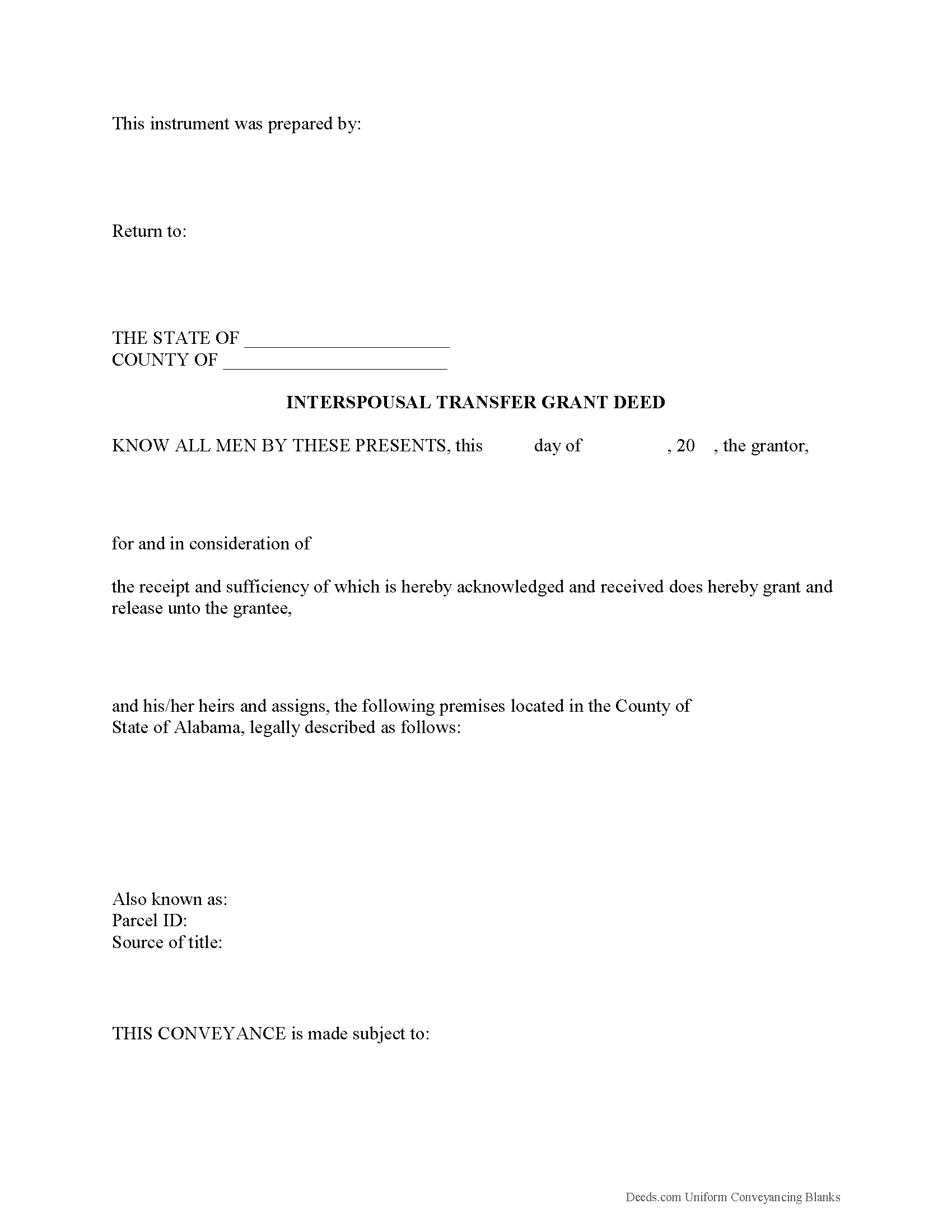
About the Alabama Interspousal Transfer Grant Deed
How to Use This Form
- Select your county from the list
- Download the county-specific form
- Fill in the required information
- Have the document notarized if required
- Record with your county recorder's office
What Others Like You Are Saying
"Awesome and quick service again, just like always from KvH. Thanks!"
"I was able to find the forms I needed and questions answered"
"Excellent service. Documents easy to understand and use."
"Very easy to work with."
"NO PROBLEMS. I LIKE THE DEED DOCUMENT AND INSTRUCTIONS. MADE IT EASY."
4.8/5 from 4,828 reviews. Read all
An Alabama Interspousal Transfer Grant Deed is used when one spouse transfers an ownership interest in Alabama real estate to the other spouse, often after a divorce settlement, during a refinance, or to change how title is held between spouses. In Alabama, the deed title alone does not control whether the document will record cleanly or hold up later. What matters is whether the instrument satisfies Alabama’s conveyance and recording rules, including the witness or acknowledgment requirement, the grantor’s marital status recital, homestead spousal assent when required, the preparer statement, the deed tax rules, and the probate-office recording standards that apply in the county where the property sits.
What the Alabama Interspousal Transfer Grant Deed does
This deed transfers one spouse’s present interest in the property to the other spouse and is commonly used to place title in one spouse’s name alone or to clean up title between spouses or former spouses. In Alabama, the form should be drafted as a real conveyance of the grantor’s interest, with a complete legal description and clear vesting language, because the probate office records the legal effect of the instrument, not just the label printed at the top.
Alabama statutory requirements for the deed
Alabama requires conveyances of land to be in writing and signed at the foot of the instrument by the contracting party or an authorized agent (Ala. Code § 35-4-20). The execution must be attested by one witness if the signer writes his or her own name, and by two witnesses in certain situations where the signer does not personally sign in the ordinary way (Ala. Code § 35-4-20). A proper acknowledgment operates as compliance with the witness requirement, which is why Alabama deeds are commonly notarized even when a separate witness line is included (Ala. Code § 35-4-23).
For recording, Alabama also requires the deed to recite the marital status of an individual grantor or vendor, and a knowingly false recital is a misdemeanor (Ala. Code § 35-4-73). In addition, a recorded real-estate instrument must show the name and address of the individual who prepared it (Ala. Code § 35-4-110). If the property description refers to a plat, the plat must be attached, or the deed must identify the plat book and office where the plat can be found, unless the deed also contains a metes-and-bounds description that satisfies the statute (Ala. Code § 35-4-74).
Execution requirements and the homestead issue
The granting spouse must sign the deed, and the signature must be either properly witnessed or properly acknowledged for recordation purposes (Ala. Code §§ 35-4-20, 35-4-23, 35-4-26). The biggest Alabama-specific trap is the homestead rule. A deed of the homestead by a married person is not valid without the voluntary signature and assent of the husband or wife, shown by acknowledgment before an officer authorized to take acknowledgments (Ala. Code § 6-10-3). For an interspousal transfer, that means you should not assume that naming the other spouse in the deed is enough. If the property is the marital homestead, the non-granting spouse’s assent must be handled in a way that satisfies Alabama law.
Alabama-specific recording traps
- Marital status recital: The deed must state the individual grantor’s marital status or the probate judge can refuse recordation (Ala. Code § 35-4-73).
- Prepared-by statement: Alabama requires a printed, typed, or stamped statement showing the name and address of the individual who prepared the instrument (Ala. Code § 35-4-110).
- Homestead assent: A transfer involving the homestead can fail if the spouse’s voluntary signature and assent are not properly shown (Ala. Code § 6-10-3).
- Plat references: If the legal description uses a recorded plat, the deed needs the attached plat or the correct plat-book reference and office information unless the statute is otherwise satisfied (Ala. Code § 35-4-74).
- Vesting language: Alabama does not presume survivorship. If ownership is intended to include a right of survivorship, the deed must say so expressly (Ala. Code § 35-4-7).
- Recording tax documentation: The probate office calculates deed tax from the actual purchase price paid or, if the property was not sold, the actual value shown on the required proof form used for recordation tax purposes (Ala. Code § 40-22-1).
- County checklist items: Probate offices commonly expect the grantee’s mailing address, a complete legal description, and a return-to recording block. Those details help avoid delays even when the core transfer language is otherwise acceptable.
Vesting and survivorship in Alabama
If the deed leaves the receiving spouse as sole owner, the vesting should clearly say so. If the deed is being used as part of a title change between spouses and the property will still be owned by more than one person afterward, the vesting language matters. In Alabama, survivorship is not automatic. Unless the instrument states that the tenancy is with right of survivorship or uses other words clearly showing that intent, the survivorship feature is not created (Ala. Code § 35-4-7). A deed that simply names co-owners without that language can create a very different result than the parties expected.
Recording the deed in Alabama
The completed original should be recorded in the office of the judge of probate in the county where the property is located (Ala. Code §§ 35-4-50, 35-4-62). Recording matters because an unrecorded conveyance can be ineffective against later purchasers, mortgagees, and judgment creditors without notice (Ala. Code § 35-4-90). Alabama also treats recordation as notice of the contents of the conveyance, so prompt recording helps protect the spouse receiving title and reduces later chain-of-title problems (Ala. Code § 35-4-63).
Deed tax, RT-1, and related filing issues
Alabama charges recordation tax on deeds at the time of recording, generally at the rate set by statute, and the probate office will not record the instrument until the tax and recording fee issues are resolved (Ala. Code § 40-22-1). The statute also requires proof of the actual purchase price or, if the property was not sold, proof of actual value, and the Department of Revenue form used for that purpose is the Real Estate Sales Validation Form, Form RT-1. Depending on the facts of the transfer, there may also be tax-related questions outside the deed itself, including whether any exemption applies and whether a nonresident transfer rule is implicated under Alabama law. Those issues do not change the conveyance language, but they can affect what must be filed with the probate office before the deed is accepted for record.
What is included in the download package
The Alabama Interspousal Transfer Grant Deed package includes the deed form, step-by-step guidelines, and a completed example to help you match Alabama’s recording requirements before filing in the probate office.
Important: County-Specific Forms
Our interspousal transfer grant deed forms are specifically formatted for each of the 67 counties in Alabama.
After selecting your county, you'll receive forms that meet all local recording requirements, ensuring your documents will be accepted without delays or rejection fees.