Madison County Interspousal Transfer Grant Deed Form
Last validated October 9, 2026 by our Forms Development TeamFormatted for recording in Madison County, for property anywhere in the county: rural and unincorporated areas as well as Brownsboro, Gurley, Harvest, Hazel Green, Huntsville, Madison, Meridianville, New Hope and 5 more.
- 3 documents included
- Immediate PDF download
- Formatting guarantee
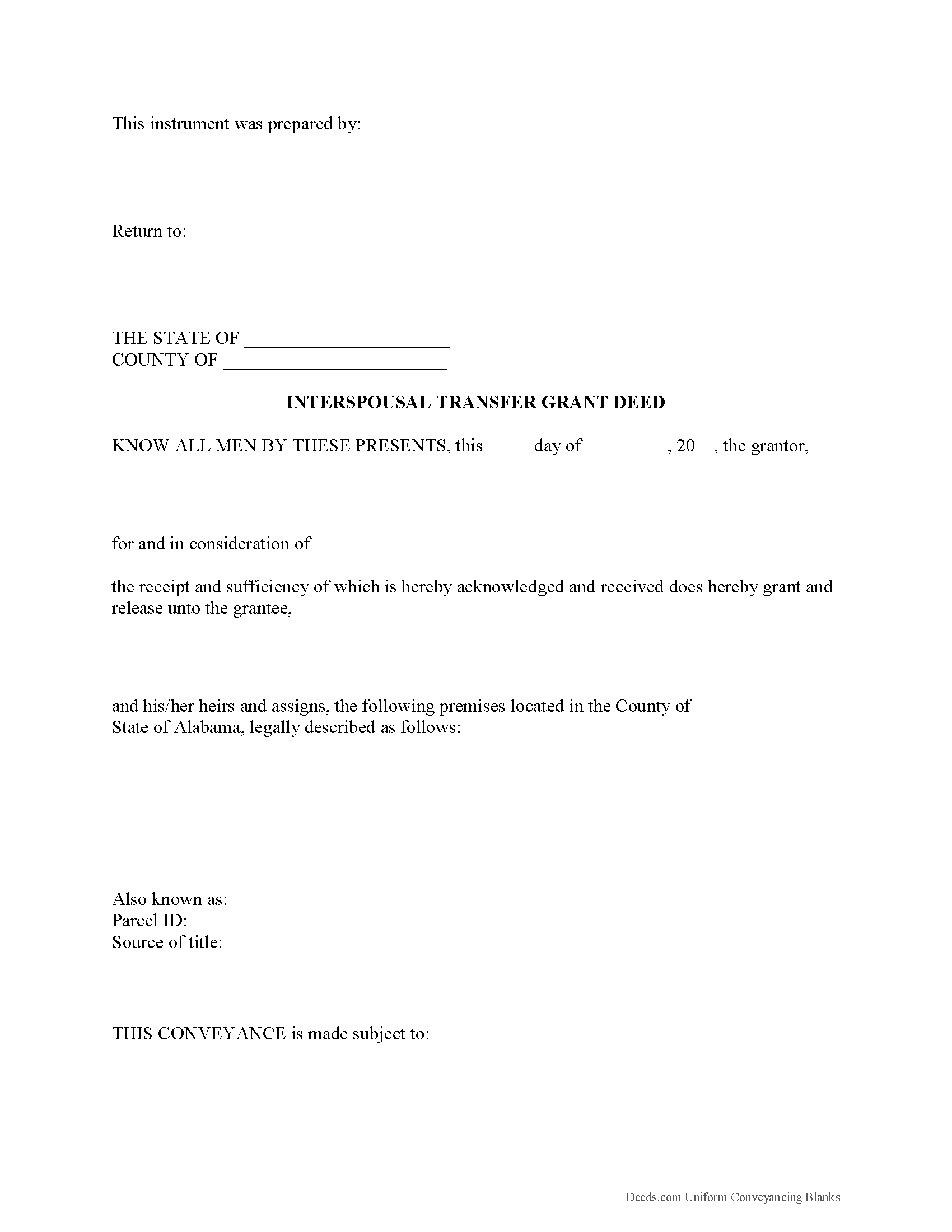
Madison County Interspousal Transfer Grant Deed Form
Fill in the blank form formatted to comply with all recording and content requirements.
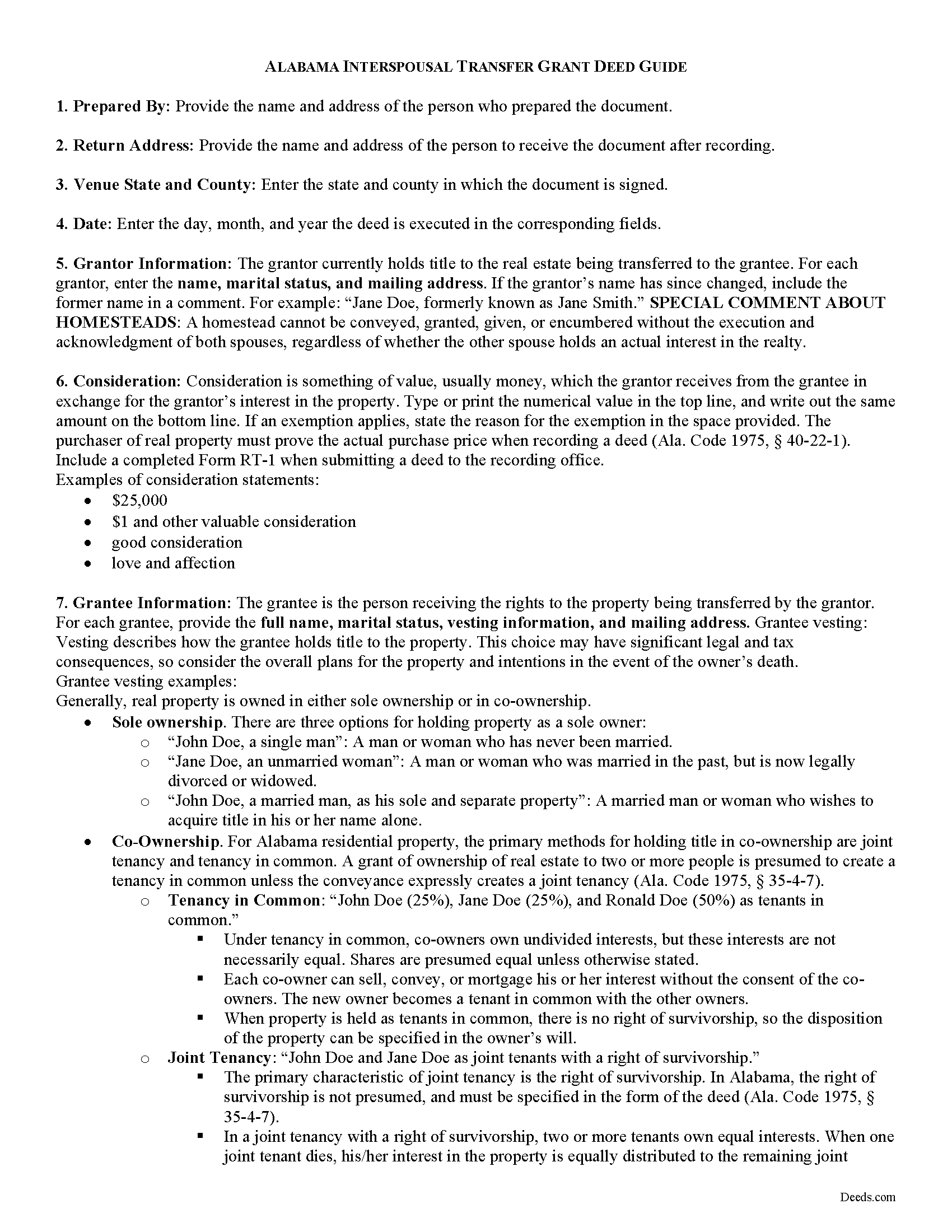
Madison County Interspousal Transfer Grant Deed Guide
Line by line guide explaining every blank on the form.
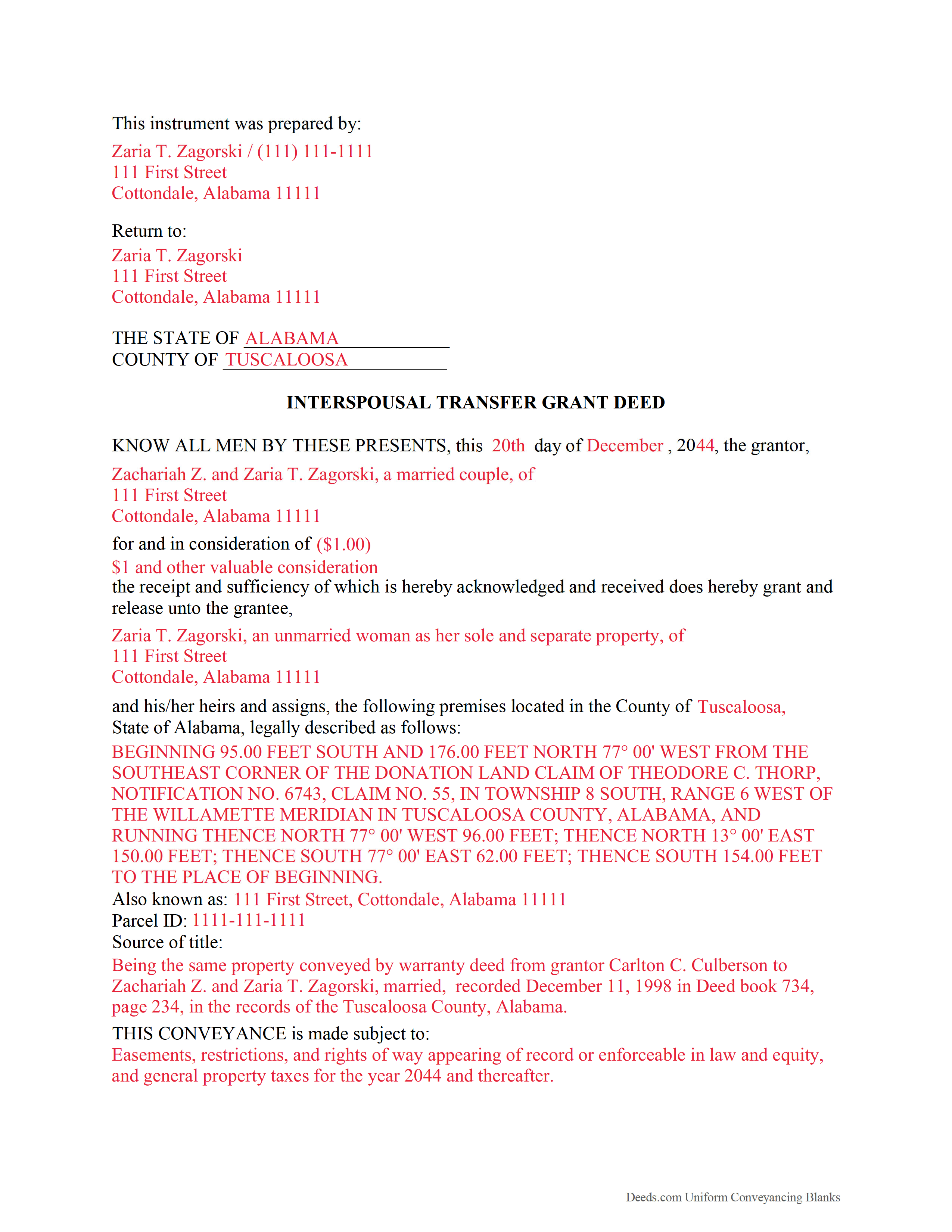
Madison County Completed Example of an Interspousal Transfer Grant Deed Document
Example of a properly completed form for reference.
All 3 documents above included • One-time purchase • No recurring fees
Immediate Download • Secure Checkout
Additional Alabama and Madison County documents included at no extra charge:
Where to Record Your Documents
Madison Probate Office
Huntsville, Alabama 35801
Hours: 8:30 to 4:30 M-F
Phone: (256) 532-3339
Recording Tips for Madison County:
- Bring your driver's license or state-issued photo ID
- Ensure all signatures are in blue or black ink
- Both spouses typically need to sign if property is jointly owned
- Bring extra funds - fees can vary by document type and page count
- Check margin requirements - usually 1-2 inches at top
Cities and Jurisdictions in Madison County
Properties in any of these areas use Madison County forms:
- Brownsboro
- Gurley
- Harvest
- Hazel Green
- Huntsville
- Madison
- Meridianville
- New Hope
- New Market
- Normal
- Owens Cross Roads
- Ryland
- Toney
Hours, fees, requirements, and more for Madison County
How do I get my forms?
Forms are available for immediate download after payment. The Madison County forms will be in your account ready to download to your computer. An account is created for you during checkout if you don't have one. Forms are NOT emailed.
Are these forms guaranteed to be recordable in Madison County?
Yes. Our form blanks are guaranteed to meet or exceed the applicable formatting requirements used for recording in Madison County, including margin requirements, font requirements, and other layout standards. This guarantee applies to formatting, not to the legal sufficiency of information entered by the user or the suitability of a form for a particular transaction.
Can I reuse these forms?
Yes. You can reuse the forms for your personal use. For example, if you have multiple properties in Madison County you only need to order once.
What do I need to use these forms?
The forms are PDFs that you fill out on your computer. The free Adobe Acrobat Reader is recommended, and most PDF apps also work. You do NOT enter your property information online - you download the blank forms and complete them privately on your own computer.
Are there any recurring fees?
No. This is a one-time purchase. Nothing to cancel, no memberships, no recurring fees.
How much does it cost to record in Madison County?
Recording fees in Madison County vary. Contact the recorder's office at (256) 532-3339 for current fees.
Questions answered? Let's get started!
An Alabama Interspousal Transfer Grant Deed is used when one spouse transfers an ownership interest in Alabama real estate to the other spouse, often after a divorce settlement, during a refinance, or to change how title is held between spouses. In Alabama, the deed title alone does not control whether the document will record cleanly or hold up later. What matters is whether the instrument satisfies Alabama’s conveyance and recording rules, including the witness or acknowledgment requirement, the grantor’s marital status recital, homestead spousal assent when required, the preparer statement, the deed tax rules, and the probate-office recording standards that apply in the county where the property sits.
What the Alabama Interspousal Transfer Grant Deed does
This deed transfers one spouse’s present interest in the property to the other spouse and is commonly used to place title in one spouse’s name alone or to clean up title between spouses or former spouses. In Alabama, the form should be drafted as a real conveyance of the grantor’s interest, with a complete legal description and clear vesting language, because the probate office records the legal effect of the instrument, not just the label printed at the top.
Alabama statutory requirements for the deed
Alabama requires conveyances of land to be in writing and signed at the foot of the instrument by the contracting party or an authorized agent (Ala. Code § 35-4-20). The execution must be attested by one witness if the signer writes his or her own name, and by two witnesses in certain situations where the signer does not personally sign in the ordinary way (Ala. Code § 35-4-20). A proper acknowledgment operates as compliance with the witness requirement, which is why Alabama deeds are commonly notarized even when a separate witness line is included (Ala. Code § 35-4-23).
For recording, Alabama also requires the deed to recite the marital status of an individual grantor or vendor, and a knowingly false recital is a misdemeanor (Ala. Code § 35-4-73). In addition, a recorded real-estate instrument must show the name and address of the individual who prepared it (Ala. Code § 35-4-110). If the property description refers to a plat, the plat must be attached, or the deed must identify the plat book and office where the plat can be found, unless the deed also contains a metes-and-bounds description that satisfies the statute (Ala. Code § 35-4-74).
Execution requirements and the homestead issue
The granting spouse must sign the deed, and the signature must be either properly witnessed or properly acknowledged for recordation purposes (Ala. Code §§ 35-4-20, 35-4-23, 35-4-26). The biggest Alabama-specific trap is the homestead rule. A deed of the homestead by a married person is not valid without the voluntary signature and assent of the husband or wife, shown by acknowledgment before an officer authorized to take acknowledgments (Ala. Code § 6-10-3). For an interspousal transfer, that means you should not assume that naming the other spouse in the deed is enough. If the property is the marital homestead, the non-granting spouse’s assent must be handled in a way that satisfies Alabama law.
Alabama-specific recording traps
- Marital status recital: The deed must state the individual grantor’s marital status or the probate judge can refuse recordation (Ala. Code § 35-4-73).
- Prepared-by statement: Alabama requires a printed, typed, or stamped statement showing the name and address of the individual who prepared the instrument (Ala. Code § 35-4-110).
- Homestead assent: A transfer involving the homestead can fail if the spouse’s voluntary signature and assent are not properly shown (Ala. Code § 6-10-3).
- Plat references: If the legal description uses a recorded plat, the deed needs the attached plat or the correct plat-book reference and office information unless the statute is otherwise satisfied (Ala. Code § 35-4-74).
- Vesting language: Alabama does not presume survivorship. If ownership is intended to include a right of survivorship, the deed must say so expressly (Ala. Code § 35-4-7).
- Recording tax documentation: The probate office calculates deed tax from the actual purchase price paid or, if the property was not sold, the actual value shown on the required proof form used for recordation tax purposes (Ala. Code § 40-22-1).
- County checklist items: Probate offices commonly expect the grantee’s mailing address, a complete legal description, and a return-to recording block. Those details help avoid delays even when the core transfer language is otherwise acceptable.
Vesting and survivorship in Alabama
If the deed leaves the receiving spouse as sole owner, the vesting should clearly say so. If the deed is being used as part of a title change between spouses and the property will still be owned by more than one person afterward, the vesting language matters. In Alabama, survivorship is not automatic. Unless the instrument states that the tenancy is with right of survivorship or uses other words clearly showing that intent, the survivorship feature is not created (Ala. Code § 35-4-7). A deed that simply names co-owners without that language can create a very different result than the parties expected.
Recording the deed in Alabama
The completed original should be recorded in the office of the judge of probate in the county where the property is located (Ala. Code §§ 35-4-50, 35-4-62). Recording matters because an unrecorded conveyance can be ineffective against later purchasers, mortgagees, and judgment creditors without notice (Ala. Code § 35-4-90). Alabama also treats recordation as notice of the contents of the conveyance, so prompt recording helps protect the spouse receiving title and reduces later chain-of-title problems (Ala. Code § 35-4-63).
Deed tax, RT-1, and related filing issues
Alabama charges recordation tax on deeds at the time of recording, generally at the rate set by statute, and the probate office will not record the instrument until the tax and recording fee issues are resolved (Ala. Code § 40-22-1). The statute also requires proof of the actual purchase price or, if the property was not sold, proof of actual value, and the Department of Revenue form used for that purpose is the Real Estate Sales Validation Form, Form RT-1. Depending on the facts of the transfer, there may also be tax-related questions outside the deed itself, including whether any exemption applies and whether a nonresident transfer rule is implicated under Alabama law. Those issues do not change the conveyance language, but they can affect what must be filed with the probate office before the deed is accepted for record.
What is included in the download package
The Alabama Interspousal Transfer Grant Deed package includes the deed form, step-by-step guidelines, and a completed example to help you match Alabama’s recording requirements before filing in the probate office.
Important: Your property must be located in Madison County to use these forms. Documents should be recorded at the county recording office listed above.
This Interspousal Transfer Grant Deed meets all recording requirements specific to Madison County.
Our Promise
The documents you receive here are guaranteed to meet or exceed the applicable Madison County recording format requirements. If there is a rejection caused by our formatting, we will correct the issue or refund your payment. This guarantee applies to document formatting only and does not extend to information entered by the user, the selection of the form, or the legal effect of the completed document.
Save Time and Money
Get your Madison County Interspousal Transfer Grant Deed form done right the first time with Deeds.com Uniform Conveyancing Blanks. At Deeds.com, we understand that your time and money are valuable resources, and we don't want you to face a penalty fee or rejection imposed by a county recorder for submitting nonstandard documents. We constantly review and update our forms to meet rapidly changing state and county recording requirements for roughly 3,500 counties and local jurisdictions.
4.8 out of 5 - ( 4,829 Reviews )
Tajsha N. 5 out of 5 stars
I would absolutely use this service again. It was very convenient and I was pleasantly surprised at how responsive the staff was letting me know updates to my recording package. Also, my documents recorded immediately. I did have trouble uploading my document in the beginning because I didn't realize it had to be a pdf file. Once I figured that out, it was immediately accepted. Great service!
We appreciate your business and value your feedback. Thank you. Have a wonderful day!
Jo G. 5 out of 5 stars
The form was easy enough to purchase but I ended up not needing it. No fault of Deeds.com, but it was of no value to me.
Thank you for your feedback. We really appreciate it. Have a great day!
James A. 5 out of 5 stars
Thanks for you help to get me out of a quick problem. Downloads were great. I recommend this service for the arcane situations of legal angst.
We appreciate your business and value your feedback. Thank you. Have a wonderful day!
Jacqueline G. 5 out of 5 stars
I'm 84 and not all that smart when it comes to what a Lawyer usually helps you with, but I took a chance to see if I could do this. Walla, I was able to do it. I was helping my son who had a stroke a few years ago and the transaction went well. Thank you.
Thank you for your feedback Jacqueline. We appreciate you.
Marion Paul W. 5 out of 5 stars
Quick service .Easy download.I ordered Quit Claim and should have ordered warranty deed. I will make it work
Thank you!
Maria S. 3 out of 5 stars
The paperwork/forms are fine, but there isn't enough explanation for me to figure out how to file the extra forms (which I do need in my case). The main form, Deed Upon Death is fine. I think the price is pretty high for these forms. I wouldn't have purchased it because there are places to get them for much cheaper (about 6 dollars), but this site had the extra forms I wanted (property in a trust and another form). Unfortunately these were included as a "courtesy" and there are no instructions for them. So three stars for being clear about what was in the package, having the right forms that I need, but instructions for putting them to use and price took a couple of stars off. Downloading was easy and once you download you can type the info into the PDF--that makes working with the forms much easier.
Thank you for the feedback Maria. Regarding the supplement documents, it is best to get assistance from the agency that requires them. These are not legal documents, they should provide full support and guidance for them.
DAVID G. 5 out of 5 stars
Extremely helpful -- logically presented -- great documentation...
We appreciate your business and value your feedback. Thank you. Have a wonderful day!
Kelly M. 5 out of 5 stars
Received exactly what you said I would get. Good Quick Service
Thank you, Kelly. We’re glad everything was as expected and that the service was quick.
Thuc P. 5 out of 5 stars
Fast and good service. Very details in instructions.
Thank you!
Alan K. 5 out of 5 stars
All I needed was a simple Certificate of Trust. Deeds.com had a template for exactly what I needed. I didn't have to make an appt with an attorney, wait for one to be available, nor pay a ridiculous amount for a standardized document. Super easy.
Thank you for your feedback. We really appreciate it. Have a great day!
PEGGY D. 5 out of 5 stars
Very easy to find what I needed. Really liked the instructions included with the forms and also the suggestion of other forms that I might need.
We appreciate your business and value your feedback. Thank you. Have a wonderful day!
BRIAN M. 5 out of 5 stars
Excellent Service, Fast and efficient. Thank You!
Thank you!
GERALD P. 5 out of 5 stars
Product is as advertised. Most beneficial is including detailed instructions and examples. Most other options did not include instructions.
Thank you for your feedback. We really appreciate it. Have a great day!
Bayyinah M. 5 out of 5 stars
EasyPeasy!
Thank you!
Ronald R. 5 out of 5 stars
first tinme use, good buy=t expensive
Thank you!