Alabama Limited Power of Attorney for the Sale of Real Property
County Specific Legal Forms Validated as recently as September 23, 2026 by our Forms Development Team
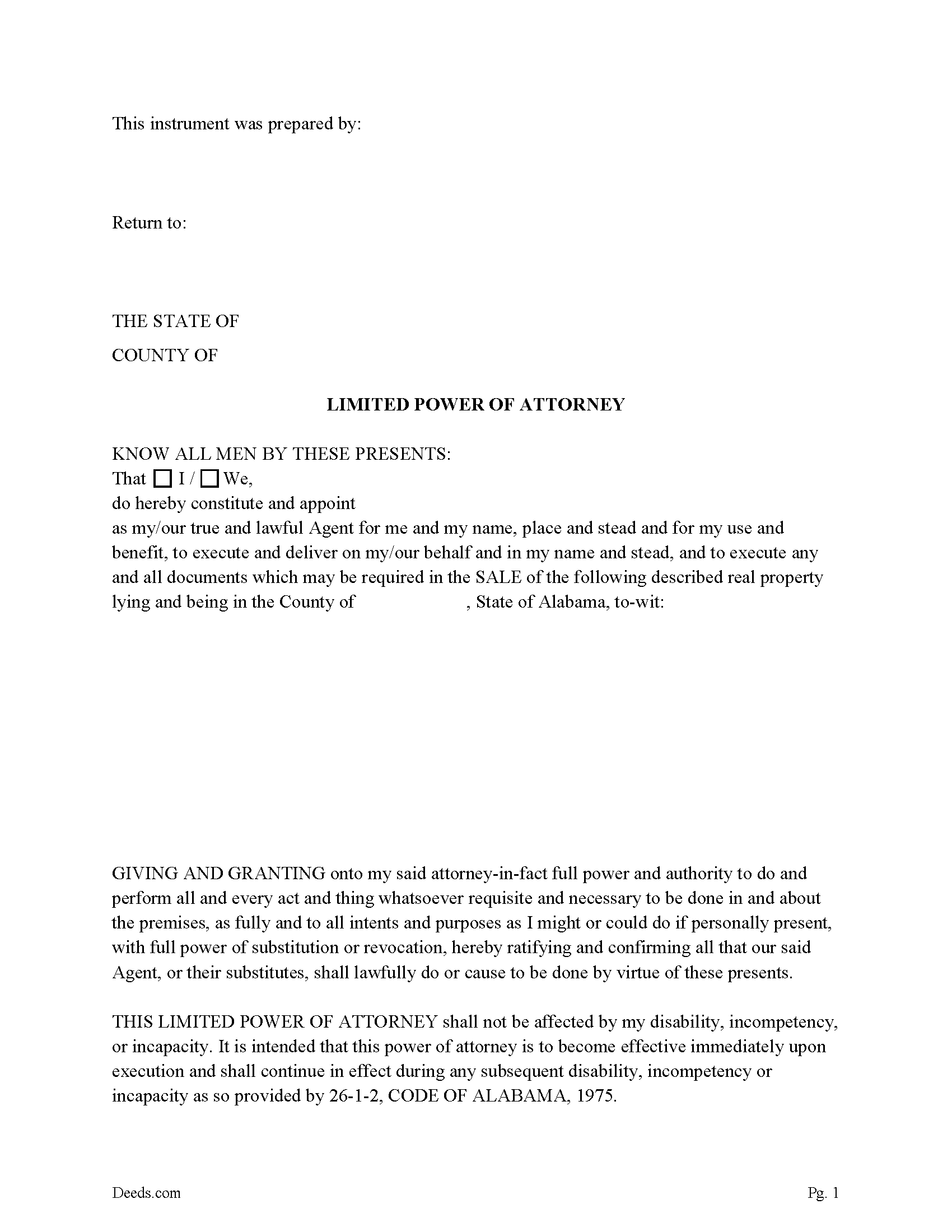
About the Alabama Limited Power of Attorney for the Sale of Real Property
How to Use This Form
- Select your county from the list
- Download the county-specific form
- Fill in the required information
- Have the document notarized if required
- Record with your county recorder's office
What Others Like You Are Saying
"Excellent work. I have recommended some friends to your website and will continue. Thanks."
"You made this so easy to process the Executor Deed. THANK YOU a thousand times. Appreciate that all …"
"Thank you! This is very helpful"
"Download was easy to complete, but difficult to revisit site to review purchased forms on line. Sugg…"
"First time user and my experience was just great! Great people to work with and would recommend to o…"
4.8/5 from 4,821 reviews. Read all
An Alabama Limited Power of Attorney for the Sale of Real Property is used when an owner wants another person to handle one identified Alabama real estate sale without giving broad, open-ended authority over other assets. That limited scope matters in Alabama because the deed signed at closing must trace back to an agent with written authority, and the transaction usually depends on getting that authority into the same county probate records where the deed will be recorded. Alabama practice also brings in state-specific recording traps, including marital-status recitals, homestead spousal assent, preparer identification, and county probate recording requirements, so a sale-specific power of attorney needs to be drafted with the closing and recording process in mind, not just as a generic agency form.
What the Alabama Limited Power of Attorney for the Sale of Real Property does
This form lets the principal appoint an agent to sign the documents needed to sell a specifically identified parcel of Alabama real estate, such as the deed, settlement papers, affidavits, and other closing documents described in the power. It is commonly used when the owner cannot attend the closing in person because of travel, illness, military service, work demands, or distance from the Alabama county where the property is being sold. In a sale-only format, the authority is restricted to that transaction and typically ends when the stated purpose has been completed, which fits Alabama law recognizing termination when the purpose of the power of attorney is accomplished (Ala. Code § 26-1A-110).
Alabama statutory requirements for a valid sale power of attorney
Under Alabama’s Uniform Power of Attorney Act, a power of attorney is durable unless the document says it terminates upon the principal’s incapacity (Ala. Code § 26-1A-104). The principal must sign the power of attorney, or direct another person to sign in the principal’s conscious presence, and the signature is presumed genuine if acknowledged before a notary or other officer authorized to take acknowledgments (Ala. Code § 26-1A-105). A power of attorney executed in Alabama on or after January 1, 2012 is valid if it complies with that execution rule (Ala. Code § 26-1A-106).
Because this form is limited to the sale of identified real property, the description of the property and the scope of the agent’s authority should be narrow and clear. Alabama law also imposes baseline duties on an agent who accepts the appointment, including acting in accordance with the principal’s known expectations, in good faith, and within the scope of authority granted (Ala. Code § 26-1A-114). If the document states that it terminates at closing, or once the described sale is completed, that stated end point controls along with the general termination rules in Ala. Code § 26-1A-110.
Signing and acknowledgment rules that matter in Alabama closings
The power of attorney itself is signed by the principal, but the deed delivered at closing will be signed by the agent under the written authority granted in the power of attorney. Alabama’s conveyance statute requires land conveyances to be in writing and signed by the contracting party or by the party’s agent having written authority (Ala. Code § 35-4-20). For the deed signed under the power of attorney, Alabama also has its own execution formalities: the conveyance is ordinarily attested by one witness, but a proper acknowledgment satisfies the witness requirement (Ala. Code §§ 35-4-20, 35-4-23). In practice, Alabama real estate instruments are usually notarized so the acknowledgment can carry the execution requirements for recording.
That creates an important distinction. Alabama does not generally require witnesses for the power of attorney itself under the Uniform Power of Attorney Act, but the deed the agent signs for the seller still has to meet Alabama conveyance rules to record cleanly. The acknowledgment form used for Alabama real property instruments is prescribed by statute, and homestead conveyances have an added spousal-assent issue discussed below (Ala. Code §§ 35-4-29, 6-10-3).
Alabama recording traps in real-property sales
Alabama has several county-recording issues that routinely affect sales handled through an agent. A sale power of attorney can be perfectly valid between the principal and agent and still create a closing problem if the related deed package misses one of these Alabama-specific requirements.
- Written authority for the agent: Alabama requires the deed to be signed by the owner or by an agent with written authority, so the power of attorney needs to be complete, specific, and available for recording when the deed goes on record (Ala. Code § 35-4-20).
- Marital-status recital: Alabama probate judges are not to accept a deed, contract, or other conveyance of land from an individual grantor unless it recites the grantor’s marital status (Ala. Code § 35-4-73).
- Homestead spousal assent: If the property is homestead property of a married person, a conveyance is not valid without the voluntary signature and assent of the spouse, shown by acknowledgment substantially in the statutory form. A power of attorney for the sale does not eliminate that Alabama homestead requirement (Ala. Code § 6-10-3).
- Preparer statement: Alabama requires a printed, typed, or stamped statement showing the name and address of the individual who prepared the instrument. If a printed form is used, the preparer is the person who filled in the blanks or examined the completed entries (Ala. Code § 35-4-110).
- Plat-reference rule: If the legal description refers to a plat, the instrument may be rejected unless the plat is attached and made part of the instrument, or the document identifies the plat book and office where the plat can be found, unless the land is otherwise described by metes and bounds (Ala. Code § 35-4-74).
- Recordation tax and recording fees: Alabama probate judges collect deed tax and recording fees when the deed is presented, based on the actual purchase price paid or the actual value of the property as required by statute (Ala. Code § 40-22-1).
- Existing vesting language: If the seller took title using survivorship language, the deed signed by the agent should match the actual vesting shown in the owner’s chain of title. In Alabama, survivorship does not arise automatically between joint tenants; the creating instrument must say so or use other words showing that intent (Ala. Code § 35-4-7).
Recording the power of attorney and deed in the Alabama probate office
In Alabama, conveyances of real property are recorded in the office of the judge of probate, and they must be recorded in the county where the property is located (Ala. Code §§ 35-4-50, 35-4-62). Instruments executed in accordance with law may be admitted to record, and recording in the proper office operates as notice of the instrument’s contents (Ala. Code §§ 35-4-51, 35-4-63). Alabama is also a notice-recording state for real property interests, so an unrecorded conveyance can be ineffective against later purchasers, mortgagees, and judgment creditors without notice (Ala. Code § 35-4-90).
For a sale handled by an attorney-in-fact, the practical point is simple: the closing package needs to be prepared so the deed and the agent’s written authority can be accepted by the county probate office without delay. Prompt recording protects priority, supports title examination, and reduces the chance that a later filer or creditor claim will complicate the transaction.
What is included in the download package
The download package for this Alabama Limited Power of Attorney for the Sale of Real Property includes the Alabama sale-specific power of attorney form, step-by-step instructions, a completed example, and county recording information to help you prepare a document that fits Alabama real estate closing and probate recording requirements.
Important: County-Specific Forms
Our limited power of attorney for the sale of real property forms are specifically formatted for each of the 67 counties in Alabama.
After selecting your county, you'll receive forms that meet all local recording requirements, ensuring your documents will be accepted without delays or rejection fees.