Alabama Mineral Deed
County Specific Legal Forms Validated as recently as September 28, 2026 by our Forms Development Team
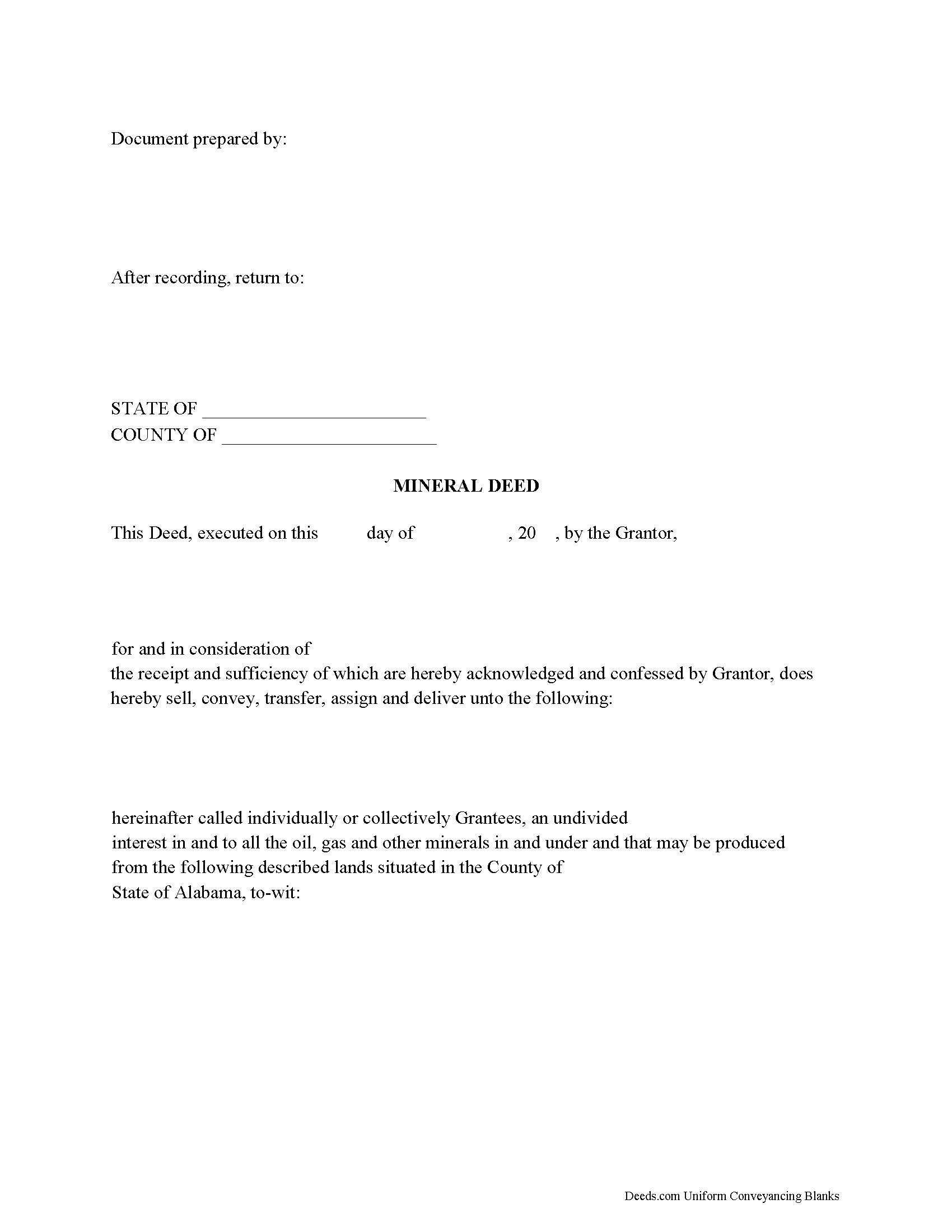
About the Alabama Mineral Deed
How to Use This Form
- Select your county from the list
- Download the county-specific form
- Fill in the required information
- Have the document notarized if required
- Record with your county recorder's office
What Others Like You Are Saying
"Nice!"
"It's very easy to navigate through the website to find the service that you want. Great program."
"Excellent program, easy to access and download."
"I purchased a Deed on Death for Washington State. Very user friendly site. Thank you 5star"
"I was very pleased with my experience on Deeds.com. I hand purchased the wrong papers and they credi…"
4.8/5 from 4,833 reviews. Read all
An Alabama Mineral Deed is used when the parties want to transfer ownership of oil, gas, and other mineral rights in Alabama land by deed rather than by lease. This is NOT a Lease. Alabama stands out because mineral interests are recorded through the county probate system, the deed must recite the grantor's marital status, homestead property can require the spouse's assent even when the spouse is not in title, and nonproducing mineral conveyances trigger Alabama's separate mineral documentary tax instead of being treated like an ordinary surface conveyance in every respect (Ala. Code §§ 35-4-73, 6-10-3, 40-20-31 through 40-20-34).
When an Alabama Mineral Deed is commonly used
This deed is commonly used when a grantor is selling or otherwise conveying all or part of the mineral estate under Alabama land, including a stated fractional interest, and wants the transfer documented in recorded deed form rather than by lease. In Alabama, that can include the right to the described oil, gas, and other minerals, together with associated rights tied to the conveyed mineral interest, subject to how the deed is written and to any valid, existing leases or prior severances already of record.
Alabama execution and content requirements
Alabama requires conveyances of land or interests in land to be in writing and signed at the foot of the instrument by the grantor or an authorized agent. As executed, the deed must be attested by one witness, but a proper acknowledgment before an authorized officer satisfies the witness requirement, which is why Alabama deeds are often notarized even when only one signature is being acknowledged (Ala. Code §§ 35-4-20, 35-4-23, 35-4-24). If the signer cannot write, or if another person writes the signer's name, Alabama requires the additional witness formalities stated in the statute (Ala. Code § 35-4-20).
Alabama also has a recording-specific content rule that catches out-of-state forms: a conveyance submitted for recording must recite the marital status of the grantor or vendor. That matters on mineral deeds because the probate office indexes the instrument as presented, and omission of marital status can delay or block recording (Ala. Code § 35-4-73). Alabama does not require the deed to recite consideration to be valid, so the absence of a purchase-price recital does not by itself invalidate the conveyance (Ala. Code § 35-4-34).
Alabama-specific traps on mineral conveyances
The biggest Alabama trap is assuming a mineral deed is exempt from homestead concerns because it deals with subsurface rights. Alabama's homestead statute applies to a deed or other conveyance of the homestead by a married person, and the spouse's voluntary signature and assent must appear in the required form when the property is homestead property (Ala. Code § 6-10-3). If the mineral deed affects homestead property and that spousal assent is missing, the document can create major title problems.
Another frequent issue is using a description that works in conversation but not in the recording office. If the minerals are tied to a subdivision lot, many Alabama probate offices expect the legal description to include the recorded plat reference. If the deed refers to a plat, local recording offices commonly want the plat book and page or other recording reference identified, and some offices also expect the derivation or source-of-title reference for indexing and title-chain review. In practice, many Alabama probate offices also expect a preparer line such as This document prepared by even though that is handled as a recording-office requirement rather than a core conveyancing statute.
Mineral deeds also need careful drafting on scope. The form should clearly state whether the grantor is conveying all minerals owned, only a stated fraction, and whether the conveyance includes present rights to royalties, overriding royalties, or other payments attributable to the conveyed interest. Because Alabama mineral interests are often already subject to recorded leases or prior severances, the deed should be matched to the exact chain of title instead of relying on a generic full-interest assumption.
Recording with the Alabama probate office and why timing matters
In Alabama, deeds affecting real property interests are recorded in the office of the judge of probate, and the deed should be recorded in the county where the land is located (Ala. Code §§ 35-4-50, 35-4-62). A properly recorded conveyance gives notice of its contents, which is why prompt recording matters any time mineral rights are being sold, split, or reserved (Ala. Code § 35-4-63). If the land lies in more than one county, the recording and tax handling can become more involved, so the property description needs to be prepared with that in mind.
For Alabama mineral deeds, the tax issue is not just the ordinary deed tax. Alabama imposes a separate mineral documentary tax on recorded instruments conveying, reserving, or excepting certain interests in nonproducing oil, gas, or other minerals, and that tax is paid to the probate judge of the county where the land is situated (Ala. Code §§ 40-20-31, 40-20-34). That is a state-specific point that often surprises filers using forms modeled on other states. Depending on the transaction, the probate office may also require supporting tax paperwork or value information at recording.
Vesting and the interest being conveyed
Because mineral interests in Alabama can be owned separately from the surface, the grantee's name and vesting language should be chosen with the same care used on a full real estate deed. If more than one grantee is taking title and survivorship is intended, Alabama does not assume survivorship automatically. The deed must say that the tenancy is with right of survivorship or use other words showing that intent; otherwise the interest does not pass by survivorship merely because two people take title together (Ala. Code § 35-4-7).
This matters even more with minerals because the deed may transfer a fractional interest that will be inherited, divided, leased, or paid out over time. A deed that clearly states the grantee names, the exact fraction conveyed, and any survivorship language helps reduce later probate, title, and payment disputes.
What the download package includes
The download package includes the Alabama Mineral Deed form formatted for county recording, along with step-by-step instructions and a completed example to help with preparation. The form is built for conveying oil, gas, and mineral rights in Alabama and is designed to address Alabama execution and recording issues such as signature formalities, acknowledgment, marital-status recitals, and county recording through the probate office. The package is an instant download so the form can be reviewed, completed, and taken to recording without waiting for shipping.
Important: County-Specific Forms
Our mineral deed forms are specifically formatted for each of the 67 counties in Alabama.
After selecting your county, you'll receive forms that meet all local recording requirements, ensuring your documents will be accepted without delays or rejection fees.